


APRIL 2 — I have a friend who only got one A in her SPM, back in the 1980s.
I met up with her a couple months ago. We talked about old times and I found out that, wow, nowadays she flies from Malaysia to France regularly as the regional manager of a medical organisation. (So much for “1 A in SPM” leading to sleeping on the street!)
Also, something she did made me realise how she was so successful despite a relatively poor SPM performance. Her superpower was one I absolutely don’t see often: Her listening skills.
She spent more than 70-80 per cent of the time asking about me and our friends. Almost devoid of ego, she only talked about herself when specifically requested to or if a story made sense in the context of the on-going chat.
She showed the entire group of us that she actually much preferred hearing our stories and histories as opposed to showing off what she’s achieved (which was hardly miniscule).
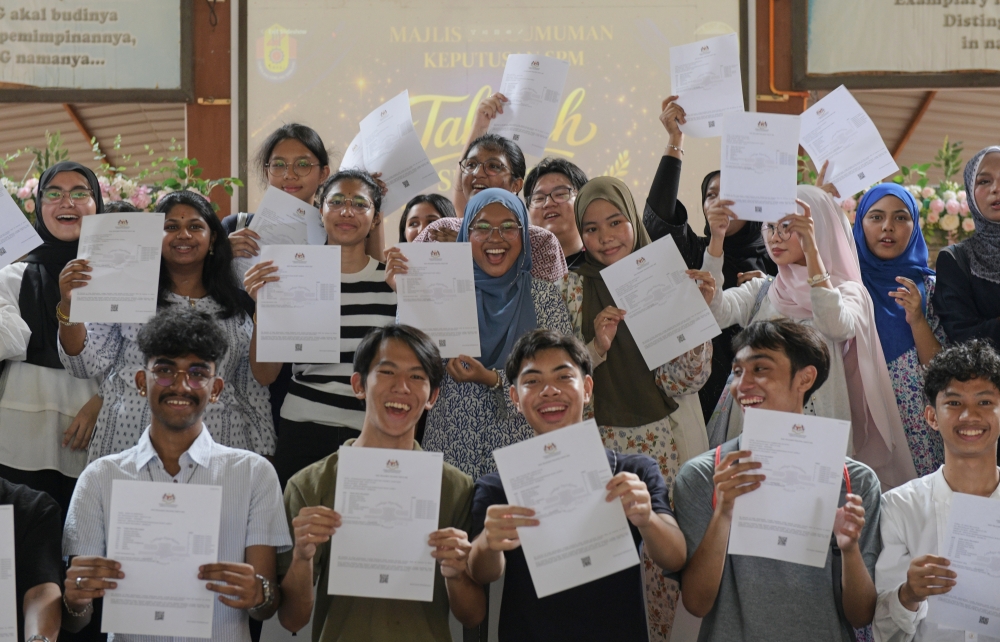
I’ll come back to my friend later but, before I forget, a big shout-out to everyone who aced their SPM results!
Your hard work paid off, and your family and teachers must be beaming with pride.
But if your results didn’t meet your expectations or you outright didn’t pass? That’s honestly not a bad thing either — it might just mean your future won’t hinge on academic scores alone.
Doing well in exams is awesome, no question. But don’t let your grades define you, and don’t let a disappointing result crush your spirit.
School can teach you valuable skills, but it can also stifle your natural curiosity or make you think “success” only comes from acing tests.
It can trick you into believing learning only happens in classrooms or that high marks equal real-world readiness.
If you scored a string of As, that’s fantastic — celebrate it! But don’t let those grades become your whole identity.
They’re a solid foundation, but life’s got bigger tests coming. And if you’ve been wrestling with studies from primary school to Form 5, maybe that’s a sign academia isn’t your thing. That’s not a flaw — it’s a hint you’re meant to shine somewhere else.
To the extent that the SPM still relies heavily (although not exclusively) on MCQs, these exams could end up being not much more than a memory game.
SPM could thus take on game show vibes i.e. general knowledge/trivia, guessing, luck, fastest to the timer, individual memory, abstract and “useless” information, closed book, IQ, etc.
But life is more like a reality show isn’t it? The big winners all possess people skills, organisation/managerial skills, planning/forward-looking, negotiation/persuasion, relationship-building, conflict management, “open book”, EQ, i.e. people skills.
Treating education as a chance to develop our “reality show” slash relationship skills is quite an adventure.
You end up forcing yourself to learn about things you probably never learn much about in school i.e. how people think, what makes them tick, how to cool down tense situations, why “soft power” may be more effective than its opposite (certainly a relevant theme given the situation in Middle East?), how to change minds to meet your objectives, and so on.
Truth be told, most people can ace a math paper but couldn’t haggle successfully over a basket of fruits to save their lives; people with such skills certainly have an edge.
Like my friend, the world has a lot to offer to anyone with great people skills and just about anyone willing to learn something new.
All the best to you.
* This is the personal opinion of the columnist.


