


OCTOBER 14 ― Ever since Spain endured a humbling first-round exit from this summer’s World Cup Finals, one phrase has been predominant: end of an era.
After becoming the first ever nation to win three consecutive major trophies ― the European Championship in 2008 and 2012 and the World Cup in 2010 ― the last few months have delivered a realisation that the period of dominance for the magnificent Spanish all-conquerors has now finished.
Since the summer debacle in Brazil, former mainstays of the team Xavi, Xabi Alonso and David Villa have all retired from international duty, while Carles Puyol has retired completely, and Fernando Torres and Alvaro Arbeloa have been overlooked by manager Vicente Del Bosque.
And last week, there was an indication that another key member of the old guard, captain and goalkeeper Iker Casillas, could soon become the next member of the cull as he committed an embarrassing error ― by no means his first of the last few months ― to gift Slovakia the opening goal in their 2-1 victory.
That defeat was the first time Spain had lost a qualifying fixture since 2006 and gave added weight to the ‘end of an era’ argument, with Del Bosque facing increasing pressure to leave the glory days behind and quickly integrate a new batch of younger players.
He did just that in Spain’s subsequent game, a 4-0 victory over Luxembourg on Sunday night which featured the youngest ever Spain team to play a competitive game.
Casillas was one of those to miss out, replaced in goal by David De Gea, while fellow rising stars Dani Carvajal, Marc Bartra and Paco Alcacer were also included from the start with Rodrigo and Juan Bernat introduced from the bench to combine for the final goal, created by the former and converted by the latter.
The opposition was modest ― a 4-0 win over Luxembourg is hardly something to crow about ― but the performance was convincing and gave Spain followers reason to believe that, just as one era comes to an end, a new one is beginning.
De Gea looked confident, Carvajal was his usual all-action self and Bartra, although against a lightweight attack, was composed, while Alcacer continued his excellent start to his international career by scoring again, taking his tally to three goals in four appearances.
In addition, Atletico Madrid man Koke is gradually becoming established in the centre of the pitch, and hopes are high that he will be able to emulate the legendary Xavi by running the midfield for many years to come.
There are more to come. Real Madrid starlets Isco and Jese Rodriguez will surely soon emerge from the Under 21s to shine at full international level, while Bayern Munich pair Thiago Alcantara and Javi Martinez should become important squad members, if not regular starters, when they return from injury.
Despite their recent setbacks Spain’s future, it seems clear, is very bright, and if anything Del Bosque is spoilt for choice as he decides which young players to introduce and when.
The two biggest doubts for the short-term are Casillas, of whom Del Bosque is fiercely protective and loyal, and Chelsea striker Diego Costa, who has made a frustratingly poor start to his international career, finally scoring his first goal in his seventh Spain appearance in the second half against Luxembourg, and even then only doing so after first squandering half-a-dozen excellent opportunities.
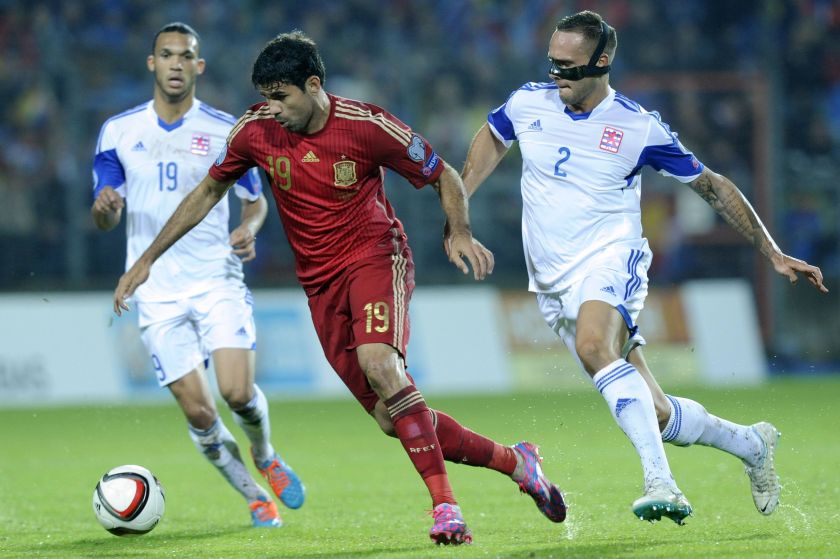
Costa, you may recall, turned his back on his birth nation Brazil to represent Spain at the World Cup Finals, and Del Bosque has made a bold personal gamble by vesting so much importance in the powerful former Atletico Madrid star.
But so far, and despite his impressive success during his first two months with Chelsea, he has looked completely out of place in the Spain line-up, whose patient, probing, short passing style of play is a million miles from the blood and thunder counter-attacking approach employed by his former and current club sides.
To get the most out of Costa, it appears, he needs space to play. Give him the ball at his feet and ten yards of grass, and he can be close to unstoppable as he takes the most direct route towards goal possible and charges through or over any defenders who happen to get in his way. He is the perfect counter-attacking striker, and he will continue to score goals for teams who ― like Chelsea under Jose Mourinho ― favour that tactic.
However, when Costa is asked to play in tight spaces, receiving low passes to his feet and expected to swiftly link play with his midfielders, his technical limitations become exposed. The most concerning aspect of his performances for Spain so far has not been the lack of goals, but his general inability to integrate with the team’s approach.
Costa is a tremendous athlete who works extremely hard and selflessly for his team, and he clearly has an eye for goal, but Del Bosque’s ultimate conclusion ― despite the personal efforts he made to lure the striker onboard ― may well be that he just doesn’t fit into Spain’s style of play.
Considering the options at his disposal, however, it’s a pretty nice problem for Del Bosque to have, and La Roja should be counted upon to retain their place among the title challengers when Euro 2016 rolls around.
*This is the personal opinion of the columnist.


