


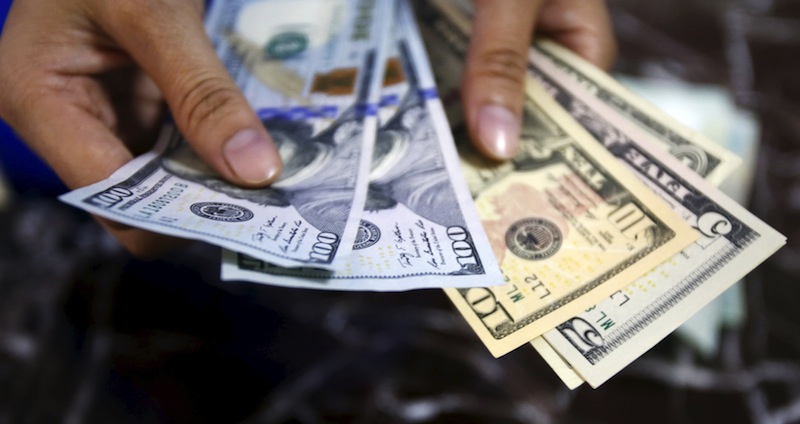
NEW YORK, Sept 18 — The dollar maintained its retreat, while Australian and New Zealand bonds tracked a rally in Treasuries as the Federal Reserve’s decision to hold off on raising interest rates stoked concern about the global economy.
The greenback headed for weekly declines against the yen and the euro after the Fed’s decision sent the Bloomberg Dollar Spot Index to a three-week low. Stocks in Wellington climbed despite a pullback in US equities yesterday, while yields on 10-year Australian debt fell for the first time in three days following the steepest drop in two-year Treasury yields since 2009. Oil extended losses into a second day, trimming its gain in the week.
“Yellen kept referring to the strong dollar and turmoil offshore, those were the main issues,” Mark Lister, head of private wealth research at Craigs Investment Partners Ltd. in Wellington, which manages about US$7.2 billion (RM 30.411 billion), said by phone.
“They probably have taken a little bit more notice of what’s happening overseas, in China and emerging markets, than some people might have expected. Every meeting is going to be considered live from now on, but it’s looking like a better than even chance that it’s next year’s story.”
US rates will remain near zero for at least another month after the Fed’s decision, which showed policy makers are reluctant to end record monetary stimulus at a time when uncertainty over China and other developing nations is whipsawing global markets. Odds of an increase this year have fallen below 50 per cent, with Fed Chair Janet Yellen saying the recent turmoil may restrain the US economy and suppress already slow inflation.
The focus remains on monetary policy today, with Bank of Japan meeting minutes due.
Early movers
The dollar was little changed at 120.15 yen by 7:51am in Tokyo, after slipping at least 0.5 per cent versus Japan’s currency and the euro last session. Ten-year Australian yields dropped by 11 basis points to 2.76 per cent, as New Zealand’s S&P/NZX 50 Index added 0.4 per cent. Standard & Poor’s 500 Index futures were little changed after the US gauge’s post-Fed declines. Copper futures climbed in the wake of Wednesday’s powerful earthquake in Chile, the No. 1 supplier of the metal. US oil slipped 0.1 per cent to US$46.84 a barrel.
The S&P 500 ended yesterday down 0.3 per cent after initially rising more than 1 per cent in the wake of the Fed decision. Stocks most sensitive to interest rates had the largest moves, with utilities and real-estate companies advancing more than 0.9 per cent while banks lost 1.3 per cent.
Yellen said most Fed officials still expect a rate increase this year and that the US economy is performing well. She reinforced that the path of rate rises would be gradual. Odds of a hike in October are now at 19 per cent, and bets on one in December have slumped to 46.6 per cent, from 59 per cent a week ago, according to fed funds futures.
The decision to hold rates wasn’t a surprise given the weakness in US equity markets. The market has been whipsawed since China unexpectedly devalued its currency on Aug. 11, a move that sent the S&P 500 to its first 10 per cent decline since 2011. The Fed has never started tightening policy within a month of a correction.
“Now that this is behind us, people are going to start focusing more on the problems that caused the correction in August, which is weakness in China and other emerging markets and a rough time on the earnings front,” said Matt Maley, an equity strategist at Miller Tabak & Co LLC in New York.
The Chicago Board Options Volatility Index endured its biggest weekly gain on record in August, and has closed above 20 for 18 straight sessions, the longest stretch since June 2012. The VIX slipped 1 per cent yesterday to 21.14.
Nikkei Futures
Futures on Japan’s Nikkei 225 Stock Average rose 0.2 per cent in Chicago to 18,190 after sliding 1 per cent in the previous session amid the gains in the yen. Japan’s currency, which typically moves at odds with the country’s share market, has strengthened 0.4 per cent this week.
Emerging-market stocks and currencies climbed after the Fed held off on a rate hike, with the MSCI index of developing nation shares rallying to the highest level since Aug. 20. Russia’s ruble, the Colombian peso and South African rand are headed for weekly gains of more than 1.7 per cent versus the dollar as the lack of a move from the Fed dims the appeal of greenback-denominated assets.
The biggest US exchange-traded fund tracking Chinese shares slipped 2.4 per cent yesterday following a 2.1 per cent drop in the Shanghai Composite Index. Volatility in the gauge of mainland Chinese equities is near an 18-year high amid concern government intervention to steady the market will fail to shore it up in the long term as the economy slows.
Asian Data
China reports on property prices today, and the governor of Australia’s central bank testifies before parliament. Japanese markets are closed from Monday through Wednesday, while those in Korea are shut on the first two days of next week.
In the US bond market, two-year Treasury yields slid by 13 basis points, or 0.13 percentage point, the most since March 2009, to 0.68 per cent, according to Bloomberg Bond Trader data.
The rate on 10-year notes fell 10 basis points to 2.19 per cent.
“It’s a bit of a tussle,” said Carin Pai, director of equity strategy at Fiduciary Trust Company International in New York. Her firm manages US$17.4 billion. “If they don’t raise rates and continue to hold off on raising rates what does that say about the economy? That it’s not strong enough to withstand an interest-rate increase. That’s what the market is grappling with right now." — Bloomberg


