


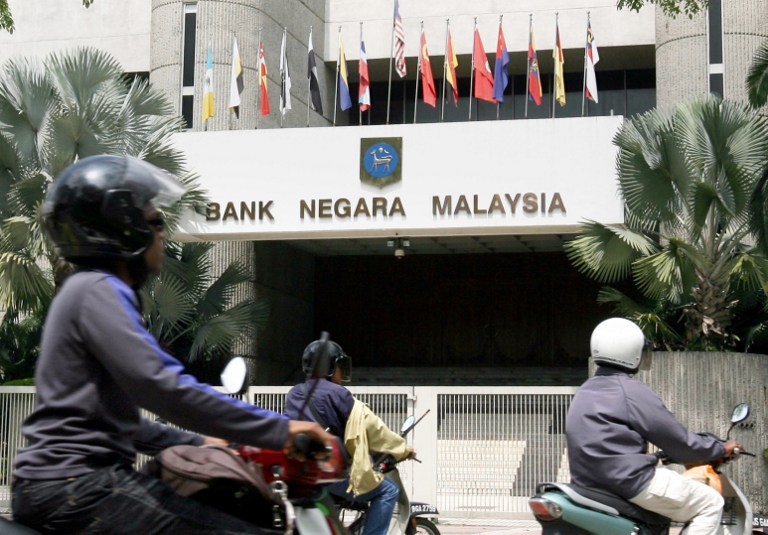


KUALA LUMPUR, July 8 ― Bank Negara Malaysia (BNM) is expected to keep its policy interest rate unchanged at a meeting tomorrow, holding a steady course amid market turbulence as corruption allegations swirled around Prime Minister Datuk Seri Najib Razak.
Following a Wall Street Journal (WSJ) report last Friday that raised pressure on Najib, traders say the central bank has intervened in currency markets each day to stop the ringgit from sliding too far past 3.80 per dollar ― the rate at which the currency was pegged between September 1998 and July 2005.
For all the concerns among investors over mounting political risk in Malaysia, there was little to push the central bank to alter monetary policy course, as inflation remained benign and there were hopes of a pick-up in economic growth later this year despite weak export growth.
“Bank Negara Malaysia will definitely be trying to reduce any kind of volatility that is being driven by political noise... but these things aren't permanent,” said Euben Paracuelles, economist at Nomura Holdings in Singapore.
“The ringgit should adjust at some point to a fundamentally consistent level,” Paracuelles said.
By lunchtime today the ringgit stood at 3.8052 per dollar, having lost 0.8 per cent since the WSJ reported that investigators probing the debt-laden state fund 1MDB had traced nearly US$700 million (RM2.6 billion) to bank accounts they believed belonged to the prime minister.
Reuters could not independently verify the WSJ report. Najib has denied taking any money from 1MDB or other entities for personal gain, and his lawyers have been instructed to consider taking legal action against the newspaper.
Unanimous view
A sharp fall in gas prices in the wake of the oil price plunge over the past year have hurt Malaysia's export earnings. The country is the world's second-largest exporter of liquefied natural gas.
Weakening exports, together with global economic uncertainties and febrile domestic politics, have rendered the ringgit the worst emerging market Asian currency this year, having lost more than 8 per cent against the dollar.
Economists said the central bank may factor in risk to the economy from potential prolonged political uncertainty during its policy review, but for now the ringgit's volatility was an immediate concern.
A Reuters poll of 15 economists were unanimous that BNM would keep its key interest rate at 3.25 per cent.
The last time the central bank changed its policy rate was a year ago, when it cut the rate by 25 basis points.
Bank of America Merrill Lynch expects a 25-basis-point policy rate cut to 3.00 per cent in the third quarter of this year.
Its report also forecast economic growth would slow to 4.6 per cent this year from 6.0 per cent in 2014. The government has forecast growth of 4.5 per cent to 5.5 per cent this year. ― Reuters


