


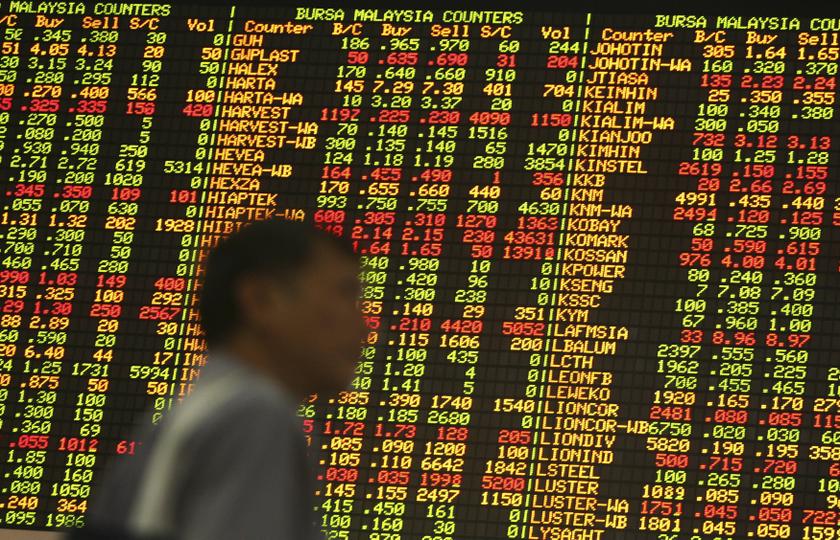


KUALA LUMPUR, July 1 — Malaysian stocks rallied by the most since 2013 and the ringgit rose along with bonds after Fitch Ratings held off from cutting the nation’s credit rating.
Fitch raised the outlook on its fourth-lowest investment grade of A- to stable from negative, according to a statement yesterday. It said a new consumption tax introduced in April and fuel subsidy reforms are supportive of Malaysia’s finances, even as government debt guarantees increase. The company warned in March that the chance of a downgrade was more than 50 per cent, helping send the ringgit to a decade low.
The FTSE Bursa Malaysia KLCI Index advanced 1.8 per cent to 1,736.88 as of 11:38am in Kuala Lumpur. MISC Bhd., SapuraKencana Petroleum Bhd. and DiGi.Com Bhd. were the biggest gainers, jumping more than 4 per cent. The ringgit strengthened 0.9 per cent to 3.7385 a dollar and earlier climbed to a one-week high of 3.7287, data compiled by Bloomberg show.
“The rating was expected and there’s no reason for Fitch to downgrade Malaysia’s rating based on what the government has done since the last review,” said Ang Kok Heng, the Kuala Lumpur-based chief investment officer of Phillip Capital Management Sdn., which manages US$428 million (RM1.6 billion). “We have been buying and we are still selectively buying,” he said, referring to the nation’s equities.
Bonds rise
The benchmark stock index fell to six-month lows on Monday as overseas investors pulled funds ahead of Fitch’s review. The ringgit slumped to 3.7887 on the same day, close to the 3.8 level it was pegged at during the Asian financial crisis before being scrapped in July 2005. The 45 per cent slump in Brent crude prices from last year’s peak has weighed on the currency, as have debt woes at state investment company 1Malaysia Development Bhd. and the prospect of higher US interest rates.
Prime Minister Najib Razak halted a decades-old fuel subsidy policy in December and started a 6 per cent goods and services tax in April to boost state coffers. Falling oil prices prompted the government to lower 2015’s economic growth forecast in January to a range of 4.5 per cent to 5.5 per cent, from as much 6 per cent.
Malaysia remains resolute in strengthening public finances and will stay on its fiscal consolidation course toward balancing the budget by 2020, according to an e-mailed statement today from the finance ministry. The deficit target for 2015 is 3.2 per cent of gross domestic product.
The 10-year government bond yield retreated six basis points to 3.95 per cent, adding to an eight-basis point decline yesterday. Five-year credit-default swaps fell five basis points to 133, the biggest drop since March.
Surprise move
1MDB’s borrowings amounted to RM41.9 billion (US$11.2 billion) as of March 2014, partly because of purchases of power plants and land. As the company’s troubled finances threatened Malaysia’s rating, Najib faced calls from former premier Mahathir Mohamad to step down as leader because of the performance of 1MDB, whose advisory board he chairs.
“Fitch continues to believe that the Malaysian sovereign is incurring additional contingent liabilities beyond explicit guarantees because of quasi-fiscal operations of state-owned entity 1MDB,” according to the Fitch statement. “Fitch thinks there is a high probability that sovereign support for 1MDB would be forthcoming if needed.”
Fitch lowered Malaysia’s outlook to negative in 2013, citing weaker prospects for public finances. Moody’s Investors Service and Standard & Poor’s also rank Malaysia at their fourth-lowest investment grades. Moody’s has a positive outlook, while S&P’s is stable.
“Fitch’s move to raise Malaysia’s outlook was a surprise,” said Wong Chee Seng, a foreign-exchange strategist at AmBank Group in Kuala Lumpur. “The ringgit’s strength reflects the realignment of trading positions as most people were factoring in a downgrade.” — Bloomberg


