BUENOS AIRES, Aug 14 — Argentina took emergency steps to stabilise its currency in the wake of an emerging-market rout caused by Turkey’s crisis, jacking up its already highest-in-the-world interest rate by 5 percentage points and announcing it will sell US$500 million (RM2.04 billion) to support the peso.
Policy makers set the rate for seven-day notes at a record 45 per cent and pledged to keep it at that level at least until October. The central bank also said it plans to phase out 1 trillion pesos (RM139.2 billion) of short-term notes by December in an effort to limit the currency volatility that often popped up when the securities were rolled over. And the bank also changed a system for US dollar auctions to make them harder for traders to anticipate.
Argentina’s dramatic moves are in contrast to what’s happening in Turkey, where President Recep Tayyip Erdogan’s government has lost the confidence of investors by refusing to raise interest rates in the wake of the crisis.
While Argentina suffers from some of the same economic problems — fast inflation and sizable current-account and budget deficits — the Latin American country is reacting with orthodox policies blessed by advisers from the International Monetary Fund. Government officials Monday cut their 2018 economic growth forecast to zero, citing the turmoil sparked by Turkey. Most economists anticipate a recession this year, a central bank survey shows.
“The central bank is showing determination to prevent an overshooting of the the currency and inflation,” said Alberto Ramos, the head of Latin America research at Goldman Sachs. “An external shock has hit the currency and they’re reacting in the classic way — what you need to do is hike rates and hope to be able to stabilise the currency with that.”
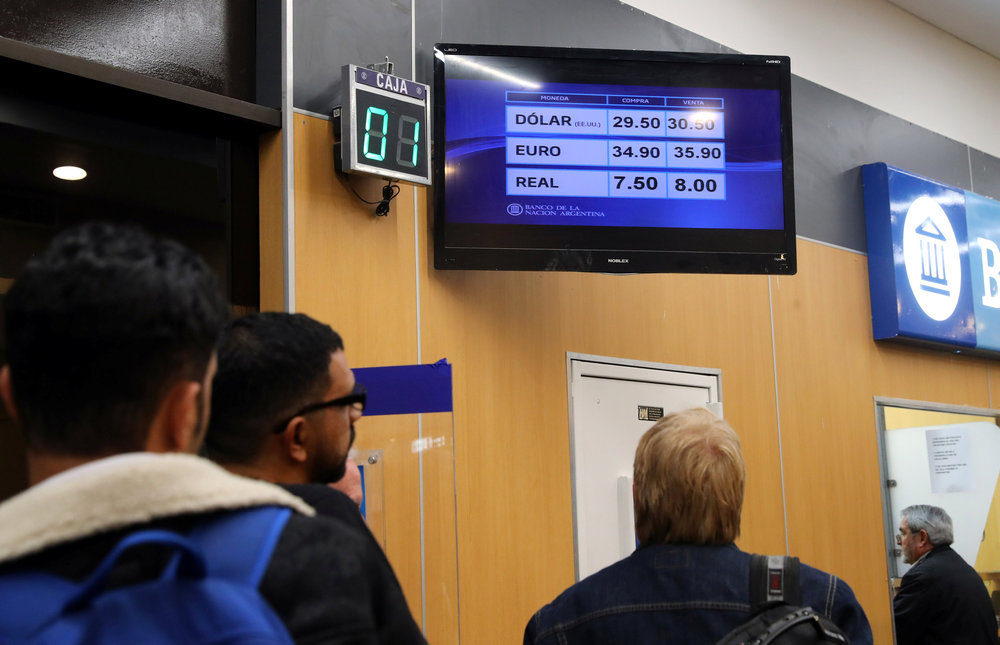
The peso fell past 30 per US dollar for the first time yesterday before recovering from its lows of the day. It was down 2.3 per cent to 29.93 per dollar after sinking as much as 3.6 per cent.
It was the fourth surprise rate hike by the central bank this year as officials try to combat a currency selloff spurred by concerns that inflation is out of control and the government wasn’t taking sufficient steps to shore up the economy. Argentina’s peso has tumbled 38 per cent this year and the yield on its century bonds has soared past 10 per cent.
But the most recent selloff in the peso — down more than 6 per cent drop in the past two days — was spurred by concerns Turkey’s problems would infect other emerging markets. Argentina was seen as among the most vulnerable economies.
“They had to do something against contagion,” said Siobhan Morden, the head of Latin America fixed income at Nomura Holdings. “You have to do what you can to minimise financial contagion to the real economy.”
Yesterday’s announcement came as the IMF began its mission to Argentina after granting a US$50 billion credit line to the South American nation in June. That was the same month former Finance minister Luis Caputo took over at the central bank from Federico Sturzenegger, who admitted he had lost credibility with investors as he resigned.
The fund supports the central bank’s plan to wind down its short-term notes, known as Lebacs, IMF spokesman Gerry Rice said, adding that the securities were “a source of vulnerability” for Argentina.
The notes, designed to mop up excess cash in the economy, became a growing concern for investors after the amount in circulation swelled to 976 billion pesos. In the latest auctions, the government only partially rolled over some of the securities, leaving extra pesos in circulation that analysts said stoked dollar demand and fed inflation.
The central bank will end daily auctions of US$50 million to US$100 million, which used IMF funds, and instead sell its reserves whenever it sees fit to stem volatility in the peso. Its first sale under the new system will be US$500 million today. It has already spent about US$15 billion in reserves this year to defend the peso.
The change in methods for US dollar sales echoes a move Mexico made in 2009 when its currency was tumbling in the wake of the global financial crisis. It shifted from a set US$400 million-a-day auction system to direct interventions of various sizes. The idea was that a less predictable central bank would discourage bearish bets.
The US$500 million may not be enough to satisfy US dollar demand today as 100 billion pesos of short-term notes are allowed to mature, said Ezequiel Zambaglione, the head of research at Buenos Aires-based broker Max Valores SA. That could put downward pressure on the peso, he said.
Some investors complained yesterday that Argentina’s communication about its plans to support the peso sowed confusion, with separate announcements for each part of its initiative that make it harder to understand the strategy.
“They have a problem with communication,” says Guillermo Nielsen, who served as Argentine finance secretary between 2002 and 2005. “Everything is not 100 per cent clear yet.” — Bloomberg