









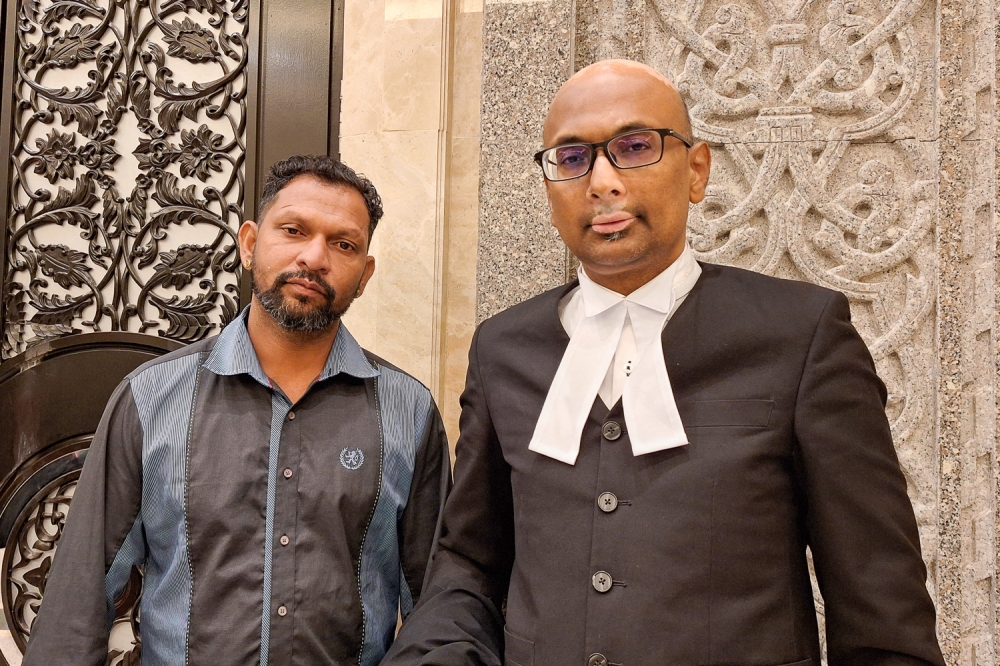


KUALA LUMPUR, July 22 — Velmurugan, a 38-year-old man who was born in an estate in Tanjung Malim, Perak, today lost his citizenship appeal at the Court of Appeal.
Velmurugan wants to be declared a Malaysian, as his biological mother Balamah was born in Malaysia before Merdeka and his maternal grandmother was born in Perak.
He also highlighted that three of his biological mother’s siblings — who were also born in Malaysia pre-Merdeka — are already registered as Malaysians.
But the Court of Appeal decided that Velmurugan is not entitled to Malaysian citizenship under the Federal Constitution, as his mother’s citizenship status was undetermined when he was born.
Here’s a quick recap of key facts in Velmurugan’s case, and what the Court of Appeal decided:
Velmurugan’s story: A cycle of lack of education and citizenship challenges across generations
Velmurugan’s grandmother’s citizenship status in official records is undetermined, while both Velmurugan and his mother were uneducated and had late birth registrations.
Up until her death in 2024, Velmurugan’s mother Balamah’s citizenship status in the National Registration Department’s (NRD) records was “Belum Ditentukan” (Yet to be determined), as there were inconsistencies on whether she was born in Perak or Kuala Lumpur and the number of siblings she has.
A DNA test had both certified that Balamah is the biological sister to her Malaysian sister and that Velmurugan is Balamah’s biological son.
Velmurugan had married a Malaysian woman, and his five children are all Malaysians.
Velmurugan said his mother was entitled to Malaysian citizenship as she was born in Malaysia and not born a citizen of any country, based on the Federal Constitution (specifically Article 14(1)(b) and the Second Schedule’s Part II’s Section 1(e)).
Velmurugan also believes that he should also be entitled to Malaysian citizenship for the same reasons.

Why the Court of Appeal said no to Velmurugan’s citizenship bid
Court of Appeal judge Datuk Azhahari Kamal Ramli, who chaired a three-judge panel, delivered the panel’s unanimous decision to reject Velmurugan’s citizenship appeal.
While agreeing that Velmurugan was born in Malaysia, the Court of Appeal said he can only be entitled to Malaysian citizenship under Section 1(e) if he can prove his lineage at the time of his birth.
In other words, the court was saying that Velmurugan has to show his biological parents’ citizenship status, in order to show that he is “not born a citizen of any country” and to follow their citizenship status.
Velmurugan said he had fulfilled this lineage requirement, as his biological mother and maternal grandmother were both born in Malaysia and not born citizens of any country.
The court said Velmurugan appeared to be suggesting that this means there is a “presumption” that his mother should be “deemed” or considered as a Malaysian citizen, and that he too should be a citizen.
“We are unable to agree, there is no presumption of citizenship under Part III of the Federal Constitution. One is either a citizen or not,” Azhahari said today in online court proceedings over Zoom, stressing that Velmurugan is not a Malaysian if he cannot meet the constitutional requirements.
Saying that there was no evidence given to show Velmurugan’s parents were legally married at the time of his birth, the judge said this means Velmurugan’s lineage would be traced to his biological mother and that he would follow his mother’s citizenship.
“However, the problem is there is no evidence that the appellant’s mother is a Malaysian citizen. From the records of the 1st respondent, the appellant’s mother’s citizenship status was recorded as ‘Belum Ditentukan’, due to inconsistencies in testimonies of witnesses during investigation by the 1st respondent,” the judge said, referring to Velmurugan as the appellant and the NRD as the first respondent.
Court says Velmurugan’s mother and him can’t automatically be Malaysians just because her siblings are Malaysians
The court also disagreed with the argument that Velmurugan’s mother should be a Malaysian citizen, because her siblings are Malaysian citizens.
The court said Velmurugan’s mother’s citizenship status does not depend on her siblings and that whether she is entitled to Malaysian citizenship must be decided according to the Federal Constitution.
The court also said Velmurugan’s mother’s three siblings — Velmurugan’s aunt and two uncles — are not citizens by “operation of law” or because they were automatically entitled to citizenship under the Federal Constitution, noting that they had been granted citizenship by registration instead.
“Based on the above, the citizenship status of the siblings of the appellant’s mother does not automatically confer the appellant’s mother citizenship of Malaysia. Likewise, the appellant cannot now claim he is a citizen by operation of law under Section 1(e),” the judge said.
While Velmurugan said he has a “legitimate expectation” to be a Malaysian citizen since his mother’s siblings are Malaysians, the court disagreed with this argument as it ruled that he can only be entitled to citizenship if he meets the Federal Constitution’s requirements.
“The fact that the appellant’s uncles and aunt and his children are citizens of Malaysia does not ‘ipso facto’ entitle him to Malaysian citizenship,” the judge said, referring to the Latin phrase for “by the fact itself”.
Velmurugan had also argued he is entitled to Malaysian citizenship under the Federal Constitution’s Article 19, which is citizenship by naturalisation.
But the court said the granting of citizenship under Article 19 is a matter for the federal government to decide, saying that Velmurugan must first file an Article 19 application to the federal government and fulfill the citizenship requirements in Article 19.
The court rejected Velmurugan’s Article 19 argument as he had not filed such an application yet.
The other two judges on the panel today are Datuk Faizah Jamaludin and Datuk Hayatul Akmal Abdul Aziz.
When contacted after the Court of Appeal’s decision, Velmurugan’s lawyer Annou Xavier said he would seek instructions from his client on what to do next.
“It is a sad day for my client as he was born in Malaysia in an estate setting, but due to not properly registering his birth and obtaining proper documents from his mother, he is still stateless.
“I would need to inform Velmurugan of the court’s decision and see what would be the next step,” he told Malay Mail, also confirming that Velmurugan has yet to file an Article 19 citizenship application.
Velmurugan was also represented today by Calista Chin Sue Lee, while federal counsel Safiyyah Omar represented the NRD director-general, the Home Ministry and the Malaysian government.
Recommended reading:
- Stateless his whole life, 38-year-old Perak man wants to be Malaysian; says late mother born pre-Merdeka should have been citizen too
- ‘Jauh di mata, dekat di hati’: Woman born pre-Merdeka died before she could be recognised as Malaysian just like siblings, lawyer tells court
- Court of Appeal rules children born out of wedlock cannot inherit Malaysian father’s citizenship