


KUALA LUMPUR, Dec 20 — The Royal Malaysia Police (PDRM) has identified three main modus operandi commonly employed by drug syndicates to smuggle illicit substances into and out of the country, namely through deep sea routes, the use of drug mules, and the exploitation of container services at ports.
Bukit Aman Narcotics Criminal Investigation Department (NCID) director Datuk Hussein Omar Khan said the methods were identified following extensive operational activities and intelligence analysis carried out by the department from January until last Thursday.
Elaborating on the deep-sea transit modus operandi, Hussein said syndicates typically use fishing vessels to venture into international waters, where drug consignments are transferred from so-called “mother ships” before being brought into Malaysian waters.
“Among the notable successes was the Op Gombe on April 23, which was launched following intelligence on drug smuggling activities from the Golden Triangle to Australia via sea routes off Terengganu. The operation led to the arrest of two local men and the seizure of 590 kilogrammes of methamphetamine and heroin base, estimated to be worth RM24.9 million,” he said at a press conference at the Kuala Lumpur contingent police headquarters here today.
Hussein added that syndicates also recruit individuals as drug mules through social media platforms such as TikTok, Facebook and Instagram, as well as messaging applications including WhatsApp, Telegram and WeChat.
“These individuals were lured with promises of free holiday packages and lucrative salaries, only to be exploited as drug mules. The syndicates employed various concealment methods, including strapping drugs to their bodies, ingesting drug packets, hiding them in luggage or specially modified compartments, and using transit routes through third countries before delivering the drugs to their final destinations,” he said.
On the modus operandi involving the abuse of container services, Hussein said syndicates exploit the international cargo delivery system by declaring legitimate goods in customs documentation while concealing large quantities of drugs for import or export.
He added that the effectiveness of enforcement efforts against this tactic was demonstrated through the Op Borzoi on Jan 25, which was carried out following intelligence sharing between the NCID and the Australian Federal Police (AFP) on methamphetamine smuggling destined for the Sydney market. The operation led to the seizure of 33,200 kilogrammes of methamphetamine, estimated to be worth RM1.06 billion.
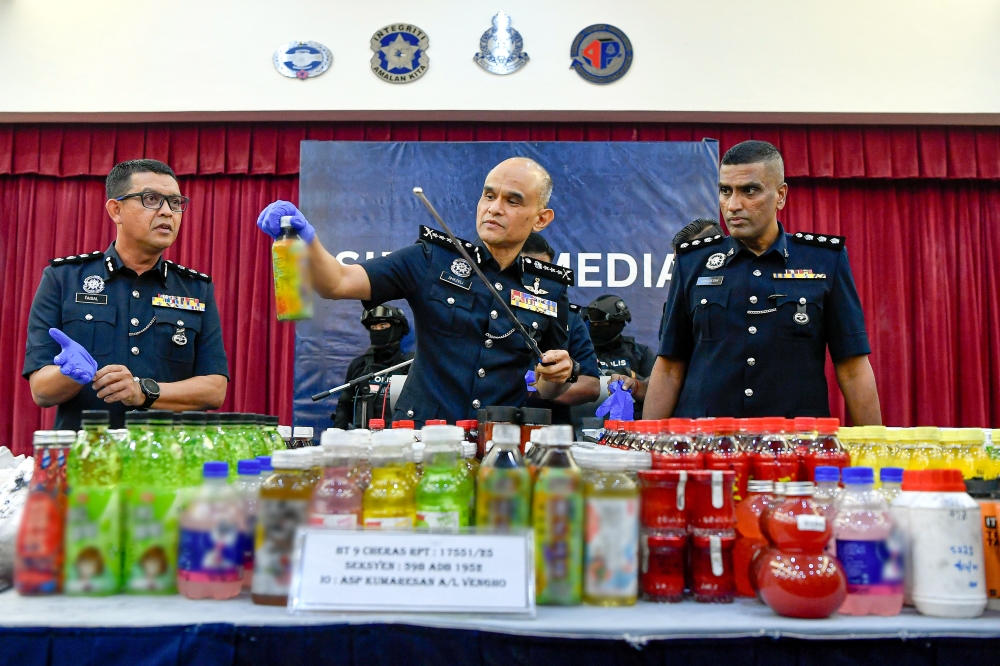
“In addition, Op Virola conducted on Nov 7, through collaboration between the NCID and the AFP, successfully uncovered methamphetamine smuggling activities originating from Middle Eastern countries and transiting through Port Klang, Selangor. The operation led to the seizure of 45 kilogrammes of methamphetamine, estimated to be worth RM1.44 million,” he said.
He said from January until last Thursday, the NCID dismantled 270 drug trafficking syndicates through 609 operations, resulting in the arrest of 737 individuals. In addition, the department raided 19 illegal drug laboratories, arresting 52 suspects, including four chemists, and seized 215 tonnes of drugs and chemical substances with an estimated black market value of RM3.1 billion.
“During the same period, a total of 234,567 investigation papers were opened under the Dangerous Drugs Act and the Poisons Act 1952, involving 255,248 arrests, with 67 per cent of the cases brought to court. Enforcement actions to cripple syndicates’ financial networks also resulted in the seizure of RM141 million in assets and the forfeiture of RM29 million. In addition, 808 individuals were detained under the Dangerous Drugs (Special Preventive Measures) Act 1985 to disrupt and dismantle syndicate networks,” he said. — Bernama


