


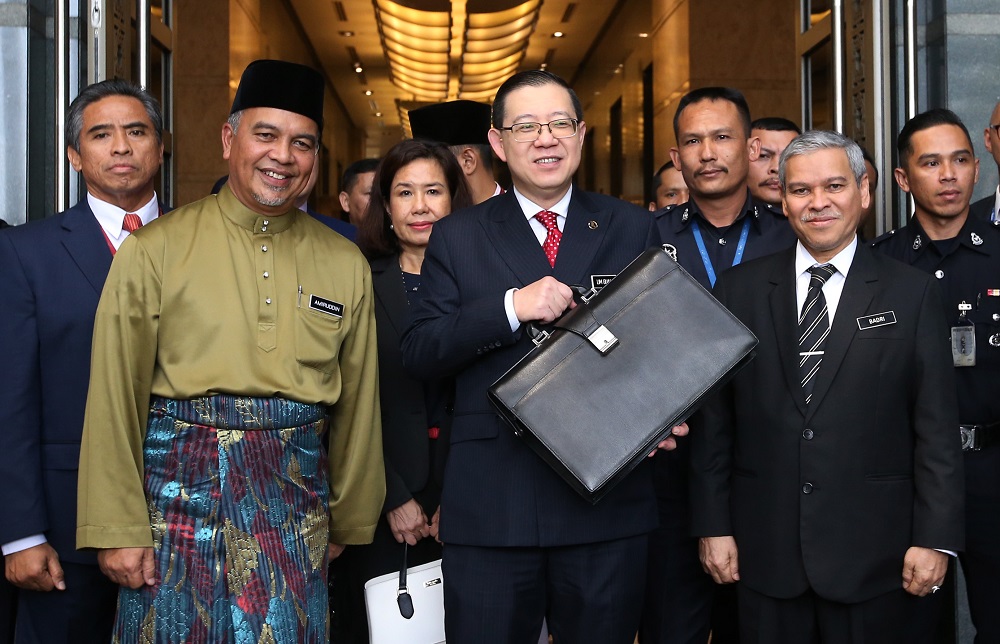
KUALA LUMPUR, Nov 3 — Several economists concurred that Pakatan Harapan’s (PH) maiden Budget contained laudable policies but noted that its projections could be altered by changing conditions.
Some saw the Budget as signalling a return to relying on petroleum income, saying this made government revenue subject to oil price volatility.
“The higher dependence on oil-related revenues (including special Petronas dividend) (30.9 per cent of total revenue) next year, makes the fiscal targets vulnerable, should Brent crude oil prices drift back below US$70 per barrel,” United Overseas Bank (UOB) senior vice-president for global economics and market research, Julia Goh, said.
The Fiscal Outlook and Federal Government Revenue Estimates 2019 Report stated a RM30 billion dividend will be sourced from Petronas’ accumulated retained earnings.
Prime Minister Tun Dr Mahathir Mohamad told the press yesterday that Petronas could afford the dividend owing to the current oil price of almost US$80.
 Maybank Investment Bank Bhd (Maybank IB) regional head of economic research Suhaimi Ilias said the higher 3.7 per cent full-year deficit target was a result of items the previous administration did not disclose.
Finance Minister Lim Guan Eng said previous deficit figures were unreliable due to the heavy use of off-the-books accounting, which was why the targeted 2.8 per cent was not possible with transparent reporting.
“The deficit would have been larger if not for the jump in oil- and gas-related income, especially petroleum income tax and Petronas’ dividend,” Suhaimi said.
Economic analyst Prof Madeline Berma said the government had to weigh matters carefully for its first-ever Budget.
“To me, this Budget reflects two things. On the one hand, the need for fiscal prudence... and on the other hand, meeting the needs of rapid and quality economic growth,” she told Malay Mail.
 However, Berma expressed disappointment at the lack of programmes to alleviate the plight of the Orang Asli community, especially relating to the land issues.
“No special policy for the Orang Asli and Orang Asal, only an increase in budget allocations,” she added.
Political and economics analyst Prof Ho Kee Ping criticised the amount set aside for development — RM54.7 billion — when the overall Budget was RM314 billion.
He said this will be of concern to the country’s future.
“Not smart for development and growth. You have a bigger budget, but the development budget is still the same as before — 16 to 17 per cent,” he said, labelling it a purely populist budget.
“A bigger budget doesn’t mean a good budget for development,” he said.


