


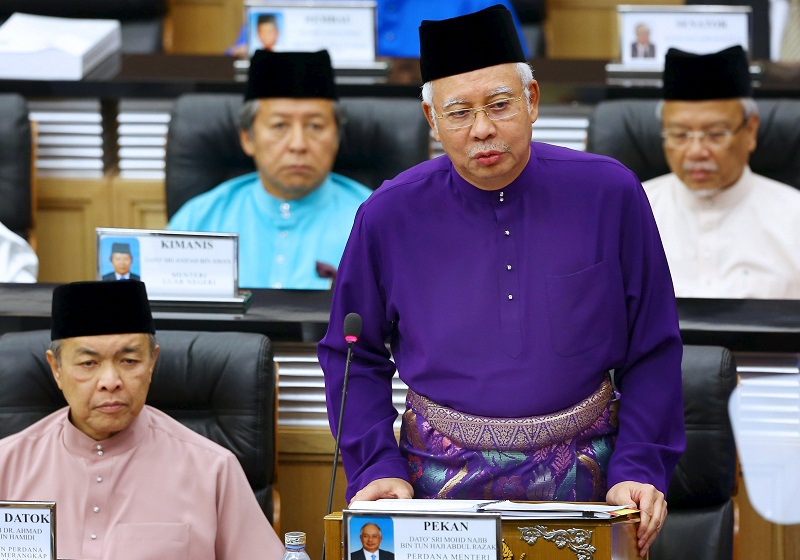
KUALA LUMPUR, Nov 13 — Malaysia has bounced back from the Asian financial crisis of 1997 to become a dynamic social and economic force to be reckoned with in Southeast Asia under Prime Minister Datuk Seri Najib Razak’s leadership, former Australian high commissioner to the country John Dauth said today.
Ahead of his country’s prime minister Malcolm Turnbull’s visit to the region, the Australian diplomat lavished praise on Najib for his “bold” and “courageous” raft of reforms to transform agricultural-heavy Malaysia even as the latter continues to face criticism from detractors at home and abroad over the controversial Trans-Pacific Trade Agreement.
“Bold measures will always generate controversy. The real point is that good economic management needs them. And Najib has done it,” Dauth wrote in an opinion piece published today in The Australian.
Among the bold moves the Australian praised Najib for were cutting subsidies and rolling out the broad 6 per cent Goods and Services Tax to strengthen the government’s pocket beyond reliance on its oil and gas production and improve its credit reputation with global ratings agencies.
He noted that under Najib, Malaysia has not only weathered the financial crisis of the late 1990s but emerged stronger than before economically, and is continuing to outpace its neighbours and bigger economies like Thailand—Southeast Asia’s second largest economy—even though external trade is estimated to slow down its GDP to 4.7 per cent this year, and creating some 1.8 million more jobs and raising the country’s living standards across the board.
“As a result, Malaysia is on the cusp of crossing the US$15,000 (RM287,844) per capita GDP threshold into the tier of advanced-income countries — a goal Najib made the centrepiece of Malaysia’s 2016-2020 economic programme.
“That this is a realistic ambition is because Najib, who has also been Finance Minister since 2008, has the experience and has shown the required leadership,” Dauth wrote.
He lauded Najib’s reform policies for closing the gender gap in the male-dominated corporate world by setting a 30 per cent goal for women in boardrooms nationwide, observing that the proportion was higher than in Hong Kong and Singapore.
“You don’t do that without the tried and tested leadership of someone like Najib,” Dauth said.


