


JAKARTA, Sept 25 — The Association of Plantation Investors of Malaysia in Indonesia (APIMI) today confirmed that none of the Malaysian plantation companies operating in Indonesia were involved in open burning activities.
APIMI’s chief representative Nor Hazlan Abdul Mutalib said, to the contrary, all Malaysian plantation companies practiced zero burning in field clearing work.
He said the practice of burning forests and cultivated areas for any purpose was an offence in Indonesia and all members of APIMI complied with the laws on operating plantations at all times.
“Most of the Malaysian plantation companies are also members of the Roundtable on Sustainable Palm Oil (RSPO), an organisation which issues certification on the export of palm oil to Europe, and one of the conditions for obtaining RSPO certification is no open burning practices,” he told Bernama here today.
He said the RSPO was very firm on environmental issues and would revoke a certificate of recognition from any member who was found guilty of burning activities at oil palm estates.
Nor Hazlan said if there were cases of open burning in plantations owned by Malaysians, they were actually carried out by the local people who lived in the area.
Nor Hazlan said, perhaps many people were not aware that one of the conditions of investing in oil palm plantations in Indonesia was that the investment company was obliged to set aside as 20 per cent of the plantation area for the locals.
He said those living as squatters there could not be transferred by the government, and they in turn conducted their own farming activities as well as open burning.
“If seen from satellite data, it certainly looks like the fires are in plantation areas owned by Malaysian investors, but it is not the oil palm plantations, it is the area of plantations managed by the local people,” he said.
He said the matter had to be explained to the authorities every year, since the fires occurred yearly, especially during the dry season.
He said, besides that, there was also misinterpretation of ‘Malaysian-owned’ companies, that is when a company had a manager who is a Malaysian, there were those who claimed it was a Malaysian company.
“The manager only works at a locally owned company, and if the company is involved in open burning, they claim it is the work of a Malaysian-owned firm,” he said.
Nor Hazlan said the claim that a company owned by Malaysian investors was recently found guilty of open burning was also incorrect, because the company had long been sold to a local businessman.
He said, as a commitment to anti-open burning, he also represented APIMI to sit on the Task Force established by the Indonesian government to address the issue.
“We also organise fire drills and have collaborated with the local fire brigades to provide education on the adverse effects of open burning to the locals,” he said.
Meanwhile, Malaysian Ambassador to Indonesia Datuk Seri Zahrain Mohamed Hashim said the Indonesian government should act decisively to enforce the law against any agricultural company involved in open burning.
He said the important thing now was to act decisively and quickly, regardless of who owned the companies involved.
“This haze matter should be resolved in a more comprehensive manner and not only taking into account if the company is Malaysian or Singaporean, because this has become a serious case which is at a critical level, and it occurs every year,” he said.
He said that the embassy constantly monitored and provided information to the Malaysian government, and even helped find ways to overcome the haze problem.
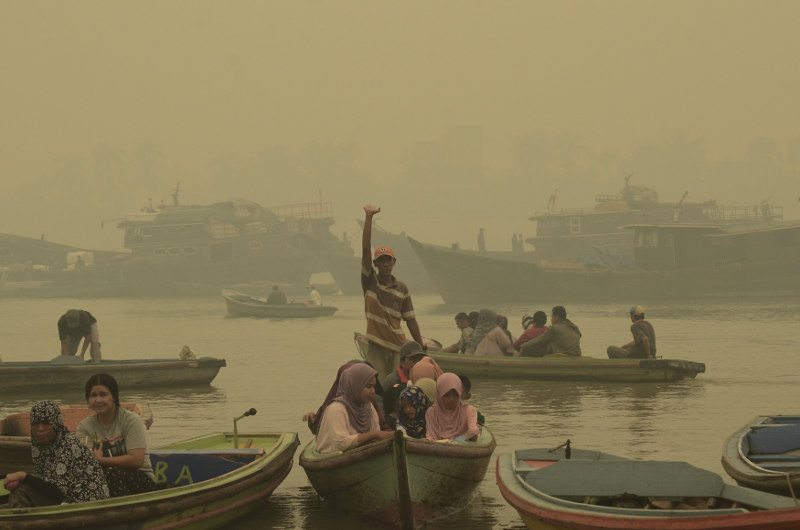
The issue of forest fires in Indonesia is an annual phenomenon, and it has caused serious haze, that affects the health and daily activities of Malaysians.
There are certain parties in Indonesia which often allege that Malaysian-and Singaporean-owned plantation companies perform forest burning activities for re-farming purposes.
Recently, President Joko Widodo had directed to revoke the licences of irresponsible plantation operators.
He said that forest fires had resulted in huge losses to the government, and so far the government had identified seven companies involved in such acts.
He, however, did not mention the names of the companies nor their owners. — Bernama


