

















PUTRAJAYA, Aug 26 ― A five-man Bench chaired by the Chief Judge of Malaya, Tan Sri Zulkefli Ahmad Makinudin, reserved today its decision on a test case that would have paved the way for sexual harassment suits to be heard in a civil court beyond the current narrow limits dictated by the Employment Act.
The court did not set a time frame to deliver its decision, after hearing arguments from lawyers from both sides.
Earlier, a lawyer for the alleged sexual harasser told the Federal Court that any law regulating sexual harassment should be enacted by Parliament instead of formulated by judges.
Admitting that the current provision under the Employment Act 1955 is unsatisfactory, lawyer Fahri Azzat argued that legislating a more comprehensive law would require feedback from the public instead of through common law.
“The court must be careful in developing such laws, as legislators have already enacted the Employment Act, although it is unsatisfactory,” said Fahri, who represented the appellant.
“The court must not be the forum to develop the law, it must be in Parliament,” he added, pointing out that there is no universally-agreed definition of sexual harassment yet.
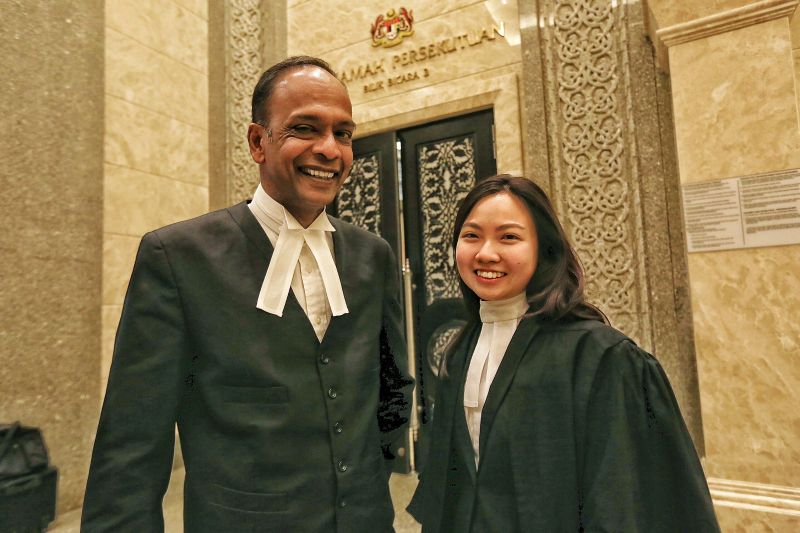
In response, the respondent’s lawyer, Datuk M. David Morais has argued that victims of sexual harassment would require immediate avenue for redress instead of waiting for the legislation to be passed.
Common law or case law are laws developed by judges through court decisions, as opposed to statutory law, which are enacted by Parliament, such as the Employment Act.
Currently, women can only file a sexual harassment complaint under Part XVa of the Employment Act, which women’s rights activists claimed is insufficient as it only covers women who are formally working.
Today’s case before the Federal Court is being pursued by way of a claim for damages under tort, a concept under common law that refers to a civil wrong that unfairly caused someone to suffer loss or harm.
The lawyers have since offered the court to consider the development of two new torts to handle the sexual harassment case: the tort of harassment, or the tort of intentionally causing nervous shock, or both.
In today’s appeal, the male appellant had initially sued his former co-worker, the female respondent, for alleged defamation in a Kuala Lumpur High Court, claiming that a sexual harassment complaint lodged by her was defamatory towards him and was purportedly the reason why his work contract had not been renewed.
The respondent had subsequently counter-sued him for sexual harassment, claiming the incident had caused her serious emotional, mental stress and trauma.
The respondent was working under the appellant in Lembaga Tabung Haji (LTH) when she lodged a complaint with the pilgrim fund’s chief executive officer in 2009 of the alleged sexual harassment.
An inquiry set up by LTH afterwards found insufficient evidence to exact disciplinary action against the appellant, and he was slapped with only a strong reprimand from the firm’s human resource department, while the respondent was transferred to another division.
High Court’s Justice Amelia Tee Abdullah in her decision on September 2012 had dismissed the appellant’s claim and allowed the respondent’s counterclaim, awarding her RM120,000 in total for damages.
The appellant then appealed the case in the Court of Appeal, where a three-man panel led by Justice Datuk Zaharah Ibrahim on December last year also upheld the High Court judge’s decision, leading him to file an appeal in the apex court heard today.