




KUALA LUMPUR, July 5 — Did you know the adventurous Portuguese set sail for Malacca in the 1500s to crush the centre of Islamic propagation and mass convert the Muslim locals to Christianity as an extension of the Crusades?
Local writer Uthaya Sankar SB was stunned when he recently discovered this “incorrect” historical fact and voiced concern at its revision.
“The first [concern] is about facts, because I remember very well from what we learnt in schools, the reason that Portuguese came was for trade purposes.
“But what is highlighted now is the Perang Salib, as if these are the main purpose the Portuguese came here – for Perang Salib, to convert Muslims in Malacca to Christianity. That would definitely give a wrong impression to our young ones,” he told Malay Mail Online when contacted last week, using the Malay word for the Crusades.
Uthaya noted that the local history textbooks in the 1970s and 1980s had stated that the Portuguese came to Malacca for the spice trade, which is played down in the current edition that he said places more emphasis on the Crusades as one of the major motivations.
According to Uthaya, several Christian parents and students had approached him, expressing unease over the textbook paragraph that they claimed would encourage students to “hate” Christians.
“It has become a surprise to not only the Christians, Serani Portuguese, but also Malaysians, because the facts have been changed, rephrased to give bad impression to other people,” he said.
He was told that this paragraph came about in the 1990s.
Uthaya believed that this paragraph is part of a longer list of attempts to change history in Malaysian textbooks but said he did not raise the issue with the Education Ministry because he doubted attention would be given to his complaint.
“Yes, for the past few years, we have Malaysian historians saying that what we are reading in our history textbooks is not the same as our history itself.
“There’s so many facts which have been changed, even though people have been highlighting these, the ministry has not paid any attention and I believe this will not be paid attention by the ministry.”
So he posted it on his Facebook page in a bid to create public awareness and generate pressure on the government to correct the facts.
“If we keep quiet, we have to be ready to see more history being changed in the near future,” he said.
At the time of writing, Uthaya’s June 29 Facebook post – which highlighted the paragraph – has been shared by over 1,000 Facebook users and has garnered over 300 ‘likes’.
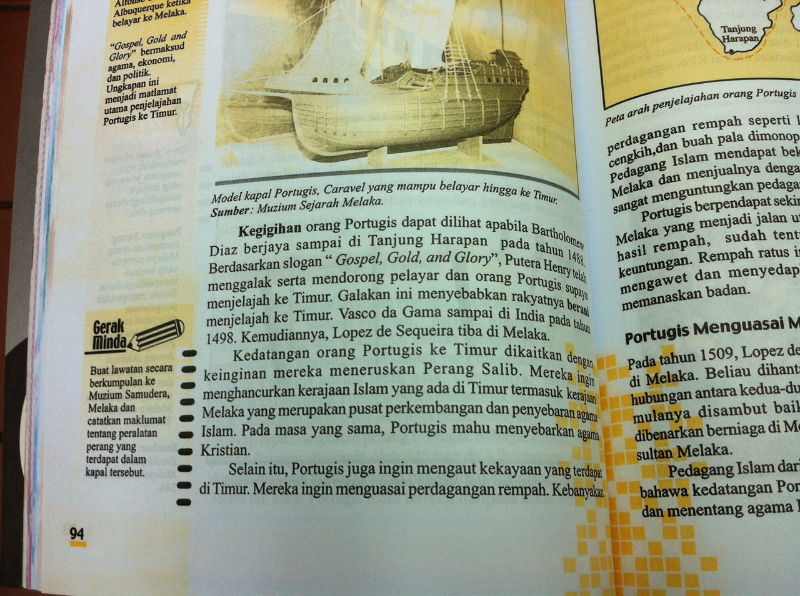
Uthaya had highlighted a paragraph from the 2009 edition of the Form 1 History textbook. Malay Mail Online’s check showed that the same paragraph appeared in the 2014 edition.
“Kedatangan orang Portugis ke Timur dikaitkan dengan keinginan mereka meneruskan Perang Salib. Mereka ingin menghancurkan kerajaan Islam yang ada di Timur termasuk kerajaan Melaka yang merupakan pusat perkembangan dan penyebaran agama Islam. Pada masa yang sama, Portugis mahu menyebarkan agama Kristian.”
[Translation: The Portuguese arrival to the East was associated with their desire to continue the Crusades. They wanted to destroy the Islamic governments in the East, including the Malacca government that was a centre for the expansion and propagation of Islam. At the same time, the Portuguese wanted to spread Christianity.]
The Crusades, which saw Christian armies engaging in a “holy war” with Muslims in the Middle East, is traditionally regarded by historians as having started in the 1095 and ending in 1291 or the late 13th century.
The same Form 1 history textbook states that Lopez de Sequeira arrived in Malacca with the Portuguese navy in the year 1509. The Portuguese captured Malacca in 1511.
The history textbook also includes the Portuguese desire to gain control of the spice trade as one of their motivations for coming to Malacca.
Malay Mail Online is awaiting a written response from the Ministry of Education’s textbook division.


