


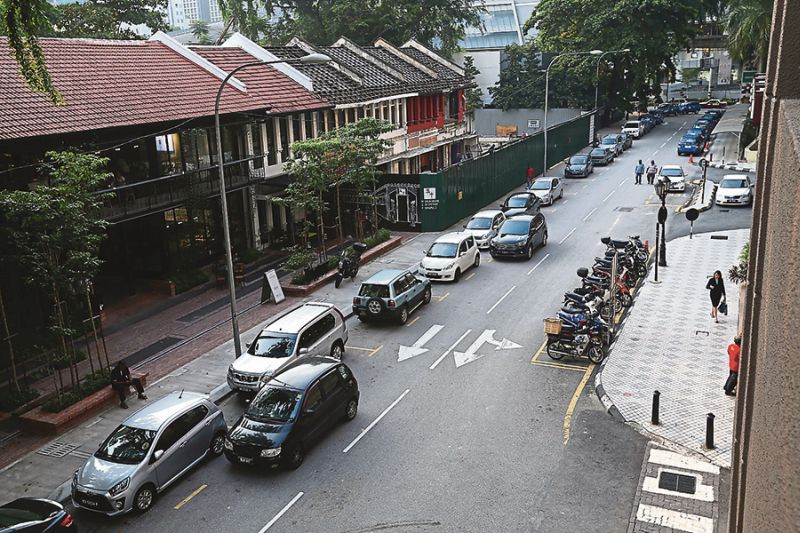


PETALING JAYA, July 3 — A major transformation to give new life to the trouble-stricken Asian Heritage Row in the heart of Kuala Lumpur is finally on the drawing board.
The 350m stretch of nearly 100-year-old buildings along Jalan Doraisamy, which have in recent years been plagued by violent crime, is set to undergo re-invention to turn it into “The Row”, a high-end destination, by early next year.
The late hours and fights at night spots are to be replaced by normal closing hours and coffeehouses that would see brisk business in the evenings.
Kuala Lumpur mayor Datuk Seri Ahmad Phesal Talib told Malay Mail the street that was once considered “the” place to be for party-lovers but fell into disrepute was undergoing redevelopment that would lead to a successful future.
“We are reusing the current existing building to maintain the heritage element. This will be an adaptive reuse of existing development, a practice where one recycles the current land,” he said, adding that the effort began in 2013.
He said the development was to patronise the new businesses that would come up in in the area.
“Greater focus will be placed on eateries and coffeehouses this time around, and we are drifting away from nightclubs which operate till the wee hours of the morning,” he said.
Ahmad Phesal said the move would discourage late-night incidents such as fights among customers and bouncers.
Malaysian developer Urbanspace Sdn Bhd and architecture firm Studio Bikin, and Singapore-based developer Pocket Projects have been engaged to manage the restoration work.
Asian Heritage Row was originally planned in 2003 as a project to revive the rundown pre-war Grecian-Spanish inspired houses along the street.
Following a recent murder where a Syrian was found dead on June 16, Malay Mail revisited Heritage Row where the incident occurred.
What was once the talk of the town has now become a rundown, dimly-lit street with patches of entertainment spots which are outnumbered by the number of mamak restaurants.
Naturally, brawls between intoxicated adults have grown out of hand in several instances, with the death of four people in fights since 2012.
The fights took place towards the end of operating hours at 3am when most patrons were highly intoxicated.
A recent fire destroying three shop lots further damaged the diminishing appeal of the street.
Parking attendant, S. Sakthi, 30, said he usually left work the moment he finished his shift at night as he wished to avoid trouble after that at nearby clubs.
“The customers that come here now are generally older than the crowd a few years ago.
“Having worked here for the last three years, I have seen the crowd change from a younger and more approachable one to to an older and quieter crowd which used younger people to represent them in brawls,” he said.
He said fights would normally occur at least once a week in the past, but now fights are less frequent but more violent.
A club manager, who wanted anonymity, said customers who visited the club he managed had changed over time from a younger crowd made up mostly of college students to an older and more matured crowd which he suspects included VIPs.
“I do not normally encounter fights in my club but when they do happen, we have bouncers to control the situation.
“Sometimes even the bouncers are hesitant about who they argue with as that person could be someone important and influential judging by the cars they drive,” he said.
A bartender, who only wished to be known as Michael, said the crowd start coming in much later these days than in the past .
This has led to clubs being forced to open later than their licence allowed which exposed them to action by City Hall.
“Before this the club would be packed by 12.30am. But now, the crowd only starts to grow after midnight with patrons still entering clubs at 2am,” he said.
Michael added that fights did happen along the street but that he and his colleagues tried not to get involved.


