


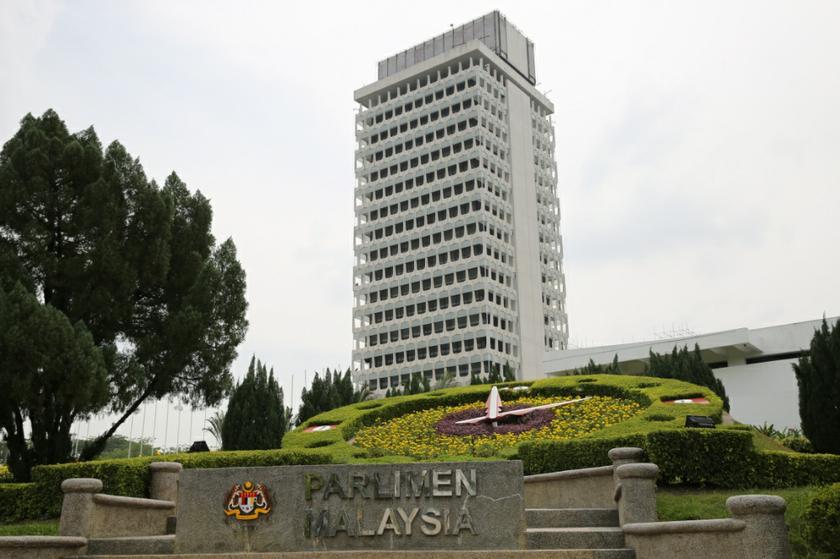


KUALA LUMPUR, June 8 — A group of “concerned citizens” has filed an injunction to prevent Parliament from tabling a private member’s bill aimed at enabling the implementation of hudud, claiming the Islamic penal code violates the Federal Constitution.
The move, according to the group’s representative Siti Kasim, would temporarily delay the attempt to debate the bill, at least until the court decides if the injunction would be allowed. Case management for the injunction application will be heard on June 12.
“Under the law, this means they cannot table the bill. If they do, it could be contempt of court,” Siti, a lawyer, told reporters in the Parliament building here.
The group comprises four individuals, namely lawyer Mansoor Saat and members of civil rights groups Azira Aziz, Hasbeemaputra Abu Bakir and Hazwany Jamaluddin.
The injunction named Dewan Rakyat Speaker Tan Sri Pandikar Mulia Amin, Deputy Speakers Datuk Ronald Kiandee and Datuk Ismail Mohamad Said as well as Dewan Rakyat Secretary Datuk Roosme Hamzah.
The group said the Bill, submitted by Hadi two months ago, was an “indirect attack on the Federal Constitution”.
Mansoor and Siti pointed out that while the Bill aims to make significant changes to the Constitution to implement a law that would affect all Malaysians, no efforts were made to ask them if they actually agree with hudud.
“We believe that democracy must be participatory where a decision must have the active agreement of all 30 million Malaysians through a referendum and not limited to the whims and fancy of only a handful of elites and those with vested interests,” Mansoor said.
“Therefore the amendment to the Shariah Court Act (Criminal Jurisdiction) 1965 or Act 355 is a backdoor attempt to bypass the Federal Constitution with utter disrespect towards the system and framework of the Constitution,” he added.
Hadi’s private member’s Bill seeks to widen the powers of the state Shariah Court—which is currently limited by the country’s supreme law—to execute hudud laws like death by stoning.
Currently Act 355 only gives the Shariah Court powers to punish Muslim offenders with caning or fine.
Azira pointed out that the hudud envisioned by PAS and Hadi are also sexist in nature, noting that even with limited Shariah laws, women have been prosecuted unfairly.
“Among the cases is the Kartini case where she was canned and for consuming alcohol. Only her case was widely reported and she was canned publicly but male offenders often don’t get any media attention at all,” she said.
In 2009, the Pahang Shariah Court sentenced a part-time model and mother of two Kartika Sari Dewi Shukarnor, to a fine and six strokes of the cane for drinking alcohol in a Cherating hotel in 2008.
The sentence was later commuted to three weeks of community service following public outcry.


