


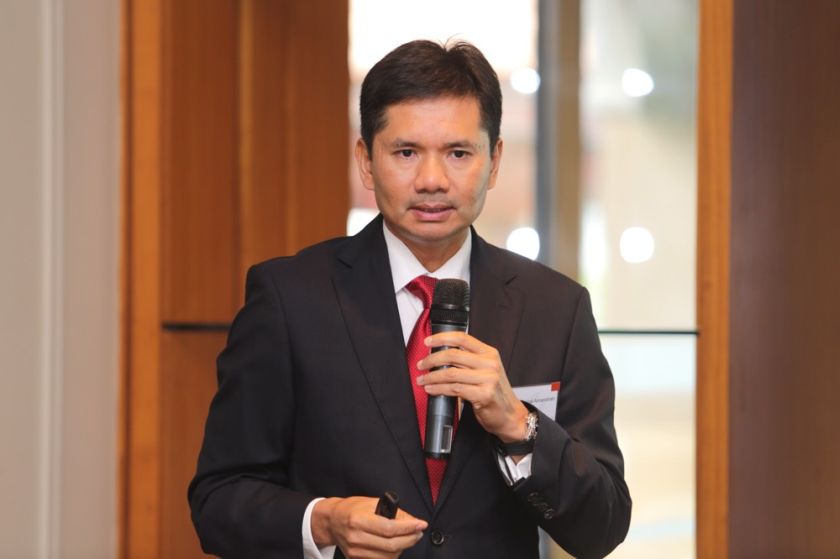


KUALA LUMPUR, May 14 ― Putrajaya’s political turmoil will not discourage multinational corporations from investing in the country, as they are mostly concerned about Malaysia’s economic standing, InvestKL CEO said yesterday.
In an interview with CNBC, Zainal Amanshah said that foreign corporations focus on the country’s economic fundamentals such as its Gross Domestic Product (GDP) and reducing deficit rather than the chatter from the political scene.
“This is very good news for them, yes there could be some noise in the political scene but some economic fundamentals are very important for them,
“In any country there are always talk about politics and so on. But if you look at the fundamentals, last year our GDP was at a 6 per cent growth, this year forecasted at 4.5 to 5 per cent. If you look at other fundamental numbers like our budget deficit, it has been trimmed down to 3.2 per cent, we are at a current account surplus, we are at a stable overall inflation at about 3 per cent and strong central bank,” he said.
He added that foreign corporations tend to look at the bigger picture, with focus on Kuala Lumpur’s stable economic tendencies, adding that many multinational corporations have already invested in the state capital due to the many incentives provided by the government.
“Businesses look at the big picture, the fundamentals which is very important to them. They look at our long history of attracting large multinationals and good quality investments in KL and Malaysia and that’s what important for them,
“There are some very big names that have committed to establishing in Kuala Lumpur just in the last 12 to 18 months. They look at the incentives like the principle hubs which are very attractive in terms of high quality investment, the maturing ecosystem, the ease of doing business consistently,” he explained.
When queried about a recent report indicating that Malaysians place more trust in non-governmental organisations (NGOs) than government agencies, Zainal said that Putrajaya plays a role in just about any organisation in the country regardless of its ownership.
“Its all about the partnership, I don’t think one entity like NGOs can create that kind of stability.
“The government has been working very hard at driving reforms in terms of policies, strategic reform initiatives, liberalisation making it easy to do business, working hand-in-hand with private sector and working hand-in-hand with NGOs.
“At the end of the day, (foreign investors) are comforted that we are open, engaging and very transparent in Malaysia,” he said.
This comes as the country’s economic and political scene are faced with a myriad of controversies, with implementation of the Goods and Services Tax (GST) as well as 1Malaysia Development Berhad’s (1MDB) RM42 billion debt among issues of concern.
Lenders such as Deutsche Bank Singapore who may be spooked by the controversy surrounding 1MDB are now contemplating demanding the full settlement of a US$975-million (RM3.6 billion) loan ahead of its due date in August, according to Singapore’s Business Times.
More worrying for the state-owned investor is that this could trigger cascading defaults on the remainder of 1MDB’s reported RM42 billion in debt if they declare the firm to be delinquent.


