


KUALA LUMPUR, May 11 — Putrajaya’s continued silence over growing religious tensions could lead to an irrevocable break in Malaysians trust in each another, the Bishop of the Anglican Diocese of West Malaysia warned last night.
Rev Datuk Ng Moon Hing said the apparent indifference by the federal government towards inflammatory behaviour by Islamist groups also sends a troubling message over the direction in which the country was heading.
“I’m really worried for the nation in the next 10 years, if nothing is done to stop it,” he told several journalists in a frank interview last night.
“If the fabric (of society) is torn to a position that it cannot be mended, I feel very sad for the next generation. My generation is retiring, your generation will be very difficult to mend... trust is difficult to mend,” he said.
Ng, who was elected the new Bible Society of Malaysia (BSM) president last night, argued that no religion in the world sanctions behaviour that is divisive or detrimental to the interests of the larger community where a faith is practised.
Taking the example of the teachings found in the bibles and holy scriptures that the BSM promotes and distributes to Christians across the country, he said that harmony and mutual benefit are central to what makes a strong society.
“Any religion or holy scripture is not to promote individual gain or benefit, otherwise it is not a religion.
“It must be a promotion of the community, the society we are in or the nation we are in. It must promote harmonious living, living together and sharing, then only the religion can survive and the nation will have parallel benefits from it,” he said.
Ng said BSM stands by the tenets of their faith as outlined in their holy scriptures, but stressed that it should not be mistaken for submissiveness especially when hardline groups such as Ikatan Muslimin Malaysia (Isma) come out publicly with controversial statements.
He, however, lamented that by making such behaviour public, it will only invite public criticism and inevitably drive a wedge in society that may end up too deep to dislodge.
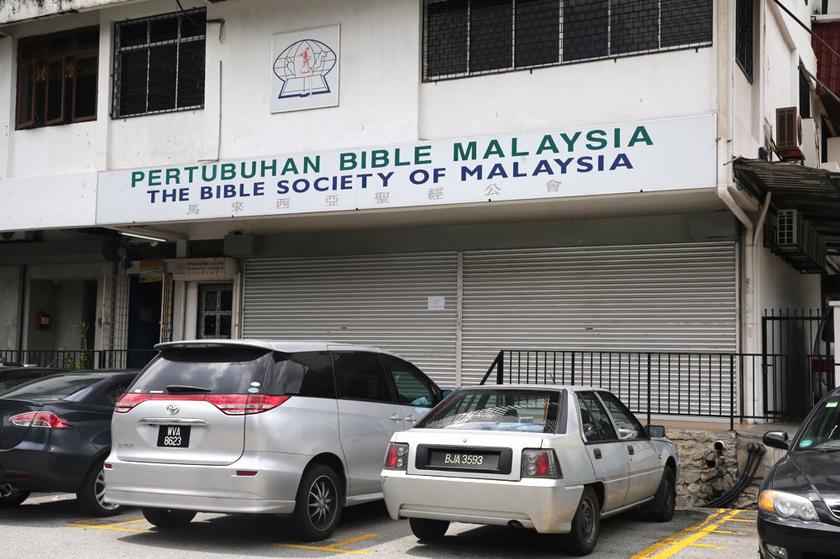
This is non-partisanship was vital, especially when dealing with cases such as the raid and seizure of Malay and Iban-language bibles by the Selangor Islamic Department (Jais) on BSM’s premises earlier this year, Ng said.
In this respect, the BSM is expected to discuss the details of its plan to relocate its headquarters out of its current premises in Selangor to a new location in Kuala Lumpur at their coming executive council meeting next month.
“This issue is not a major aim we have, it’s just an unfortunate incident which we are trying to see how best we can overcome and move on.
“We do not want to jeopardise... because of one issue then the rest of the things cannot be done. English (holy scriptures) can still go on, Chinese can still go on, Tamil can still go on, the rest can still go on,” he said, though he noted that 60 per cent of at least 10,000 holy scriptures distributed annually cater to the Bahasa Malaysia congregation.
On January 3, Jais officials accompanied by policemen raided BSM’s office here, confiscating over 300 copies of the bible in the Malay and Iban languages.
No reason has been given as yet for the raid or the outcome of the investigation.
The raid was one in a string of religious flash points in the country in recent months.
On Tuesday, Isma president Abdullah Zaik Abd Rahman said the influx of Chinese migrants into peninsular Malay had been “a mistake” that must be rectified, but stopped short of saying how this could be achieved.
He said that the ethnic group were considered intruders into Malay land, and had been brought by British colonialists to oppress Malays.
The following day, UiTM hosted a day-long seminar at its Shah Alam campus where Indonesian Muslims, academics and converts were invited to lecture on the use of Allah in the Malay archipelago and their interpretation on the life of Jesus Christ, whom Christians revere as God manifest on earth.
A speaker told the thousand-strong audience — which included former prime minister Tun Abdullah Ahmad Badawi — that the New Testament gospels, which recount the life of Jesus, were hearsay and falsehoods as the prophet was only “a human slave to Allah” and not a divine being.
The lecture took place against the backdrop of strained ties between Muslims and Christians over the use of the Arabic word “Allah”
Last year, the Court of Appeal overturned a lower court’s decision to allow a Catholic newspaper to use the word. The appellate court ruled that “Allah” was not an integral part of Christianity.
The Catholic church is looking to appeal the decision at the country’s highest court.


