





KUALA LUMPUR, March 25 — Malaysia’s conclusion that Flight MH370 ended in the southern Indian Ocean sparked a street protest by passengers’ families in Beijing and Chinese demands for the data behind the decision to declare there were no survivors.
Australia today suspended the hunt for the Boeing Co 777-200ER because of foul weather. Malaysian Prime Minister Datuk Seri Najib Razak said yesterday the Malaysian Airline System Bhd jet’s “last position was in the middle of the Indian Ocean” off Australia’s west coast and the flight ended there, based on satellite signals.
China demanded Malaysia provide information related to the analysis of the satellite data and “make clear the specific basis on which they come to this judgment,” state-run Xinhua News Agency quoted Chinese Deputy Foreign Minister Xie Hangsheng as saying. Malaysian Ambassador Datuk Iskandar Sarudin was summoned to meet Xie in Beijing, Xinhua said.
“We must accept the painful reality that the aircraft is now lost and that none of the passengers or crew on board survived,” Malaysian Air Chairman Tan Sri Md Nor Yusof said in a statement today. “While not entirely unexpected after an intensive multi-national search across a 2.24 million-square-mile (about 7.68-square-kilometres) area, this news is clearly devastating for the families of those on board.”
Search crews hunting for the plane, which had 239 people on board, plan to resume patrols tomorrow.
Condemnation triggered
“This is a remote location, far from any possible landing sites,” Najib told reporters yesterday in Kuala Lumpur. “It is therefore with deep sadness and regret that I must inform you that according to this new data, Flight MH370 ended in the southern Indian Ocean.”
Najib’s comments triggered condemnation from a group representing Chinese passengers’ families that accused Malaysia of “delaying, hiding and covering up the truth.” Najib focused on the certainty of the jet’s loss and shed no new light on why Flight MH370 abandoned its Kuala Lumpur-to-Beijing route on March 8 and went in the opposite direction.
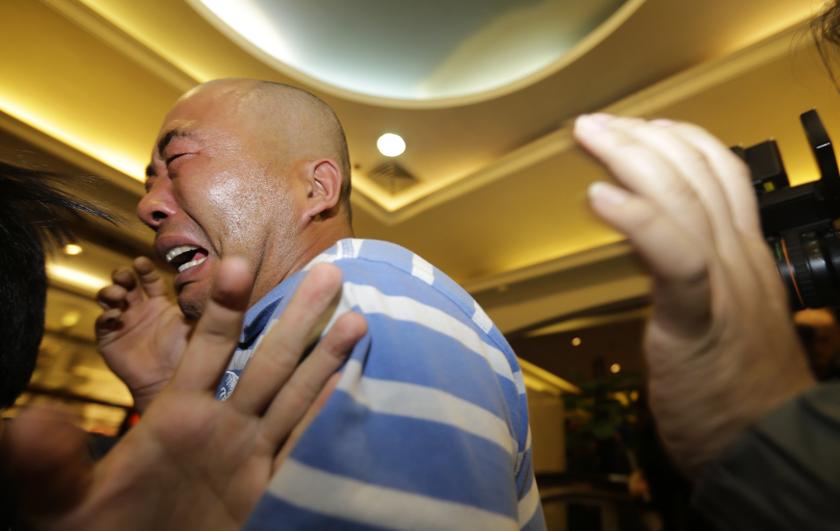
Family members and friends of passengers protested today in front of the Malaysian embassy in Beijing as anguish gave way to anger. “Give us our families back,” they chanted in unison. About two-thirds of the plane’s passengers were Chinese.
False leads
A group that said it represented travellers’ families echoed China’s criticism of Malaysia’s handling of the case.
Malaysian authorities’ “despicable and shameless actions have deceived and destroyed the hearts of our relatives of 154 Chinese passengers, misled and delayed the search efforts, wasted manpower and material resources and led to the loss of the precious rescue time,” the relatives’ group said.
Malaysia Airlines Group Chief Executive Officer Ahmad Jauhari Yahya said today the airline wanted relatives to hear the news first, before the rest of world. The airline did that by speaking to them in person or by telephone, using mobile-phone text messaging only as an additional means to ensure about 1,000 relatives heard the news from the company, rather than the media, he said.
The search has so far failed to spot any debris after several false leads.
“I’m not surprised about anything with respect to this,” Australian Defence Minister David Johnston told reporters in Perth, the western Australian city from where flights are taking off for the search zone. “This is a mystery and until we recover and positively identify a piece of debris, everything is virtually speculation.”
Pings tracked
While Najib didn’t use the word “crash,” he and Malaysia Airlines sought to remove any doubt that the plane ended up anywhere else than at sea, after days in which the absence of evidence became fodder for conspiracy theorists.
The prime minister cited an analysis of data from London- based satellite provider Inmarsat Plc and the UK Air Accidents Investigation Branch as showing that the 777 flew south after contact was lost as it neared Vietnamese airspace. Pings tracked by satellite suggested either a northward arc or, more strongly, the southerly route that Najib confirmed.
While Malaysian officials had been reluctant to publicly declare the likely final position of the flight in case it was incorrect, the new analysis of the Inmarsat satellite data removed their doubts, said a person familiar with those talks and the investigation who asked not to be named because he wasn’t authorised to speak publicly on the matter. He did not elaborate on the content of the analysis, which Najib received yesterday.
New decisions
Najib’s comments move the search to a new phase, Australian Deputy Prime Minister Warren Truss said today, according to a transcript e-mailed from his office.
“We are now investigating an accident, a loss of an aircraft, and some new decisions will have to be taken now about the direction of future operations,” Truss said. “It’ll be a matter now for the Malaysian government to request what assistance they may need to undertake the investigation.”
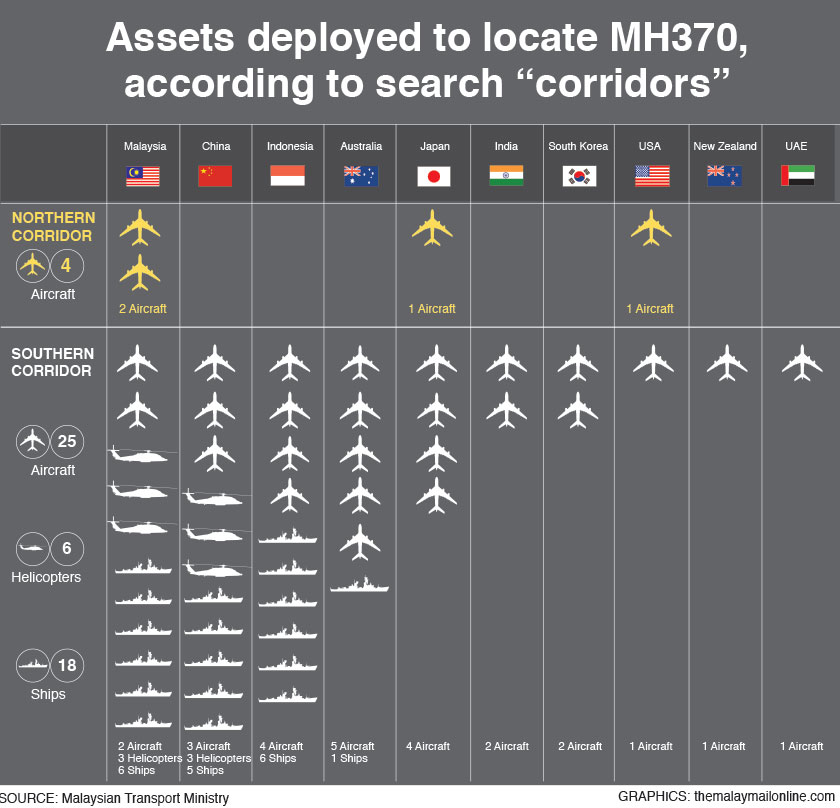
While Malaysia announced two search corridors, the focus had been on the southern Indian Ocean. Bloomberg News reported March 15 that the last satellite transmission from the jet probably placed it over the Indian Ocean.
“The satellite data has been continuously assessed, and it was finally getting to the point where the Malaysians felt comfortable enough to rule out the northern route,” said Kelly Nantel, a spokeswoman for the US National Transportation Safety Board, which has been assisting Malaysian authorities.
When Malaysia Airlines gets approval from the investigating authorities, arrangements will be made to bring the families to the recovery areas, CEO Ahmad Jauhari said.
Gale winds
“It remains immensely difficult to search at sea,” New York-based security consultant Soufan Group, led by former FBI counterterrorism specialist Ali Soufan, said in a briefing on its website. Such a hunt is “like finding a drifting needle in a chaotic, colour-changing, perception-shifting, motion-sickness- inducing haystack.”
The search area is forecast to experience strong gale force winds up to 80 kilometers per hour, heavy rain and low cloud, AMSA said in its statement. Any search activity is deemed hazardous.
Aircraft and ships scouring the southern Indian Ocean came up empty again yesterday, and the passage of time since the accident adds to the difficulty of locating surface debris in waters known for high swells and strong winds.
 Plane sightings
Australia’s HMAS Success found nothing yesterday, said Andrea Hayward-Maher, a spokeswoman for AMSA, after an Australian P3 Orion cruising overhead saw a gray or green circular object and an orange rectangular item.
They were in an area about 2,500 kilometers (1,550 miles) southwest of Perth, Prime Minister Tony Abbott told lawmakers in Canberra, without giving coordinates.
The items are separate from those reported by Chinese aircraft earlier yesterday. The crew of a Chinese IL-76 plane reported sighting two “relatively big” floating objects, around the coordinates of 95.1113 degrees east longitude and 42.5453 south latitude, state-run Xinhua News Agency said. Many white smaller objects were scattered within a radius of several kilometres of the two objects, the agency said.
Recovery of the data and cockpit-voice recorders from the 777 would help investigators narrow in on the plane’s movements and pilots’ actions in its final hours in the air after contact was lost.
Pinger locator
The US sent two pieces of equipment to Australia in case the search zone can be narrowed.
One is an underwater listening device called a towed pinger locator, which would help hunt for the plane’s voice and data recorders, said Rear Admiral John Kirby, a Pentagon spokesman. The other is a Bluefin-21 unmanned underwater vehicle, equipped with sonar and other sensors.
An Australian commercial ship called the Sea Horse Standard would be used to tow the pinger locator and deploy the Bluefin, Kirby said. The equipment is being flown to Perth along with a crew of about 10 people, he said.
The size of any wreckage may vary depending precisely on how Flight MH370 ended, said Todd Curtis, CEO and founder of safety and security consultant AirSafe.com.
Pilots attempting emergency water landings typically deploy flaps on the trailing edge of the wings to lower their speed. The Malaysian jet would have been flying at “higher than the ideal ditching speed” if it was on autopilot until the fuel was exhausted or it was nosed over into a dive, Curtis said. That would tear up the aircraft and debris could be strewn all over the place, he said.
“We do not know why, and we do not know how this terrible tragedy happened,” Malaysia Airlines CEO Ahmad Jauhari said. — Bloomberg


