


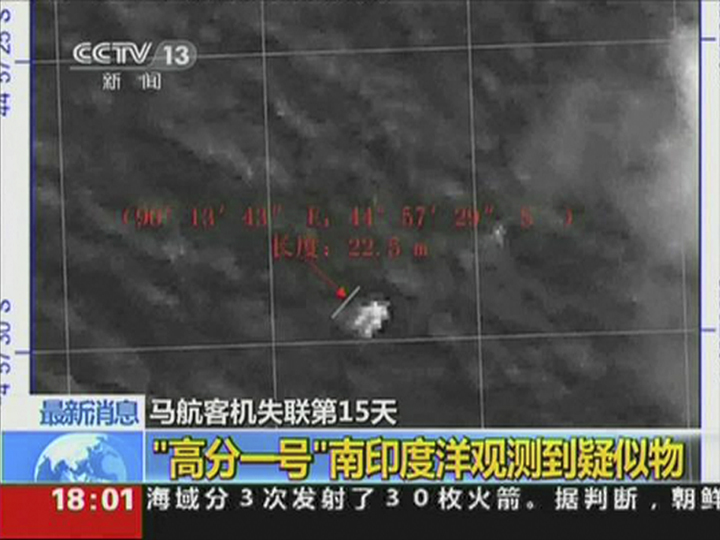


Kuala Lumpur, March 23 — The Australian Maritime Safety Authority (AMSA) has confirmed that the object spotted by a Chinese satellite fell within the area searched by the agency yesterday.
The object, which could be debris from the Malaysian airliner which went missing on March 8, has not been found but the search is continuing in icy seas some 2500 km southwest of Perth in Western Australia.
“Yesterday, China provided a satellite image to Australia possibly showing a 22.5
metre floating object in the southern Indian Ocean. AMSA plotted the position and it fell
within yesterday’s search area,” the agency said in a statement.
“The object was not sighted during yesterday’s search. AMSA has used this information in the development of the search area, taking drift modelling into account,” it said.
Yesterday, civil aircraft identified several small objects of interest which later turned out to be clumps of seaweed, it added.
The agency said today’s search has been split into two areas within the same area, covering 59,000 square kilometres.
A total of eight aircraft are involved in the search today, AMSA said.
The civil aircraft involved are two Bombardier Global Express, a Gulfstream 5 and an Airbus 319.
One aircraft left Perth for the search area just after 9 am local time and the others departed between 11am and midday.
Military aircraft are also involved in the search. The US Navy P8 Poseidon aircraft departed for the search area about 11 am while a Royal Australian Air Force(RAAF)P3 Orion aircraft left for the area at 11.45am.
Another RAAF P3 Orion is scheduled to leave for the area at 2 pm while a Royal New Zealand Air Force (RNZAF) P3 Orion is set to leave for the search area at 4pm.
Two Chinese military Ilyushin IL aircraft have arrived in Perth and are likely to join the search on Monday, AMSA added.
MH370, a Boeing 777-200ER aircraft, left Malaysia’s main airport, KLIA, around 12.40 am on March 8. The plane, carrying 239 people and bound for Beijing, travelled on the path charted for it for just under an hour. It’s last contact with air control was around 1.20 am the same day, when it was 120 nautical miles off Kota Bharu and flying over the South China Sea.
What happened next has been subject to intense debate and speculation but military radar detected the plane turning back, flying in the opposite direction of its intended flight path. There were no distress calls and the plane stopped communicating its position like it normally would.
Working on the aircraft’s last automated communication, experts plotted one of two possible paths for the flight : a northern corridor stretching approximately from the border of Kazakhstan and Turkmenistan to northern Thailand, or a southern corridor stretching approximately from Indonesia to the southern Indian ocean.


