


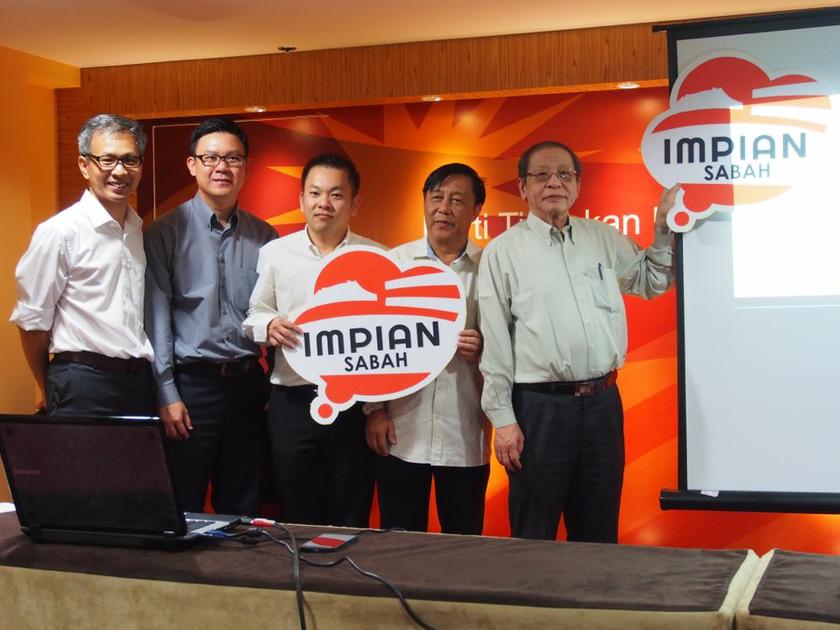


KUALA LUMPUR, Nov 27 — Following its unsatisfactory attempt at capturing more seats in Sabah in Election 2013, DAP launched today the “Impian Sabah” (The Sabah Dream) movement to penetrate rural communities in the East Malaysia state.
The first project under the movement will target a village under the Kota Marudu seat, which was previously won by Parti Bersatu Sabah (PBS) Deputy President Datuk Seri Dr Maximus Ongkili with just a 842-vote majority.
“We were able to “destroy” the “fixed deposit” moniker for Johor and Sarawak, by increasing our votes received significantly ... However, for Sabah, we were only able to increase our votes by 3.4 per cent to 35.9 per cent,” DAP's Lim Kit Siang told reporters after its launch here.
“Hence, it is undeniable that Pakatan Rakyat (PR) must pull out all the stops to increase our electoral support in the state with 26 parliamentary seats, including Labuan.”
“Impian Sabah” is the second project under the larger “Impian Malaysia” project and after “Impian Sarawak”, which was launched in September aimed at capturing rural Sarawak.
Despite targeting 33 parliamentary seats from the Johor, Sarawak, and Sabah — the three states that helped keep a weakened ruling coalition in power in the last polls — PR only managed to secure 14 seats.
Of the three states, PR won only three parliamentary seats in Sabah — Kota Kinabalu, Sandakan, and Penampang — with the first two won by DAP.
The first outreach project in Sabah will be a RM25,000 gravity-feed water system in Kampung Samparita Laut in Kota Marudu, where over 200 of its Dusun villagers have no access to piped water and currently depend on the murky river nearby.
The village falls under Kota Marudu, won by Ongkili in the May polls after a four-cornered fight involving DAP, Sarawak-based State Reform Party (STAR), and Sabah Progressive Party (SAPP).
“If not for the splitting of votes with STAR, PR would have own the seat. Hence, every effort must be made in these marginal seats so as to ensure that PR will win these seats in the next general election,” Lim added.
However, DAP denied today that it will only be carrying out projects in areas where BN won with minute majorities in the May polls, stressing that its main agenda is to deliver their promises to the rural areas.
“I think votes are secondary ...We do make full use of our efforts to assist the people of Sabah. We believe votes will come if you do well. We’re less concerned about votes today, more concerned about actually delivering what we promised,” said Tony Pua, the DAP national publicity chief.
According to Pua, the second project will be done in Tenom, the parliamentary seat won by Umno’s Datuk Raime Unggi by a 3,886-vote majority in the 13th general elections. PR’s representative was PKR’s Masdin Tumas, who won 5,885 votes.
The launch today was also attended by Sabah DAP chairman and Kota Kinabalu MP Jimmy Wong, Sabah DAP secretary and Kapayan assemblyman Dr Edwin Bosi, and Sabah DAP assistant secretary and Likas assemblyman Junz Wong,
Also present were Sandakan MP Stephen Wong, and Sri Tanjong assemblyman Chan Foong Hin. Sibu MP Oscar Ling Chai Wai and Serdang MP Dr Ong Kian Ming also lent their support.
Sabah DAP lawmakers today lamented that despite having the largest state budget for 2014 at close to RM6 billion, the state with the 3.3 million-strong population is still the state with the highest poverty rate in the country.
This is also despite the East Malaysia state being among the richest in natural resources, as well as being the richest state per capital in the early 1970s, DAP said.
According to DAP, as of 2010, 43 per cent of Sabahan households do not have access to clean or treated water, while nearly 20 per cent do not have electricity supply.
Earlier this month, DAP had offered rivals in the Sabah and Sarawak governments co-operation in a fight for what has been long overdue — dignity in the face of Putrajaya’s bullying and the right to equal treatment.
According to party secretary-general Lim Guan Eng, the party is willing to work together and help the two states fight for an increase in the share of oil and gas royalties from the present 5 per cent to 20 per cent as well as end the cabotage policy that makes goods prices in Sabah and Sarawak higher than in the peninsula.


