




KUALA LUMPUR, Nov 25 — Spying. Privacy. Security.
These three words have been popping up everywhere — in both local and international media — thanks to Edward Snowden who blew the lid off the US National Security Agency’s (NSA) snoop fest.
Governments say spying, or what they call intelligence gathering, is essential to national security. Citizens say they need to safeguard their privacy.
But where do you draw the line in the name of security especially with the all-too-real threat of terrorism hanging over everyone? And in Malaysia, authorities say gangsterism, illegal gambling and the influx of illegal immigrants are serious matters that need to be tackled as well.
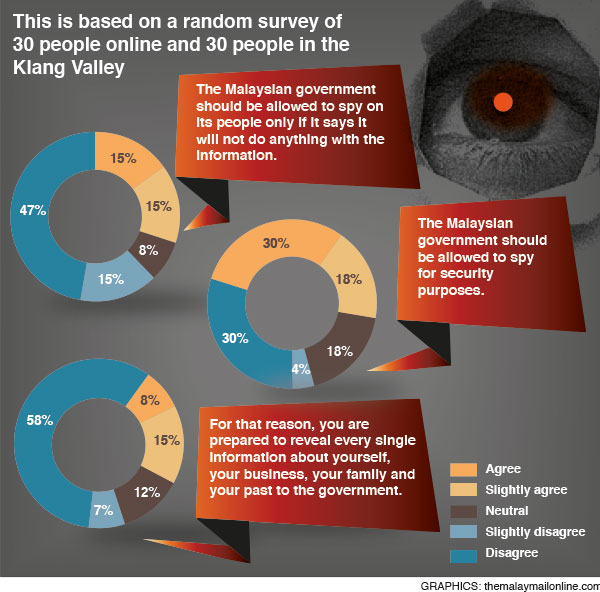
A survey by the The Malay Mail Online found that 47 per cent of Malaysians disagree with the government spying on its citizens even if it said it would not use the information collected.
However, there was a split in opinion when asked if the government should be allowed to conduct spying activities for security purposes; 30 per cent agreed while another 30 per cent disagreed, followed by 18 per cent who slightly disagree and another 18 per cent who said they were neutral.
Out of the 60 people surveyed, 30 online and 30 in person in the Klang Valley, an overwhelming 58 per cent said they are not willing to give up every bit of information about themselves, their families, and their businesses. There were 8 per cent who agreed, with some saying they have nothing to hide.
Federal Constitution
New Sin Yew, a lawyer at Chan Weng Keng and Associates, pointed out that Article 5 (1) of the Federal Constitution provides for the right to life and liberty, although previously rights to privacy was not considered to be protected under the law.
The Federal Constitution states that “no person shall be deprived of his life or personal liberty save in accordance with law.”
“What happened was the court went under the Right to Life under Article 5, so they interpreted life widely, right to family life, right to privacy, right to dignity, right to reputation and honour, so it’s very wide but this new trend of recognising your right to privacy, it’s only happened about five years ago.
“It’s because of Sivarasa’s case against the Bar Council, because of that, the judge interpreted life widely,” he said, referring to the Subang MP, whose case was in relation to his holding office in both the Bar Council Malaysia and also in a political party, PKR.
New said since the judgement was delivered, there have been other cases in the High Court which applied that judgment which recognises the right to privacy.
“Based on those cases, I suspect if the police or the government spy on you and they can’t justify why, I suspect you have a cause of action but it hasn’t been tried yet,” he told The Malay Mail Online in a recent interview.

Veteran criminal lawyer Leonard Anselm Gomes from L.A. Gomes, Meor Shaazizi and Associates also pointed out that a government spying on its people violates a certain right.
“The argument is that if you surrender a right, what happens is that you get pushed more and more till your basic rights also are gone.
“It starts with censorship, they encroach on your freedom of speech and then they say free speech is dangerous, have to control… then if the government spies on a citizen, a precedent is set... there is abuse of authority, what happens… who is in charge of keeping an eye on the very people who are spying on us?” he asked.
New pointed out the irony that the very people elected are the very people who “really trample on your human rights”, adding the problem is not unique to Malaysia.
“I think it boils down to that very same question that 3,000 years ago, what happens when two rights come in conflict with each other, which one prevails,” he said.
Awareness of rights to privacy
New said the country is still in its infancy when it comes to civil education and understanding individual rights provided by the Constitution.
“When you know that your rights are being infringed upon… something just feels wrong about it.
“I think that’s when people will start to make noise, only then... it’s a question of letting them know, you don’t know what you don’t know.
“It’s a question of informing them, it’s a question of educating them,” he said.
For example, he said up to seven years ago, a lot of Malaysians probably didn’t know their rights under the Election Act. They were unaware of electoral fraud and the practice of gerrymandering.
“Malaysia is known to be a signatory of the International Covenant on Civil and Political Rights (ICCCPR) [but] who are being tapped? Activists are tapped, political leaders are tapped, so that’s actually an infringement of their civil and political rights.
“You don’t have to go so far as wiretapping and phone tapping, SBs (Special Branch officers) going around political rallies, the presence of Special Branch... that to a certain extent is an infringement into your right to privacy. Why are they there?” he questioned.
The SB is an intelligence agency attached to the Royal Malaysian Police and it is empowered to acquire and develop intelligence on internal and external threats to the nation, subversive activities, extremist activities and activities of sabotage and spying.
Gomes echoed New’s sentiments and questioned the need for the controversial police arm today.
“When we had the Communist threat, we had what is known as the Special Branch. At that time, you could say the SB was very useful because they had all the info on Communists, but regrettably, after the Communism threat went away, what is this SB being used for, that’s the issue now,” he said.
New said moving forward, before laws are amended, education on the matter should take priority.
“The current laws that we have, the current procedures that we employ are not actually safeguarding our rights,” he said.
“I’m not saying a carte blanche abolishment of all these wiretapping surveillance because to a certain extent, it is needed, intelligence is needed, but to what extent, I don’t think I’m in the position to answer.
“It’s needed but it needs to be checked, it needs to be balanced, you can’t just give them a free rein. You can’t have absolute power to wiretap and monitor anybody equally, but you can’t not have them at all”.
Malaysians’ lackadaisical attitude towards spying
According to the survey, only 23 per cent are aware of media reports on the US using its KL embassy as one of its 90 surveillance facilities, and only 22 per cent are angry if the allegations are true.
Chief Executive Officer of Akati Consulting and cyber security expert Krishna Rajagopal said the fact that Malaysia has been so sheltered from a lot of the global crises might have contributed to the lackadaisical attitude.
“In Malaysia, I still feel we have the lackadaisical attitude when it comes to this because we feel that we are so far away from all the problems... that nothing will actually happen here, so we have the tidak apa attitude.
“When it comes to this sort of thing, we see the people who are reacting are all not independent, they are either attached to this political party or that political party.
“So that obviously there is a motive but the average Joe on the street, he doesn’t care. That is the problem… until something happens then they get paranoid,” Krishna said.
New echoed his sentiments and added it is “too much trouble to make noise.”
“I think it’s a very Malaysian thing, it’s always someone else’s problem, that’s not my problem.
“I think they should be worried, I think they should be very worried... people all over the world are worried, there is no reason why they shouldn’t be worried,” he said.
As for those people who claim they have nothing to hide, New said there needs to be a justifiable reason for spying on someone.
Gomes is one of those people.
“It depends on the circumstances… they should have a legitimate reason for doing so, but in reality, if you have nothing to hide, who cares? Normally, it is the criminals or the people who have something to hide who are raising these issues.
“I’ve got nothing to hide, go ahead, check whatever you like but I believe the government won’t be interested in the common people.
“I have got no problem with it, as I’ve said, I’ve got nothing to hide so nobody is going to arrest me, nobody is going to get information from me because I’m not doing anything,” he said.
He also said unlike in the US, Malaysians at this juncture should not be too worried about this issue.
“In Malaysia, it is hardly in existence because we don’t have a terrorist problem, we don’t have a Communist problem now, therefore there is no legitimate reason… all the spying is only used for political mileage.
Understanding of the value of personal information
Krishna said most people have the same concern, but when they go online, they tend to be more relaxed about their privacy such as checking in to locations or posting photos with important information such as car number plates or in front of their houses.
“We think it’s okay because we feel we are shielded online, we feel like we have our virtual cubicle and we’re fine but actually when someone reveals this to them, they would probably agree with the same statements that you get from the in-person surveys that you did... they would all probably say that they don’t want their personal information made public, but as a basic human right, I think almost every one does not like their privacy disturbed,” he said.
In offering a solution to finding a balance in being socially active online and safeguarding one’s privacy, he said, “Post what you’d like everybody in the world to know”.

Krishna said the carelessness of people posting too much personal information has contributed to a number of robberies.
“That’s already happening and now when you add the government perspective to it, the fact that the government has all information, that’s very scary.
“I don’t think anybody would be open to it. What I do think a lot of people would agree is that they would be okay if it was for national security.
“That means to fight organised crimes, to fight terrorists, bomb threats, robberies, that’s fine,” he said.
Importance of education
Krishna said it is necessary for the younger generation, especially the Generations X, Y, and Z, to be educated on how vulnerable they are when they post too much online.
“It is a drastic need, we have started working with partners and we have done so in Sri Lanka, for example, where we went to schools and actually taught them about it.
“I think awareness education is key. I have not seen a single person, who we have trained, at the end of the training, who said I still want to share my information blatantly online. They all come out paranoid, they all come out saying, ‘Thank god, I know this. I’m going to change.’
“It’s just that they are not sure or not aware to what extent their information is exposed online and they don’t want to seem they are anti-social. We all have these friends who have a Facebook profile without a photo and we go what’s wrong with you,” he said with a chuckle.
Krishna said it is important to increase IT literacy as well as understanding and being aware of the risks. He added that current efforts are not sufficient.
“Creating posters and sticking them everywhere doesn’t work anymore. It probably worked with the older generation but with the younger generation, it’s not going to.
“Engage in where they are active the most, Twitter, Facebook, YouTube... not some poster at some government building,” he said.
New stressed that it is important to understand the issue, and not just blindly jump on the bandwagon and go all out protesting against government spying.
“Don’t go protest just because everybody is doing it, know exactly what’s wrong, and that there is something wrong, and then once you know what’s wrong, you’ve got to decide for yourself whether or not you want to keep quiet or whether you want to talk about it.”


