


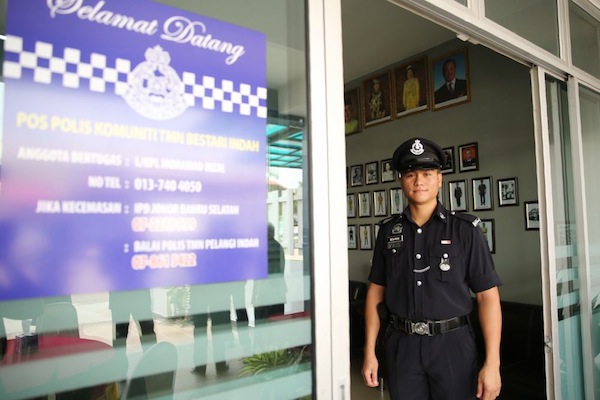


JOHOR BARU, Sept 3 — Before February 2010, Taman Bestari Indah was not the sort of neighbourhood you would want to live in.
The outwardly quiet suburban neighbourhood was literally a hotbed of crime. Criminals prowled the streets after hours, stealing cars and motorcycles, breaking into homes and staging gang robberies.
Some of the robbers even had guns and sometimes their victims were seriously hurt.
It was a time that S. Manimaran remembers all too clearly.
“I came here in 2006,” the 46-year-old electrician told The Malay Mail Online in a recent interview.
“That time, it was very bad. They (criminals) would break into houses, beat people up... there were gangs,” he recalled.
Manimaran worried for the safety of his three children. He said even being a part of a neighbourhood watch did little to help matters as without weapons or powers to arrest criminals, keeping vigilance over Taman Bestari Indah’s 2,000 homes and some 9,000 occupants was nearly impossible.
“People left the neighbourhood. They sold their houses and they left... [to] go somewhere with security,” he said.
For those left behind, living in fear became a daily reality. To make matters worse, the neighbourhood’s bad reputation allegedly forced the prices of properties down, leaving its existing owners with little choice but to stay put.

But today, Manimaran and his neighbours are no longer as afraid.
Some three years ago on February 13, 2010, their troubled neighbourhood was gifted its very own live-in law enforcer.
The Community Police Post (CPP) programme, an initiative created as part of the Iskandar Malaysia Safety and Security Blueprint formulated in 2008, was quite simply tasked with turning the region into a safe haven for investors and local Johoreans.
With special government funding channelled through the Iskandar Regional Development Authority (IRDA), the CPPs were set up at a cost of some RM8 million in the first 16 of the 208 crime-ridden neighbourhoods highlighted by the Johor police.
This included Taman Bestari Indah which became the first neighbourhood in the country to be given a CPP.
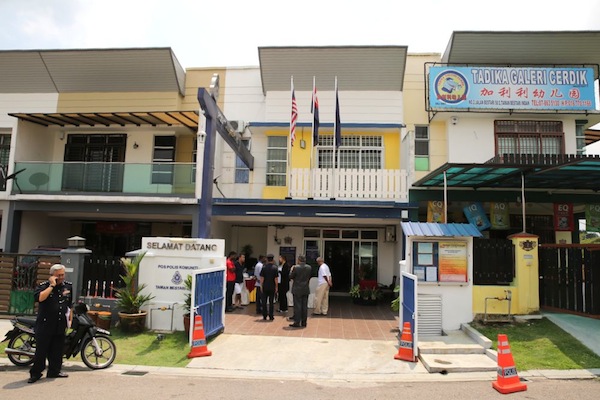
The first officer appointed to the post was then 27-year-old Constable Mohamad Rizal Mohamed Khairi. His orders were simple; to live in a designated home inside Taman Bestari Indah, get to know all his neighbours, engage with them daily and keep their homes safe from criminals.
“The CPP officer is like a penghulu. He must take ownership of his area. His job is to get to know all the residents in the area, cement the relationship.
“Encourage them (residents) to work with the police... educate them on the fact that fighting crime is a shared responsibility,” Johor police chief Datuk Mohd Mokhtar Mohd Shariff told The Malay Mail Online at his office here.
“If everyone in the area helps each other, works with each other, then the criminals will stay away. So the whole idea was that,” he added.
In return, Mohd Mokhtar said the CPP officer gets to live rent-free in a four-bedroom double-storey terrace home, fully equipped from floor to ceiling with all the necessary amenities needed for a comfortable stay.
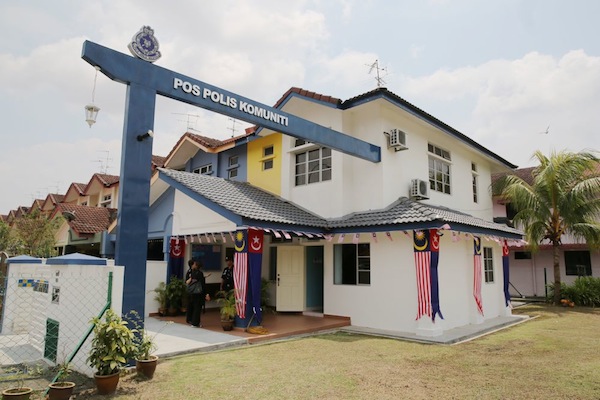
At the Taman Bestari Indah CPP, Mohamad Rizal and his wife Constable Masturi Bolhassan are given the full privacy of three upstairs bedrooms for themselves and their new-born child. The rooms are blocked off from the downstairs area by a locked grille.
 The bottom floor of their home has been renovated into a mini police station. This is where Taman Bestari Indah residents flock to lodge reports, complaints or merely drop by to say hello at any hour of the day.
When Mohamad Rizal leaves the CPP for his routine patrol, he must leave a contact number behind to ensure his locked door does not turn troubled residents away. When he goes to sleep at night, he is mindful he has to entertain distress calls, regardless what hour they come in.
When he is on holiday, a visiting policeman takes over his duties and is given a bedroom on the bottom floor of the house.
“They (residents) use the police house which doubles as an office too. It is multi-usage. It is where he lives and where he works. And the house is also used as a meeting place for residents,” Mohd Mokhtar explained.
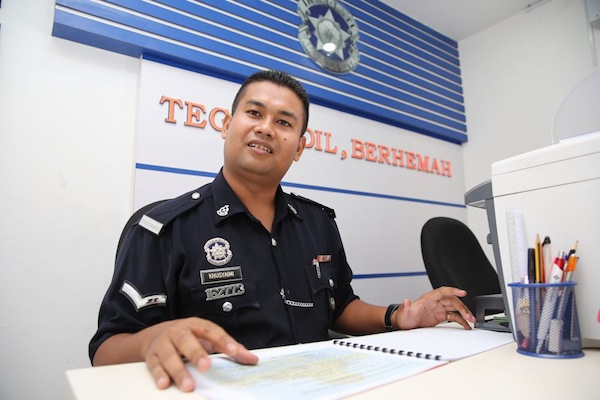
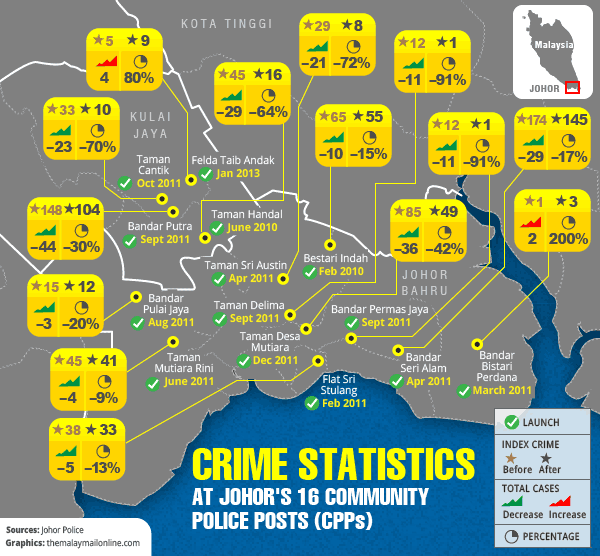
Today, three years after Mohamad Rizal moved in, the crime rate at Taman Bestari Indah has plunged 15 per cent. Residents there believe that it was the presence of the neighbourhood CPP that had frightened off many of the gangsters and burglars who used to break into homes or commit robberies.
“After the CPP opened here, crime has gone down. The criminals are now afraid,” said Manimaran, who is now part of the neighbourhood committee that helps Mohamad Rizal in his crime prevention duties.
“The policeman has now become my friend and my neighbour.”
According to Mohd Mokhtar, there are now 16 fully operational CPPs in neighbourhoods across Iskandar Malaysia and like Taman Bestari Indah, the remaining 15 posts are also reporting positive results.
The state’s chief crime-fighter said that to keep his men on their toes, he has adopted a no-nonsense approach — periodic progress reports are expected from the CPP officer to ensure they are successful in keeping their designated neighbourhoods safe.
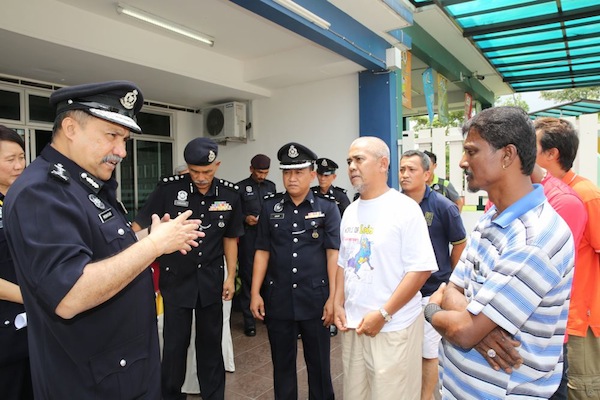
“As the police chief of Johor, I tell my men that this is a noble profession,” he said.
“We serve society in the eyes of God. You give people peace, confidence, the serenity to sleep at night, to go peacefully to the mosque, church or temple, to carry on with their living... No compromise on that.”
He told The Malay Mail Online that if the neighbourhood’s crime numbers do not drop or if residents are unhappy with their services, the CPP officers will be made to move out in favour of other more capable personnel.
“We measure them. Our instructions are clear. If they do not deliver, they are removed within 24 hours. They know what they have to do,” he said.
A visit to the CPP at Taman Mutiara Rini last week showed that since it was set up on July 15, 2011, the neighbourhood’s crime numbers have dropped by nine per cent.
Lance Corporal Mohd Khusyaimi Shamsuddin, 27, who has been stationed at the post since January this year, said that apart from his police duties, he has also played the role of mediator in common neighbourhood squabbles like family arguments, among others.
“I also go on patrols twice a week with my committee,” he said. “The response has been very good. They (residents) feel safer. Because the CPP is open... it is not just crime problem.”
“People are no longer afraid to see the police. The police are now their friends,” he said.
Statistics from Mohd Mokhtar’s office also show that the CPPs elsewhere are performing just as well, if not better than Taman Mutiara Rini and Taman Bestari Indah, with crime rate dropping by as much as 80 to 90 per cent in some areas.
The Johor police chief said he hopes that apart from the first 16 CPPs and a further two which should be handed over soon, IRDA would be able to deliver the remaining 190 from the 208 requested by his office.

“The CPP is important in managing public perception, in curbing crime and finally, in instilling public confidence,” he said.
“We are pushing IRDA to deliver us the balance. But they are also saddled with some problems. In areas we have identified, some [property] prices have gone up, or owners have refused to sell and everything changes, priority changes,” he said.
The Malay Mail Online understands that one option that IRDA is currently exploring is convincing developers of new housing estates within Iskandar Malaysia to contribute a home within their development to the CPP programme.
The authority’s chief executive Datuk Ismail Ibrahim said this would be a major cost-cutting measure for the government. As it stands, he noted during an interview at his office here, the government has already spent RM8 million for the first 16 CPPs and had approved a second allocation of RM7 million for the project’s second phase.
“Sometimes we cannot compromise. Certain things, we have to set as priority and we have to find the funds and resources for it.
“Of course, if the (crime) situation here improves, we may not need all of the 208 CPPs identified,” he said.
But, citing the success rate of the current CPPs and the sudden rise in crime following the recent spate of shootings nationwide, Mohd Mokhtar said many Johoreans are now requesting for CPPs in their neighbourhoods.
“There’s a lot of public interest,” he said. “Those who live in areas where there are CPPs) are very happy with the presence of cops. Crime has gone down.”
But Mohd Mokhtar said that apart from the CPP initiative, other improvements launched by the police contingent in recent years have also helped bring down the crime rate in Johor, a state often seen as a high-crime capital.
The police chief said despite the misperception, Johor is third behind Selangor and Kuala Lumpur in terms of crime volume and many efforts have been taken to further reduce the state’s crime numbers.
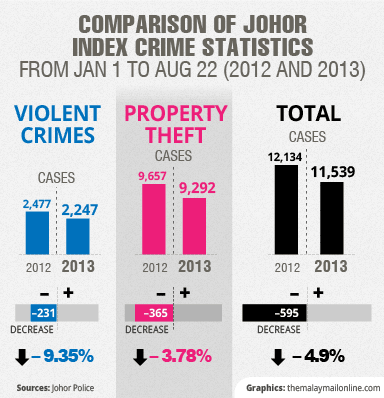 According to official police figures, the number of index crime cases between January 1 and August 22 this year was 11,539, which is a drop of 595 cases or 4.9 per cent from the 12,134 recorded in the corresponding period last year.
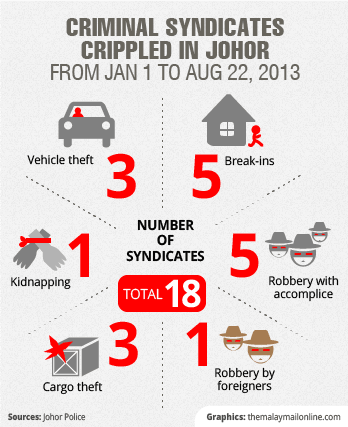
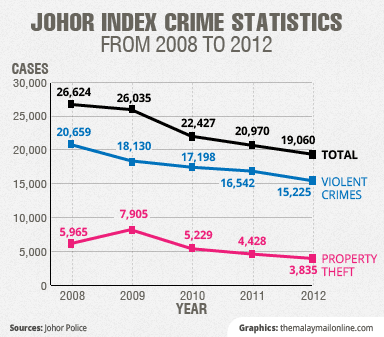
In the same period this year, the police also successfully crippled 18 criminal syndicates, including those linked to robberies, house break-ins and vehicle theft.In the five-year period between 2008 and 2012, the state’s crime rate dropped from 26,624 cases in 2008 to 19,060 in 2012, which translates to a decline of 7,564 cases or 28 per cent.
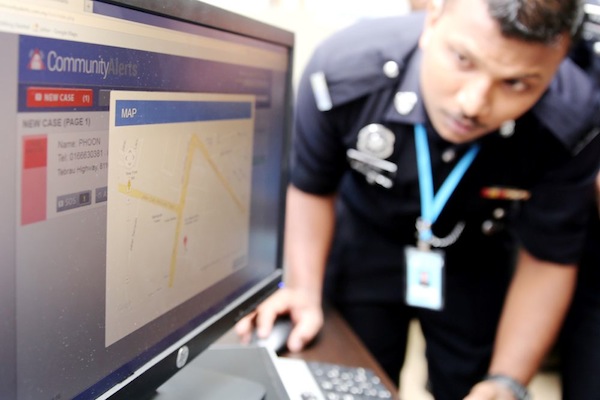
On March 2 this year, the Johor police launched the mobile application “Community Alert”, which is modelled after Selangor’s “MyDistress”. The smartphone application allows victims to send distress signals to the police with a simple click on their phones.
The state contingent has also launched the “E-Alert”, another smartphone application, meant to help users and the police share and disseminate important information among one another.
“I always say the police cannot remain analogue in a digital age,” Mohd Mokhtar said.
In another initiative, IRDA is expected to deploy a total of 1,500 CCTVs by 2017 at a cost of RM245 million.
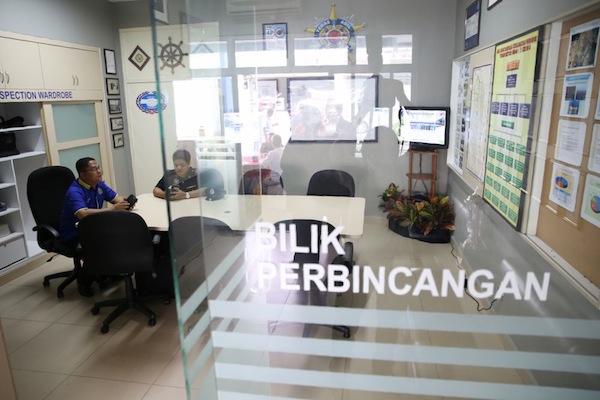
The CCTVs, to be spread out at all crime hotspots across the state, will be managed and monitored by the state police. According to IRDA, a total of 250 CCTVs are already operational in Nusajaya.
With police work in Johor buoyed by these initiatives, Mohd Mokhtar said that despite the sudden spike in gun crimes across the country recently, investors have not shied away from parking their businesses in Iskandar Malaysia.
 According to a July press release, as at June 30 this year, the number of cumulative committed investments in the southern economic region has risen to RM118.93 billion.
“I must stress that the crime situation in Johor is fully under control. The police have the upperhand over the criminals,” Mohd Mokhtar said.
“I don’t deny that the issue is there and the matter is being discussed but every day in Johor, we tell the public our success stories.
“People are free to criticise, create labels. But the reality is — Johor is booming,” he said.


