


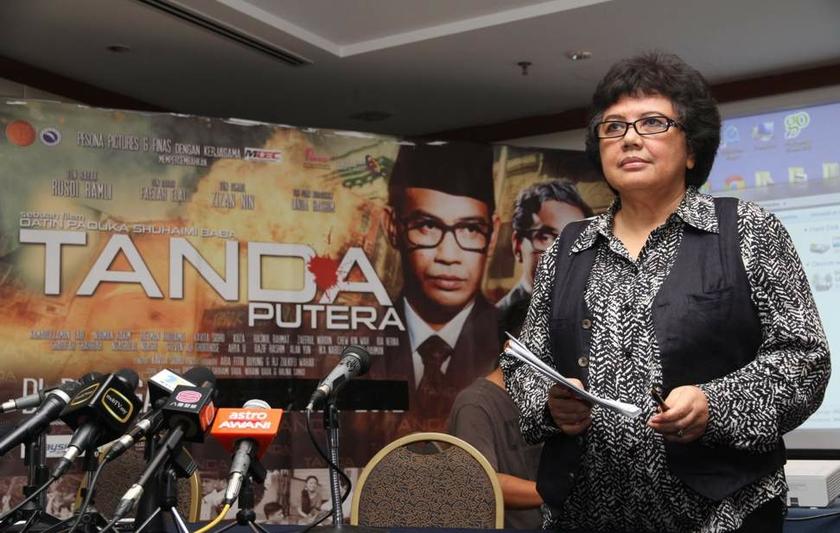


KUALA LUMPUR, Aug 29 ― Cinemas risk losing their licences if they comply with Penang’s request not to screen “Tanda Putera” as the film is covered by the government’s mandatory screening scheme, said its director Datin Paduka Shuhaimi Baba.
Shuhaimi was responding to the call by the Penang government yesterday to cinemas in the state to refrain from playing the movie, scheduled to hit silver screens today after nearly a year’s delay.
“As far as we are concerned the screening should go on as scheduled by FINAS Wajib Tayang (Compulsory Screening) Committee.
“If the cinema operators do not screen the film as scheduled, their licences can be revoked by FINAS,” Shuhaimi told The Malay Mail Online via text last night.
The National Film Development Corporation’s (FINAS) Compulsory Screening Scheme was introduced in 2005 to help local filmmakers gain a larger audience. Under the scheme, cinemas must show designated films in their largest screening hall for no fewer than 14 days.
They may demote the screening to a smaller hall if audiences fail to reach 30 per cent of capacity for four consecutive days. They may also discontinue screening at their discretion if less than 15 per cent of the hall is filled for three days in a row.
The scheme is open to any film made by a local company or a joint-venture production in Malaysia.
Shuhaimi also confirmed that the movie’s distributor received an emailed copy of the directive from the Penang city council to the cinema operators, dated yesterday, requesting them to not screen “Tanda Putera” today.
“If indeed, this instruction came from the chief minister, we find this latest development irrational and incomprehensible as he has not even seen the movie, and this misuse of authority is an embarrassment.
“We are just filmmakers and not his political opponent. Instead of victimising us, he should pick on someone his own size,” she said.
Penang Chief Minister Lim Guan Eng alleged yesterday that the film has scenes that are defamatory, based on lies, and are a threat to the harmony between the different communities in the country.
“Those scenes of Chinese youth urinating inside the Selangor menteri besar (Datuk Harun Idris’) residence and Malaysian flag can create chaos in society,” he was quoted as saying by news portal Malaysiakini.
Lim also insisted that the incident was fabricated, pointing to a witness testimony on how heavily guarded Harun’s residence had been at the time.
The offending scene became the focal point of controversy last year when an administrator posted on Facebook a photograph ostensibly of the scene along with a caption: “Lim Kit Siang telah kencing di bawah tiang bendera Selangor yang terpacak di rumah menteri besar Selangor ketika itu, Harun Idris, (Lim Kit Siang had urinated at the foot of the flagpole bearing the Selangor flag at the then Selangor MB’s Harun Idris’ house)”.
Shuhaimi had last week conceded the film was a work of fiction despite earlier vouching for its “historical accuracy”.
“Tanda Putera” was produced at a cost of RM4.8 million provided by FINAS and the Multimedia Development Corporation (Mdec).
It had originally been scheduled to be released on September 13 last year, before being postponed to November 13 and subsequently put on hold indefinitely.
Since then, it has been shown in private screenings to an assortment of viewers such as a gathering of Felda settlers in February and at an invitation-only event for International Islamic University students a month later.
The movie premièred last week to a select audience comprising cast members and several figures of authority and earned brickbats again when it was learned that the urinating scene had not been removed.
Shuhaimi was again forced to come to her movie’s defence, explaining that “Tanda Putera” is essentially about Malaysia’s second Prime Minister Tun Abdul Razak Hussein and his deputy Tun Dr Ismail Abdul Rahman — “two men who gave up everything, including their lives for the country”.


