


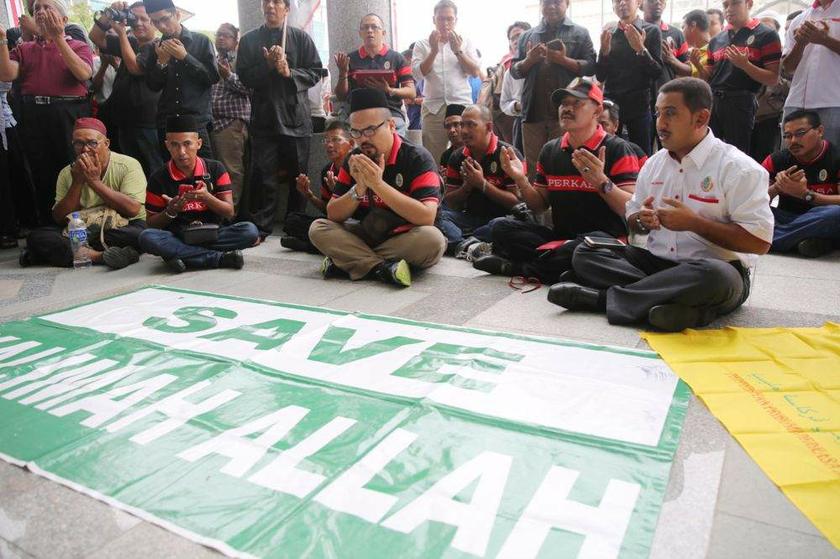


KUALA LUMPUR, Aug 25 – A global Christian evangelical conspiracy is behind the “Allah” row, Muslim activists here alleged today, as they described a clandestine agenda to colonise Islamic souls and countries.
In a feature run in Malay daily Utusan Malaysia’s weekend edition, Mingguan Malaysia, they claimed the Christian insistence on using the Arabic word “Allah” was out of a desire to proselytise to Muslims, even challenge the Federal Constitution and the Malay rulers.
“All this while there has never been any of this problem and they are the ones trying to muddle the situation,” said Ismail Mina Ahmad, president of the NGO Muafakat.
“They are seen as more vocal and aggressive, even going against the Rulers’ decree and the Constitution. They are seen as more forward in preaching because they want to spread their beliefs and propaganda, especially towards Muslims,” he said in describing non-Muslims, especially Christians.
On Thursday, the local Catholic Church failed to strike out Putrajaya’s appeal against the 2009 landmark High Court ruling that upheld Christians’ right to refer to God as “Allah”.
In the run up to the appeal on September 10, the activists called on Muslims today to band together against an alleged organised campaign by Christians to influence the court’s decision.
“One thing that baffled me when we gathered at the court the other day, there was a representative from the US Embassy there. What was their agenda, and why were they there?” accused Abdul Karim Omar, the secretary of Muslim NGO union Pembela.
The purported campaign has been described by Universiti Malaya (UM) lecturer Dr Wan Adli Wan Ramli as an attempt by Christians to spread their belief to a “new audience” in Africa, China and the rest of Asia, including Southeast Asia.
Wan Adli claimed that Christian missionaries had to find a new target group since the people in the West have supposedly started to reject Christianity and accept Islam as a more spiritual belief.
“Muslims must know that this is a strategy to make us apostates. All this has been written in many documents detailing their moves as a strategy and we cannot deny it,” said Abdul Karim, without mentioning said documents.
Part of this alleged conspiracy, according to Wan Adli, is to exalt “modernity” as being a better cultural alternative to Islam.
“I see the Christianisation process as not to garner more Christians, but to modernise people,” said the lecturer in Aqidah and Islamic Thoughts department in UM’s Academy of Islamic Studies.
Wan Adli suggested that modern Christianity has evolved far from its theological origin, and currently focuses more on neo-colonialism based on Western ideology.
Meanwhile, Ismail Mina had blamed disunity among Muslims for giving Christians “courage”, and slammed groups who think that Christians should be allowed to proselytise in the name of human rights.
The “Allah” issue is a grave matter for Muslims, stressed Wan Adli, as he justified transgressions against Christians that happened resulting from the earlier decision by the High Court in 2009.
“It shows how serious the issue is for Muslims until there are some who were driven to act rashly,” the lecturer said, referring to the violent reactions following the 2009 decision.
A total of 10 churches, two mosques, and a Sikh gurdwara were vandalised in a series of attacks in January 2010. Three churches suffered arson attacks.
“There has never been a colonisation of faith such as the ‘Allah’ issue and when it happens surely there will be angry parties,” Wan Adli added.
The “Allah” row erupted in 2008 when the Home Ministry threatened to revoke the Herald’s newspaper permit for its reference to God as “Allah”, prompting the Catholic Church to sue the government for violating its constitutional rights.
Christians subsequently argued that the word predates Islam and that their right to use “Allah” in a non-Muslim context was affirmed by the government’s own 10-point solution issued in 2011.
The 2009 High Court decision upholding the Catholic Church’s constitutional right to use the word “Allah” had shocked many Muslims that consider the word to only refer to the Islamic God.
With the decision on Thursday, the church will have to duke it out in the courtroom with Putrajaya again next month, prolonging the over four-year-long legal tussle over the Arabic word.


