


PONTIAN, April 24 — What began as simple experimentation and a deep appreciation for nature has grown into a unique creative venture for Misbaahussalam Zakaria.
The 32-year-old entrepreneur has proven that leaves and flowers are not just elements of the natural world but can be transformed into high-value fabric art through eco-printing techniques.
He said he ventured into eco-print batik craft entrepreneurship after graduating from Politeknik Ibrahim Sultan in Pasir Gudang, Johor, in 2019.
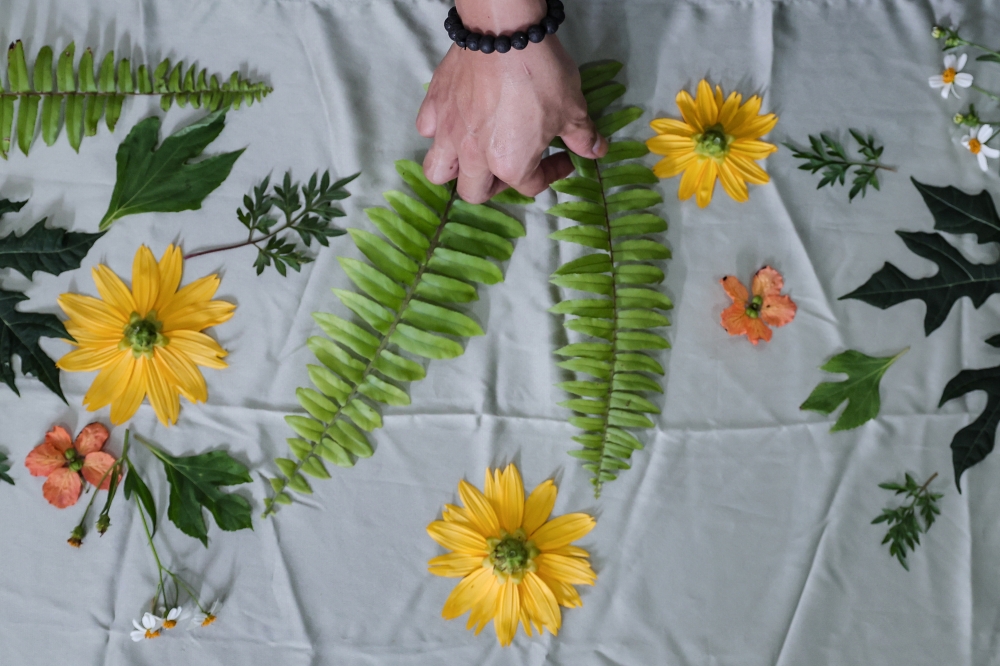
Although his creations are often mistaken for batik, he explained that the technique he uses is actually eco-printing, a process of producing patterns on fabric using leaves and flowers, without the wax-resist method commonly associated with creating traditional batik.
He said the idea developed after studying techniques introduced by Australian textile researcher India Flint, who is known for using natural materials in fabric art.
“From there, I conducted my own research on suitable leaves, flowers and fabrics (that can be used for eco-printing). I also learned about tannins in leaves, which help produce natural colours,” he said when met recently at his home in Taman Maju Emas here.
He explained that not all leaves produce colour, but each still leaves an impression, either through tonal variations or silhouette-like shapes on the fabric.
He mainly uses eucalyptus, castor and ketapang leaves, as well as flowers such as hibiscus, sunflower and cosmos, each producing different results depending on their natural properties.
“The eco-printing process is meticulous and time-consuming. The fabric must undergo pre-treatment by soaking it in water containing substances such as ferrous sulphate, zinc or aluminium sulphate.
“After that, the leaves and flowers are arranged on the cloth, which is then rolled before being steamed for at least two to three hours to ensure the colours are fully absorbed,” he said.
He added that the temperature and natural materials used play an important role in determining the final outcome, including achieving darker tones like black, which require high tannin content or repeated dyeing.

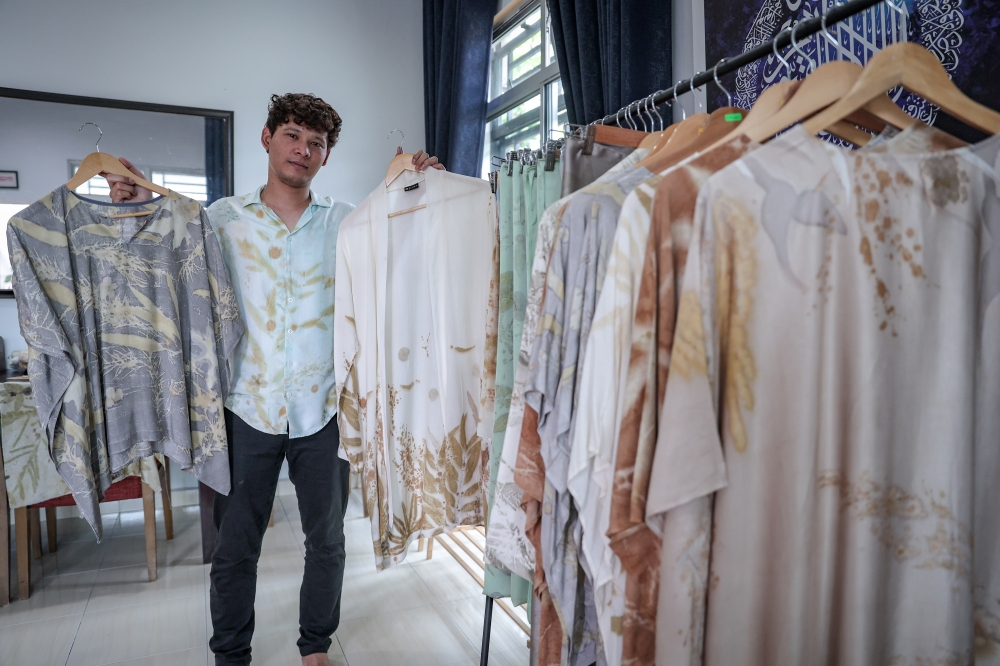
Misbaahussalam is able to produce between six and 12 pieces of fabric a day through the eco-printing process. The fabrics are later sewn into clothing, tudung, cardigans and shirts. He also offers silk fabrics with eco-prints. His products are priced between RM50 and RM400 each, depending on the type of material used.
Misbaahussalam said his products are marketed directly at craft events and festivals, as well as at popular tourist locations such as Central Market Kuala Lumpur, with customers comprising both locals and foreigners.
Sharing a memorable milestone in his entrepreneurial journey, he said winning a category (‘Kemasan Lembut’) in the ‘Piala Seri Endon 2023’ batik design competition remains one of his proudest achievements.
“The prestigious competition, which brings together fashion designers, artists and batik entrepreneurs from all around the country, was an incredibly valuable experience for someone still new to the industry,” he said.
Despite gaining increasing recognition, he admitted that challenges remain, particularly in terms of capital and facilities such as a workshop and production equipment.
“My initial startup cost came to around RM10,000 to RM12,000, covering fabric and equipment costs and basic operational expenses. I still don’t have my own premises, and that is one of the main challenges in expanding my business.
“I plan to scale up production, set up my own workshop and train more members of the local community here, including single mothers, in eco-printing. I am also working on combining natural dye techniques with other materials to achieve stronger colours while remaining environmentally friendly,” he added. — Bernama


