


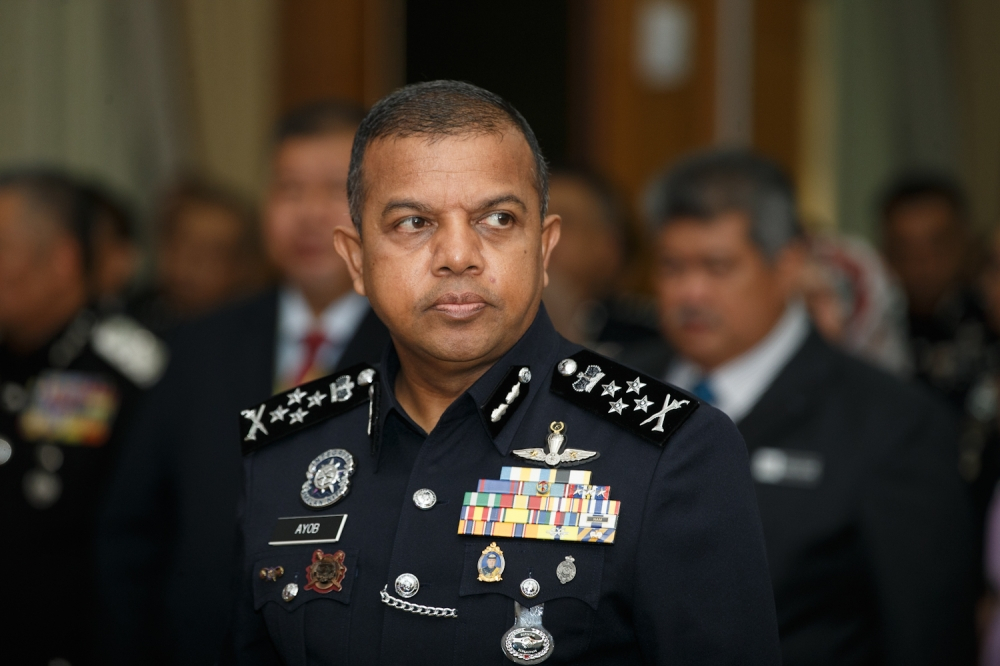


GEORGE TOWN, April 23 — Disciplinary action was taken against 1,429 police officers and personnel between January and December last year, said Deputy Inspector-General of Police Ayob Khan Mydin Pitchay.
He said actions taken ranged from warnings (419 cases) and fines (211 cases) to deferred salary increments, salary reductions, demotions, and dismissal.
“Out of that, 134 were dismissed from service,” he said in his opening speech at the Forum Perdana Crime Consciousness And Public Safety (CCPSS) at St Giles Wembley Hotel here today.
He added that the misconduct included corruption, extortion, causing injury, and drug-related crimes.
“That is why I emphasised earlier that we will take firm action and will not compromise on any misconduct involving police officers or personnel,” he told reporters.
Earlier, in his speech, he said firm enforcement against misconduct was necessary to preserve public confidence in the police force.
“We cannot deny that there is misconduct among police officers and personnel, maybe only a few, or 0.01 per cent, but the impact is significant,” he said.
He acknowledged that misconduct within the force should not be dismissed as isolated incidents, and must be dealt with thoroughly and consistently.
He said integrity remains the foundation of trust in any institution, particularly enforcement agencies entrusted with public safety.
“We can have experience, resources, and funding, but without integrity, all of that has no value,” he said.
Ayob Khan said misconduct could no longer be hidden, unlike in previous decades, due to social media in a modern society.
“Today, one mistake can be recorded, shared, and viewed not only across Malaysia but around the world,” he said.
“This responsibility becomes even greater for those holding senior positions. The higher the rank, the greater the trust. This includes national leadership,” he said.
He said this trust cannot be compromised and that there should not be external pressure to influence how government agencies, especially the police, carry out their duties.
“Government agencies must be allowed to operate within established SOPs, laws, and regulations,” he said.
He added that those in high-ranking positions may face many temptations.
“Greater authority often brings greater tests,” he said.
He said integrity is not limited to corruption alone, but also includes abuse of power, failure to comply with procedures, negligence, and disciplinary violations.
He said the police force is strengthening anti-corruption measures through its internal anti-corruption prevention strategy, aligned with the Royal Malaysian Police integrity framework and the National Anti-Corruption Strategy.
Ayob Khan said the strategies alone were insufficient without consistent implementation.
“Plans and policies are meaningless if action is selective or there are inconsistencies in taking action against misconduct,” he said.
He added that members of the public now have multiple channels to report police misconduct, including through the Integrity and Standards Compliance Department (JIPS) and the Independent Police Conduct Commission (IPCC).
“Members of the public can choose whether to lodge complaints with JIPS or directly with IPCC,” he said.
He also said collaboration between police, non-governmental organisations, and the public in preventing crime is important.
He said Malaysia’s police force comprises around 130,000 officers and personnel nationwide, so cooperation with communities is essential.
“We cannot be everywhere at the same time,” he said.
Ayob Khan said organisations such as community groups could act as a bridge between police and society by sharing information and improving trust.
He said cooperation with NGOs and community groups would enable preventive action, instead of the police only reacting to crimes.


