


SINGAPORE, Nov 8 — The term Impressionism immediately evokes images of sun-dappled scenery and flowers painted in pastels.
However, a walk through the Into the Modern: Impressionism from the Museum of Fine Arts, Boston in the National Gallery Singapore reveals a story that is more than just about beautiful colourful sceneries, but a narrative of how the French artists captured moments in a time when modernity began to change the world in the late 19th century.
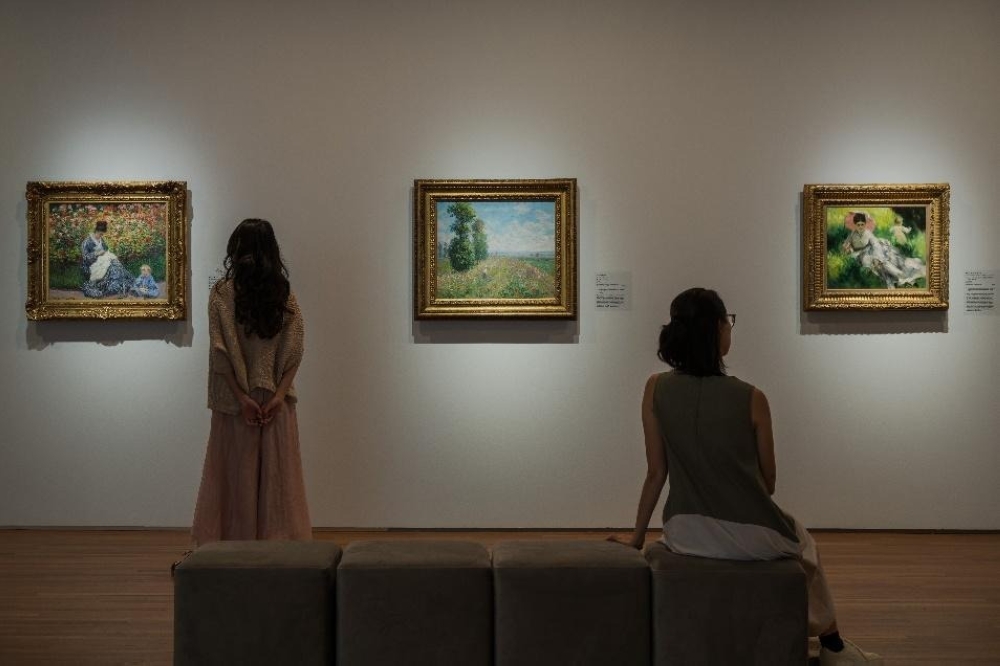
Impressionism was often attributed to renowned artists such as Claude Monet, Pierre-Auguste Renoir, Édouard Manet, Paul Cézanne, Berthe Morisot and Edgar Degas.
However, the curatorial narrative put together jointly by the National Gallery Singapore and the Museum of Fine Arts, Boston, offers a fresh perspective of how Impressionism is not only a showcase of how the artists transformed the way light and colour interacted with Nature but also captured moments in time from rural labour to urban transformation to shifting gender roles.
The exhibition, opening on November 14, features more than 100 artworks by 25 of the Impressionist movement’s key artists, including 17 paintings by Claude Monet.
The paintings are organised into seven thematic sections that span three gallery spaces, taking visitors on a journey through time to a period when mid-19th century artists captured the rustic beauty of Nature amid rapid changes of industrialisation up to a time when modern life was painted in all its vibrancy and finally, a look at how Impressionism is so close to contemporary times with artists being inspired by compositions presented in photography and the discovery of print-making as an art form.

Lead curator of the exhibition, Phoebe Scott, said they tried to weave two main aspects of Impressionism in the exhibition—the visual innovation of the artists’ work and the radically changing modernity that inspired it.
“In this exhibition, you’ll see that we’ve used large scale archival reproductions, or archival projections, to try to allow visitors to connect to that idea of modernity, and perhaps even recognise some features of it, things that we still experience in the world today, that are still meaningful and resonant as we come to understand the modern life,” she said.
The exhibition opens with Seeking the Open Air and the very first piece to pop out against a stark black background is Monet’s Meadow at Giverny (1886).
“We open the exhibition with this quite dramatic work by Claude Monet that was part of a decade of exploration by Monet in the 1880s,” she said.
She said there is no discernible subject matter as it is just a simple field but Monet had made the vibrant pulsating colour the subject of the work.
“We decided to emphasise this work as a starting work because of this visual radicalism,” she said.
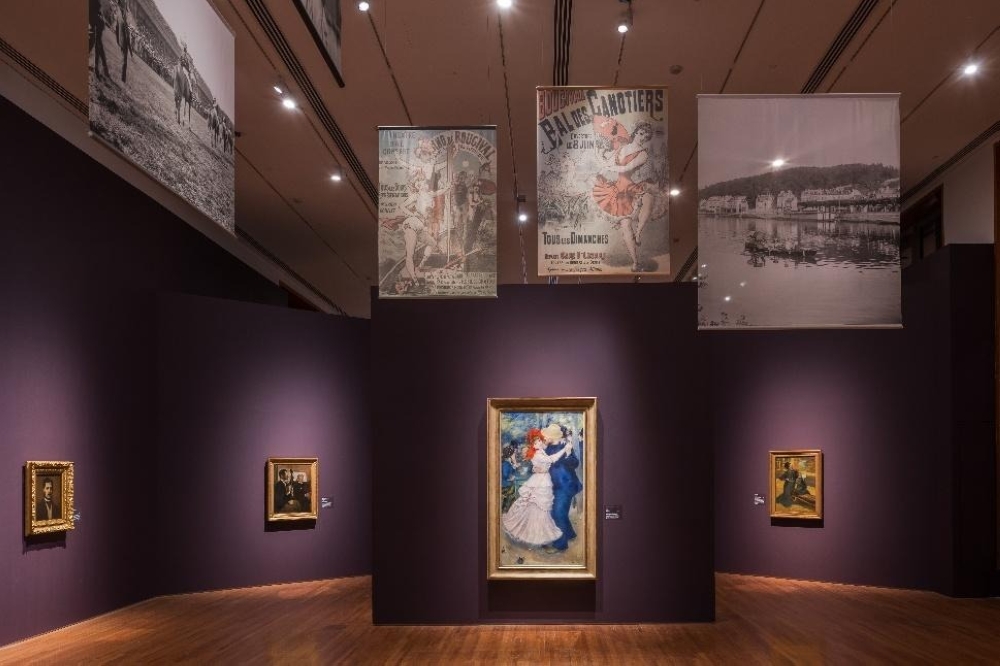
This is contrasted with his earlier works, on another wall, that were painted 20 years earlier, in 1863, titled Woodgatherers at the Edge of the Forest.
Scott said tones, the colours and the composition were more conventional as Monet was still finding a way to his later styles for which he is known.
Works by other artists in Seeking the Open Air feature similar depictions, that of forests and farmlands, therefore laying the foundations for the plein air (open air) approach that was later embraced by the Impressionists.
Among the artists is Théodore Rousseau who successfully petitioned the French government to protect parts of the Fontainebleau forest as a national preserve.
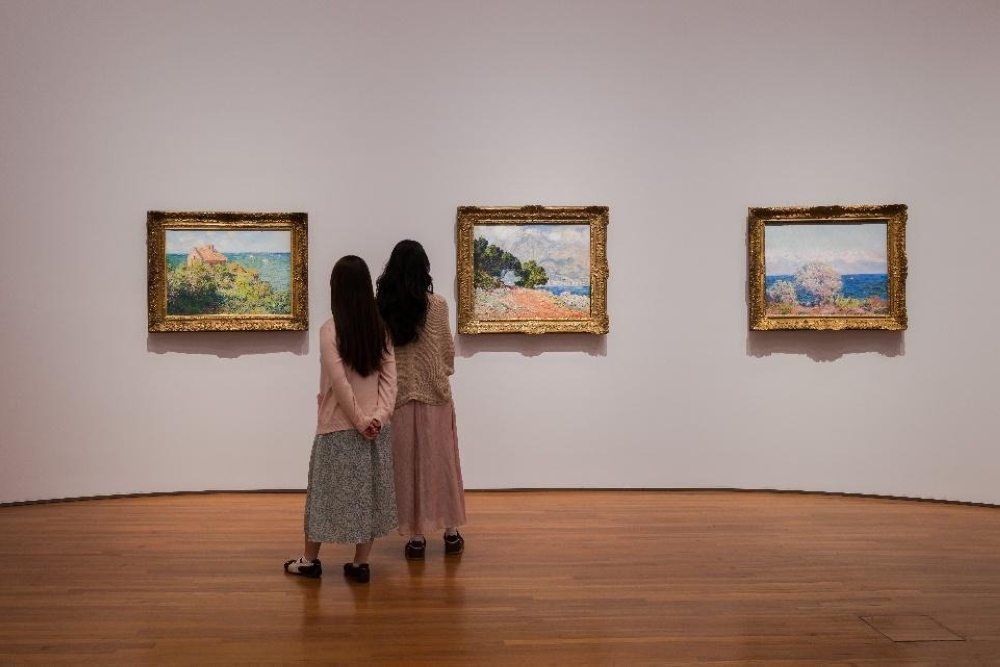
This leads on to the next theme, Plein Air Impressionism, when artists created plein air paintings with a twist—artists like Renoir and Monet were capturing the shifting light and fleeting moments of everyday life with bright palettes and expressive brushwork as a reflection of the dynamism of modernity.
As the artists started to include more modern life scenarios, their work is showcased in the next theme Labour and Leisure on the Water.
Late 19th-century posters featuring Normandy’s coastal resorts as tourism spots for holidaymakers hang down from the ceiling, underlining the ways the artists were capturing the scenes through a different lens—that of glittering seascapes, expanding railways, steamboats and ports—and the changing relationship between people and places.
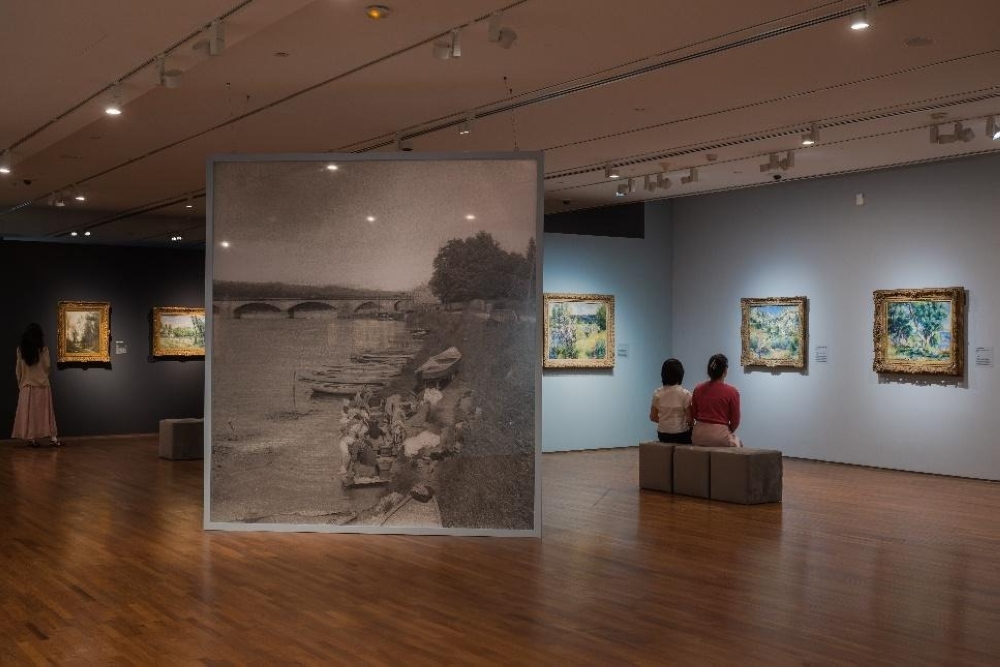
In the following sections, paintings are cleverly contrasted against black and white photographs to point out how Impressionist artists were also inspired by the compositions presented through photography while artists such as Camille Pissarro illustrated his strong belief in social equality and the dignity of labour through his works featuring rural labour and scenes of everyday work.
Standing out among the sweeping sceneries and vibrant streets, are portraits of Victorine Meurent, who was known as Édouart Manet’s favourite model.
Manet’s depictions of her are displayed alongside her self-portrait, giving visitors a different perspective of the model as an artist.
In Reimagining the Commonplace, a realistic still life of roses in a vase stands out amid the broad strokes of Impressionist artworks.
These are Roses in a Glass Vase and Roses in a Vase by Henri Fantin-Latour who was considered the undisputed master of the rose.
This section looks at how still life became a subject for the Impressionists and their peers.
The exhibition concludes with Monet—Moment and Memory that features nine iconic works by Monet and the final showcase is film footage of Monet, shot in 1915, for a glimpse into the artist at work.
“This is also to show us how close the Impressionists were to modern times and their connection to the beginning of the modern, cinematic age,” Scott said.
Impressionism is often associated with paintings but several artists in the group, namely Pissaro, Degas and Mary Cassatt were also experimental printmakers.
They treated printmaking as a form of expression and each print was considered as artworks as they signed and numbered each print.
Linking the art of printmaking and etching from the Impressionists is a case study of Singaporean artist Lim Yew Kuan who was known for his woodblock prints in the 1950s.
The exhibition also explores the legacy of Impressionism in South-east Asia through three reflective zones and interactive learning stations called ARTeliers.

The first is a specially commissioned animated film that traces the rise of plein air painting in Vietnam and this is followed by an interactive section featuring works by Singaporean artist Georgette Chen like Singapore Waterfront (1963) and the art supplies she used.
The interactive section, set in a space facing tall windows overlooking the greens and Marina Bay Sands in the distance, allows visitors to try their hand at drawing what they see through the windows.
The third ARTelier features Lim’s iterative prints.
National Gallery Singapore director and chief executive officer Eugene Tan said the exhibition not only connects Impressionism with contemporary conversations about society, environment and urban life but it also explores its influences in South-east Asia.
“Presenting the exhibition in this way highlights the gallery’s role in facilitating dialogue that connects the art of Singapore, South-east Asia and the rest of the world,” he said.
Into the Modern opens on November 14 and ends on March 1, 2026.
In conjunction with the exhibition, the gallery has also partnered with various brands and organisations to create Impressionist-inspired programmes such as An Impressionist-Inspired Afternoon Tea in Fairmont Singapore and a Pierre Hermé Paris pop-up at the gallery to unveil Into the Haute Pãtisserie.
There will also be a curatorial roundtable, lectures, performances, workshops and tours of the exhibition.
For ticketing enquiries and details on the programmes, visit the gallery’s website here.


