


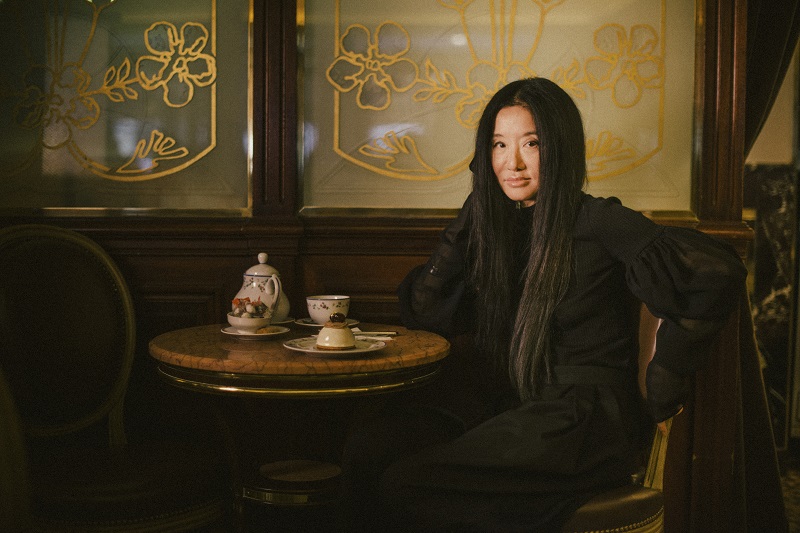
PARIS, March 2 — It is 1969. Vera Wang is 19. Her competitive figure skating career is ending, and she is studying art history at the Sorbonne during a junior year abroad. She is walking down the street with her mother. Both are dressed in their favourite designer of the moment: Yves Saint Laurent. A tan belted raincoat that fell midcalf, brown Céline boots and a Hermès Kelly bag for maman, and a navy blue peacoat, grey flannel slacks and a turtleneck for Vera.
“That was the first time that I really became Parisian,” Wang said recently, drinking tea at Chez Carette on the Place du Trocadéro.
The designer was back in town because this week she became one of a handful of US designers to be made a chevalier of France’s Legion of Honour, the country’s most elite decoration for contributions to the glory of France (peers who have received the honour include Ralph Lauren and Oscar de la Renta). At the end of the ceremony, which fell on the first day of Paris Fashion Week, she showed her fall 2017 collection in a short film online. She calls it an ode to Paris.
“When I heard about the honour, I think I was actually in shock, because I didn’t grow up as a French designer, I’m an American designer,” she said. “But I did grow up with an integral part of my life being attached to Paris and France. I have had five lives here. Maybe seven.”
Wang, who grew up in Manhattan, first visited Paris at age six. Her parents bought her a pair of charcoal-grey patent leather Mary Janes. “I looked at my feet and I was just mesmerised by them,” Wang said.
“It was my first feeling of being intrigued by fashion,” she said. “By things you wear. I suddenly just had this awakening or something.”
Fast-forward to her junior year. Wang was dating a fellow professional figure skater, Patrick Péra, who was on the French national team. She would buy fragrances at Guerlain on the Champs-Élysées, see the movies at Toreador and go clubbing at Chez Castel, a nightclub owned by French football star Jean Castel.
“I was not a member; my boyfriend was,” she said. “It was so sophisticated. You would see Alain Delon there. You would see Jean-Paul Belmondo.”
She added, with some understatement, “I did not live the life of a typical exchange student.”
She spent her days strolling on the Avenue Montaigne, Rue du Faubourg Saint-Honoré and Avenue Victor Hugo. She would shop at Kenzo, right near the Place des Victoires in the Second Arrondissement, then pop into the tiny Louis XIV restaurant nearby for lunch. “I looked for it, but it’s gone,” she said.
That year, she lived on the Rue Spontini, down from what was Yves Saint Laurent’s shop. Her mother would visit, and she “would see him coming to work at 10 at night”, Wang said.
She continued: “My mother, who always loved fashion, would say: ‘That boy is too skinny. He works too hard’.”
When her father visited, he would stay at the Plaza Athenée. “He’d call it the most expensive coffee shop in the world because he’d have a hamburger and a cup of coffee,” she said. He bought her a white cotton double-breasted “smoking”. She loved it, then spilled red wine on it by accident. “I remember crying,” she said. “I don’t usually cry over clothes. That’s how much fashion had come to mean to me by then.”
Later that year, Wang met a woman who worked as an editor at Paris Vogue. “I just went crazy, and I said, ‘When I finish college, I want to be that’,” Wang said. She did, ultimately spending 16 years as an editor at Vogue in New York.
Then, in 1982, when she was 33, she left Vogue and moved back to Paris for a year to catch her breath. “Paris has always been my escape,” she said. She bought an apartment in the 16th Arrondissement (since sold). “It’s my ‘hood,” she said.
She went for long runs in the Bois du Boulogne, dated an art gallerist and reinvented herself. When she returned to New York, she segued into working as a design director for Ralph Lauren. In 1990, she opened her own bridal boutique, and then started ready-to-wear. Which is how she ended up back here.
“It takes great courage to just live when you’ve kept yourself busy,” Wang said. “My own country has always been about career: Getting it done, always worrying but not wasting time, trying to be efficient. Paris taught me how to live.” — The New York Times


