


NEW YORK, Dec 11 — At its best, art is an essential source of comfort, wisdom and hope — and this past season was no exception. Despite our tragically driven society, museums, galleries and alternative spaces often reflected a softening of divisions and hierarchies with exhibitions that were less white, less male or less doctrinaire in historical view. They gave every sign that the art out there, past and present, is still richer and more various than we can ever know.
1. The Museum of Modern Art continued to redefine its profile as perhaps the world’s leading repository of modernism, disrupting its vaunted linear narrative with a belated overview of Francis Picabia’s fertile zigzagging (through March 19). A stunning show of Edgar Degas monotypes gave his towering achievement a more modern tilt. The Bruce Conner retrospective deviated from the museum’s New York-Europe axis, while German artist-diva Kai Althoff challenged every aspect of the curatorial process — installation, catalogue, back of the house — with a chaotic yet magical arrangement of art and collectibles that seemed staged inside a big white ark.
2. The Guggenheim, which has presented solo shows by artists from non-Western regions consistently during the last decade, struck a blow for a broader Western modernism with a magnificent survey of Hungarian constructivist Laszlo Moholy-Nagy, who seemed never to have met an art or design medium he couldn’t advance.
3. The Jewish Museum unearthed the life and work of architect-designer Pierre Chareau (1883-1950), previously known mostly for a single modernist masterpiece, the Maison de Verre in Paris, in a first American retrospective framed in a snappy design by Diller Scofidio & Renfro.
4. The Whitney Museum once more flexed its immense fifth floor with the triumphal “Open Plan”, which gave five artists working in markedly different media the run of the entire space for up to two weeks. Jazz innovator Cecil Taylor; painter and musician Lucy Dodd; filmmaker Steve McQueen; earth artist Michael Heizer; and Andrea Fraser, a skilled manipulator of human consciousness, all outdid themselves, teaching us about life, space and the exhibition as form.
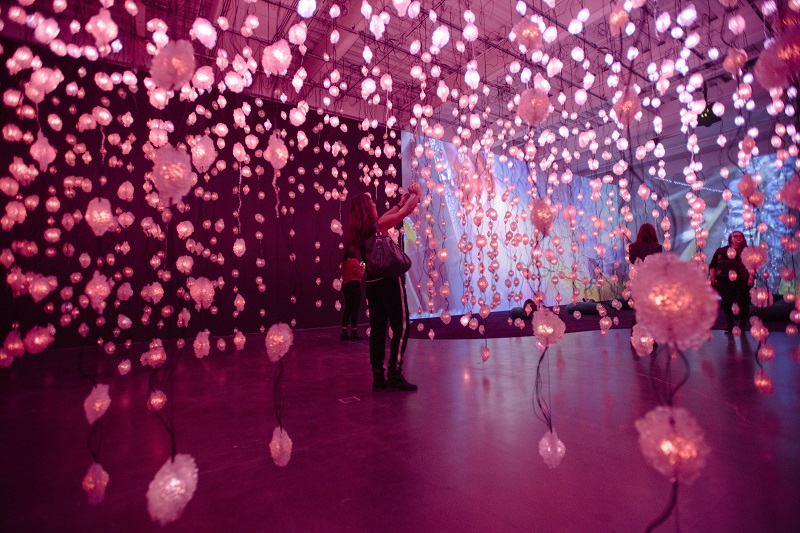
5. The New Museum also reshaped the definition of art and those who make it with “The Keeper” and gave monographic shows to painter Nicole Eisenman and digital shaman Pipilotti Rist, two of our moment’s best artists who happen to be women.
6. Brooklyn narrowed the gender gap with shows of the sculptures of Beverly Buchanan and the beyond photorealism paintings of Marilyn Minter, whose work signals that the art of the 1980s is due for an overhaul. (The Buchanan runs through March 5, the Minter through April 2.)
7. At the Met Breuer, that signal emanated powerfully in the slightly baggy retrospective of the painter Kerry James Marshall, whose 30-year career has brought craft, art history and the history of black life in America into a thrilling new alignment. It reminded us that authentic art is identity art; some is just more overtly so. The big Met also devoted a rare full-dress retrospective to a historic artist of the so-called fairer sex with “Vigée Le Brun: Woman Artist in Revolutionary France,” revealing the skilled portraitist of Marie Antoinette and a woman who had a second career after the monarchy fell.
8. The Bard Graduate Centre presented “Artek and the Aaltos: Creating a Modern World,” a handsome, densely installed, freshly researched landmark exhibition about the great post-war Finnish designer Alvar Aalto that highlighted his debt to Aino Marsio-Aalto, his wife and a designer in her own right.
9. Alternative spaces illuminated new or unknown art in invaluable ways. Seen at Participant Inc., the all but unknown early paintings, painted sculptures and installations of filmmaker Ellen Cantor were the great surprises of a series of shows about her work. White Columns revised the 1980s further with the first American exhibition of British painter Denzil Forrester, whose improvisational depictions of people at jazz clubs operate in the gap between Matisse and Archibald Motley. At Artists Space, a newcomer, Cameron Rowland, revived and revised the idea of the ready-made by using a group of convict-made objects to link the history of slavery to contemporary prison labour.
10. Commercial galleries sometimes seemed to be functioning like alternative spaces themselves. At Gavin Brown’s Enterprise, filmmaker Arthur Jafa unveiled “Love Is the Message, the Message Is Death,” which weaves existing music and mostly found footage into a wrenchingly beautiful meditation on black life, family and culture in America — a seven-minute-long life-changer through December 17. At Luhring Augustine Bushwick, Glenn Ligon’s multi-screen video deconstruction of Richard Pryor’s brilliant stand-up (in the film Richard Pryor: Live on the Sunset Strip) resulted in a masterpiece. And the Clearing, also in Bushwick, introduced French dancer-artist-activist Lili Reynaud-Dewar, whose videos forge a new relationship among architecture, movement and the naked body — here tinted red in homage to Matisse’s “Dancers.”
11. On the West Coast, the Los Angeles County Museum of Art had something of a banner year with an exhibition of Catherine Opie’s “O Project,” portraits that document the love and dignity of people who defy narrow definitions of sexual normalcy; an exhaustive retrospective of Robert Mapplethorpe (in collaboration with the Getty) and a survey of horror movie polymath Guillermo del Toro. At the Museum of Contemporary Art, Los Angeles, you can still see “Morning: Chapter 30,” the first retrospective of R.H. Quaytman’s austere merging of painting, photography and location, and “Mickalene Thomas: Do I Look Like a Lady?” the artist’s latest excursions into black female identity carried out in photography, video and exuberant 1970s interiors. (Both shows run through February 6.) One of the year’s most memorable exhibitions was the Berkeley Art Museum’s “Architecture of Life”, which inaugurated its outstanding new building while roaming from prehistoric cultures to the present. It was a profound meditation on form, functional and otherwise — the ultimate source of art’s essential comfort, wisdom and hope. — The New York Times


