


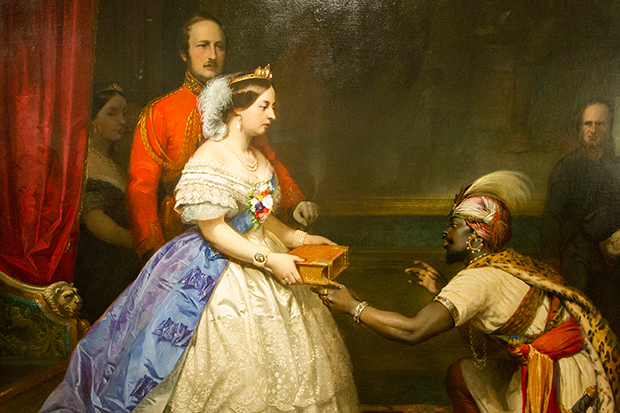


SINGAPORE, Oct 9 — Today’s generation, born long after independence from the British Empire, has no memories of the colonial era, beyond what is recorded in history books. Yet the legacy of the colonial experience lives on in almost every facet of our life today, from our language to which side of the road we drive on.
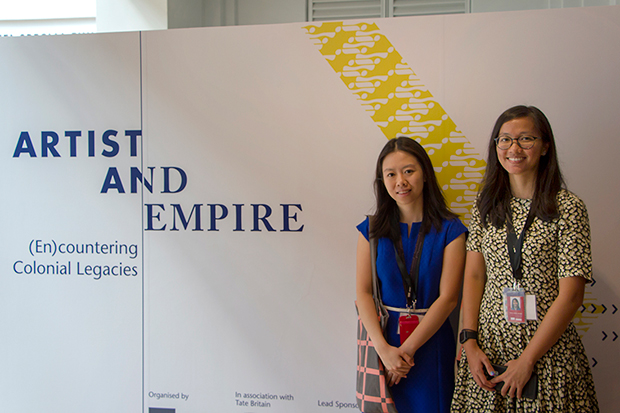
Recognising this gap in perspective, the National Gallery Singapore recently unveiled Artist and Empire: (En)countering Colonial Legacies, an exhibition presented in association with London’s Tate Britain. The Singapore show, which runs till March 26, 2017, will display over 200 artworks associated with the British Empire — both art produced in relation to the colonial experience and contemporary art in former colonies such as Australia, Brunei, India, Malaysia, Myanmar and Singapore.
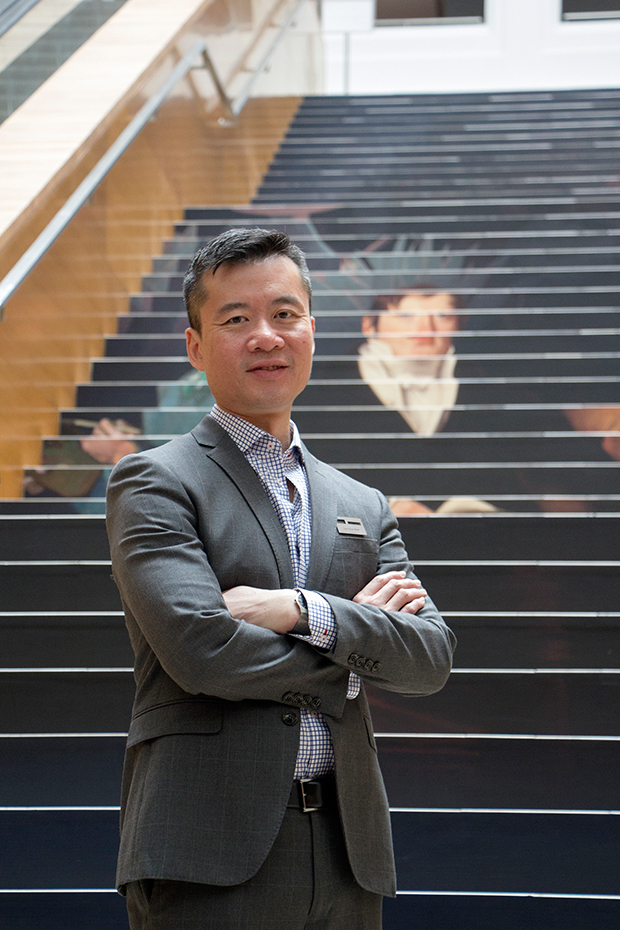
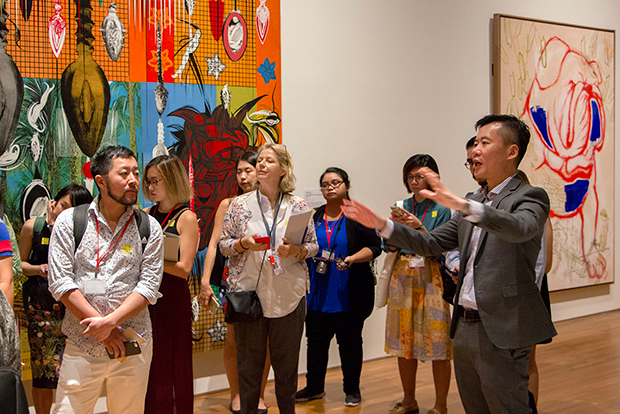
The exhibition is curated by Low Sze Wee, Director for Curatorial, Collections and Education, Melinda Susanto, Assistant Curator, and Toffa Abdul Wahed, Curatorial Assistant. According to Low, Artist and Empire opens up fresh perspectives on the region’s colonial heritage. He adds, “The Singapore show will offer visitors an opportunity to examine afresh our society today, and how we have built our sense of identity and place in relation to our past.”
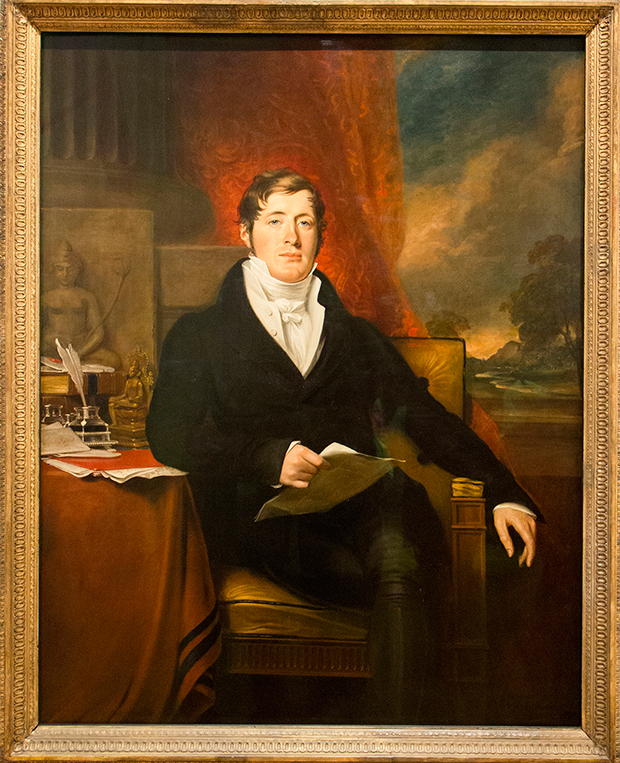
Art and Empire is divided into two clear narratives. The first section questions what the artworks reveal about our past and how they influenced our understanding of contemporary life. Perhaps the clearest juxtaposition of this is the pairing of Sir Thomas Stamford Bingley Raffles (1817) by George Francis Joseph with the installation Untitled (Raffles) by Singaporean artist Lee Wen.
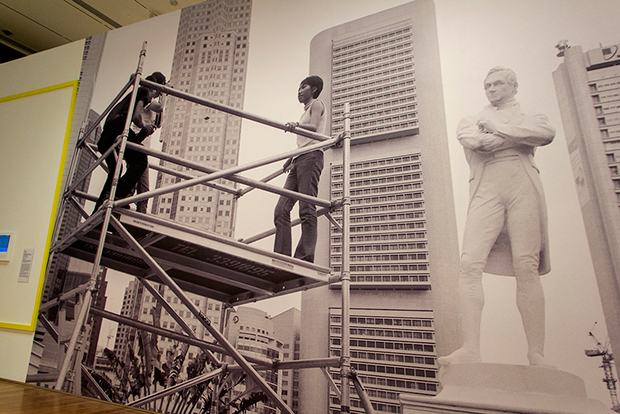
The former repositioned Raffles as a scholar, not merely an officer; the latter, built in 2000, allows the public to stand on a platform and approach the famous statue of Raffles on more equal terms.
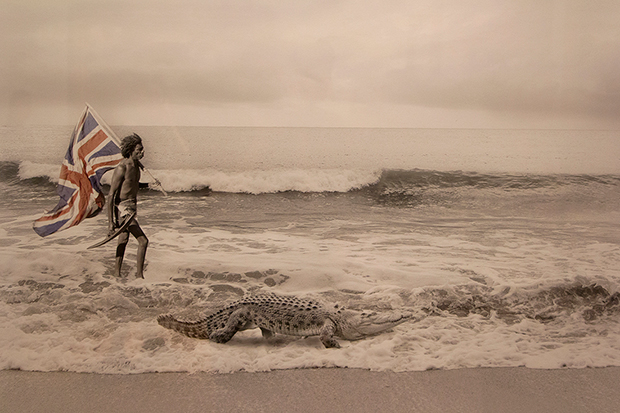
Similarly, Undiscovered (2010), a series of prints by Australian artist Michael Cook, rebuffs the old narrative of the British “discovering” Australia by having an Aboriginal man carrying the Union Jack or wearing the clothes of a British officer. Through this turn-around, Cook debunks the myth that the indigenous Australians were inferior as well as reminding viewers that the Aboriginal people had inhabited Australia for thousands of years.
In Malaysian artist Zulkifli Yusoff’s Hujan Lembing di Pasir Salak (2008), the motifs of falling banana flowers and spears highlight the futility of the assassination of J.W.W. Birch, the first British Resident of Perak in 1875; instead of ending the presence of the Empire in Malaya, it solidified colonial rule there.
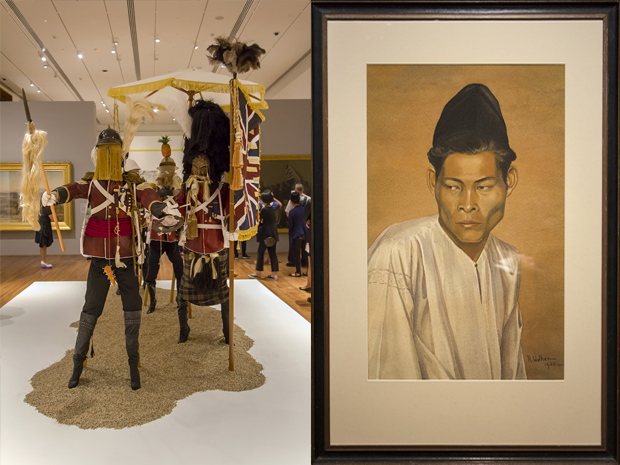
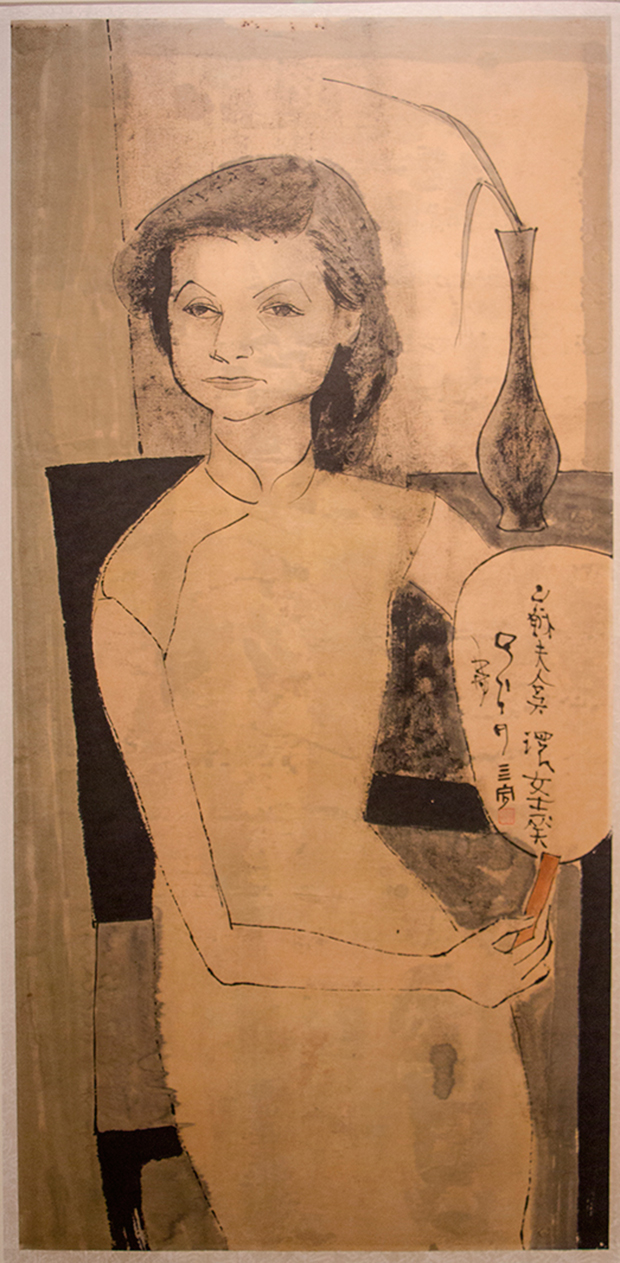
The second part of the exhibition investigates the artistic legacies resulting from the British Empire, including its decline. Examples of this exploration of identity include Ahmat (1930) by Richard Walker, which depicts a Malay man wearing a songkok, and Portrait of Khoan Sullivan (1959) by Cheong Soo Pieng, which marries Chinese ink painting techniques with a Cubist-style, grid-like background.
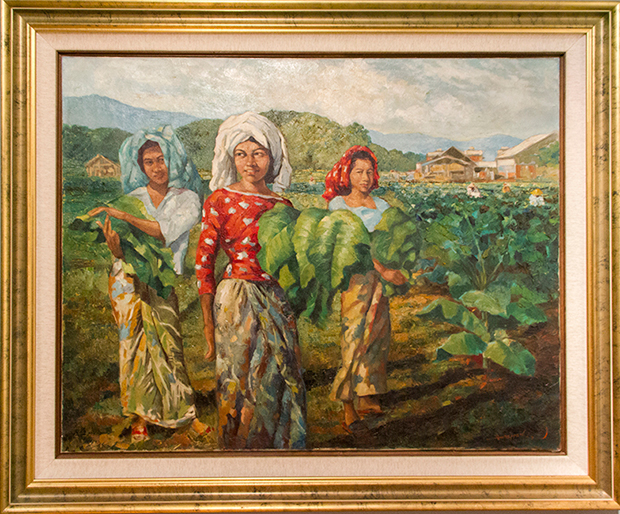
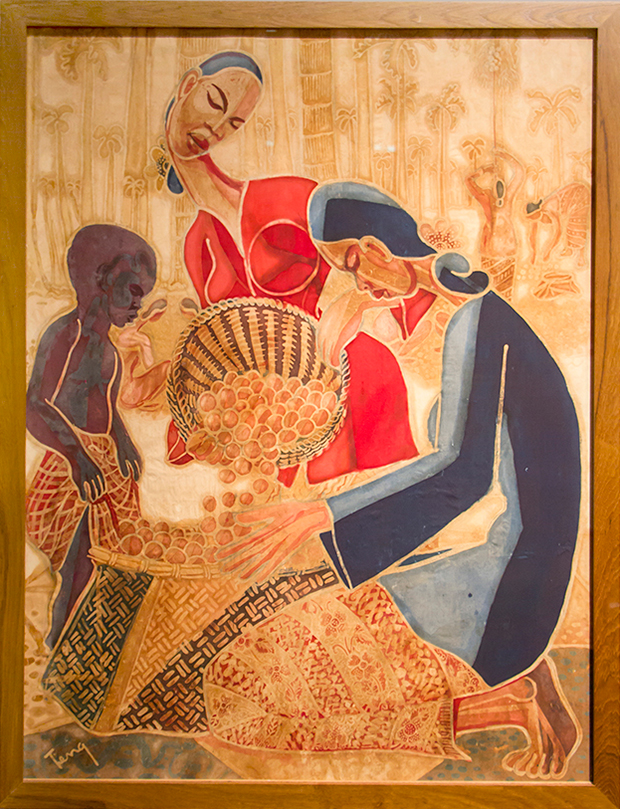
Susanto shares, “These artists were looking for local techniques and inspiration rather than Western ones. They did this through form and subject matter. Take the Two Malay Women and a Child painting by Malaysian artist Chuah Thean Teng. The image of them gathering fruit is created using the batik technique — very different from its traditional geometric and floral patterns.”
One of the challenges Low and his fellow curators faced was selecting from an overwhelming array of artworks and struggling with what to leave out. He recalls, “This was especially acute when we were looking at the modern art developments in India, Australia and South-east Asia. Each is an ambitious topic to cover in itself. Hence, in deciding between breadth and depth, we chose to focus on depth, by looking at one specific pre-independence art movement within each country.”
For some countries, they examined a range of artists such as Tom Roberts and Arthur Streeton from Australia. For others like India, they focused on one seminal figure such as Jamini Roy whose career encapsulated the diversity of the Bengal art movement.
“From our selection, we hope visitors will get a sense of how artists from the different colonies were motivated by similar concerns and impulses. For instance, in both Australia and Malaya, we see the coming together of local artists to organise themselves to travel, paint and later exhibit as a group.
“The Australian Impressionists gathered in Melbourne in the 1880s to paint their surroundings, and then held a ground-breaking exhibition called the 9 x 5 Impressionism show in 1889. Similarly, in the 1950s, four artists from Malaya decided to travel to Bali together. They held a Bali-themed show in 1953 in Singapore — which many have hailed as the beginnings of Nanyang art movement in Malaya.”
Outside of the galleries, visitors can also view two more related works in public spaces. The Statue of Queen Victoria by British sculptor Emanuel Edward Geflowski was originally commissioned by the Chinese community of Singapore in 1887, the year of Her Majesty’s Golden Jubilee. The marble statue was a means for the local Chinese to demonstrate their allegiance to the British.
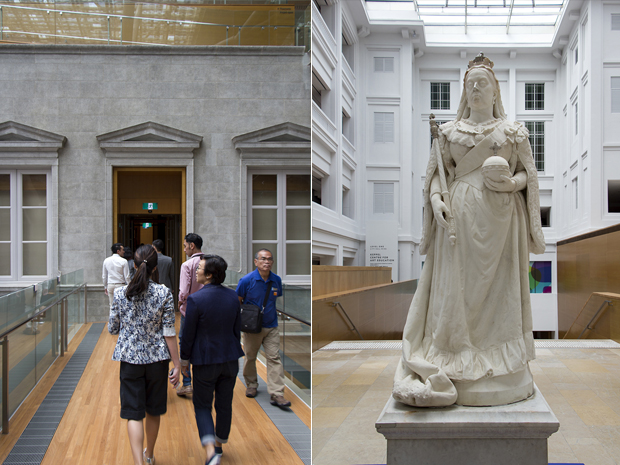
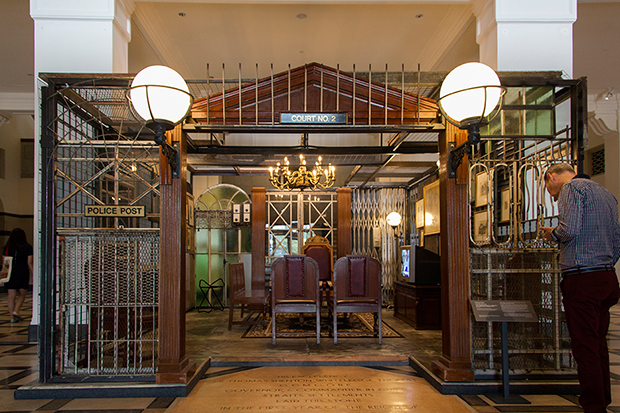
For a more contemporary take, Re:Looking (2002-2003), a mixed media installation by Malaysian artist Wong Hoy Cheong, flips history with a fictional narrative in which Malaysia had colonised Austria. A simplified version of his original has been constructed at the former Supreme Court Foyer using salvaged architectural fixtures from the colonial-era buildings that make up the present-day National Gallery Singapore.
In curating the exhibition, Low found the legacy of the British Empire to be a complex issue. He explains, “Whilst it brought about clear benefits, it also produced devastating consequences on many communities in the colonies. Art museums and their exhibitions cannot change the past. However, they have the ability to present artworks in ways that provoke deeper thinking and questioning — how did we arrive here at this point in time, and where do we want to head towards in the future, both as an individual and as a people?”
The philosopher George Santayana once said, “Those who cannot remember the past are condemned to repeat it.” Thus is the power of art: for us to gain a deeper understanding of our history and empower us to shape our future.
Artist and Empire: (En)countering Colonial Legacies
Singtel Special Exhibition Gallery, Level 3, City Hall Wing, National Gallery Singapore
1 St. Andrew’s Road, Singapore
October 6, 2016 till March 26, 2017
Admission is S$15 (RM45) for Singaporeans and S$25 (RM76) for non-Singaporeans
For more information on the exhibition, visit www.nationalgallery.sg


