

















SINGAPORE, June 29 — Professional fighters make it look so easy, throwing combination after combination and landing repeated barrages of attacks. However, that is a direct result of years of training and muscle memory.
For you to do the same one day, you must first understand the basics. In essence, every attack is made up of variations and combinations of six basic punches: the jab, straight cross, left and right hooks, and left and right uppercuts.
Used effectively with smooth, balanced footwork, these six punches can be combined used in succession to devastating effect. But first things first, let’s take a closer look at the six basic punches under the guidance of Ridhwan Muhamad, professional boxer, head coach, and co-founder of local boxing gym, Legends Fight Sport.
Power play
Throwing punches may seem simple, but to do so effectively requires one to be in a balanced position, and the key lies in having a proper fight stance.
“The basic orthodox stance (it’s the reverse for left-handed boxers) sees your left leg leading in front, and your right leg behind. Both legs should not be too far apart – shoulder width is just nice. Your legs need to be slightly bent and your weight rested on the balls of your feet,” explained Ridhwan. As for the hands, the 28-year-old shared that they should be held up over the chin to protect the face.
“Arm strength is great, but real power comes from the feet. It all starts from your feet, where you have to be balanced. This allows you to generate power from the ground through to your waist and activate your entire upper body.
“Power comes with technique, knowing when to apply it, and how to apply it well. That’s what boxing is about. Everyone can know how to punch, but a true boxer knows how to use his punches effectively,” explained Ridhwan, who is currently training for his third professional bout, and first one on home ground in Singapore. His current professional record stands at 2-0 (1 KO).
The jab
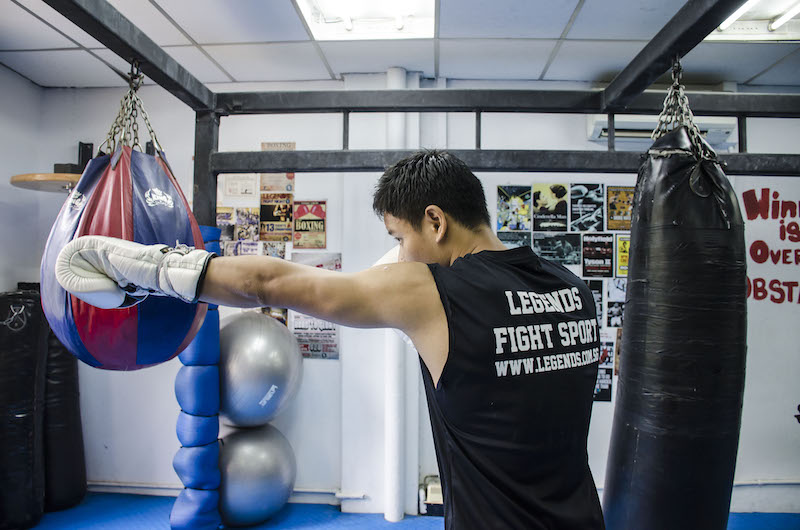
“A good jab must be hard and stiff,” explained Ridhwan. And for maximum speed and effectiveness, it should travel in a straight line from where your fists are and hit straight at your target.
“When throwing it (in orthodox stance), your right hand has got to be up protecting your face. Many people have the tendency to drop the non-throwing hand,” he cautioned.
Like all attacks, you’d want to maintain the element of surprise as well. “Keep the elbows close to your body so as not to telegraph the punch. Also, do not pull back your hand before you throw the punch — it does nothing for power.”
Arguably, the key punch that every boxer must master, “the jab helps set up punches and combinations,” said Ridhwan. “It’s also a good way to gauge distance and range. It helps to ‘test the water’ and allows you to assess your opponent based on how they react to it. That is a way to pick up on their weaknesses.”
The straight cross
The traditional power punch, the cross is usually thrown with the master hand.
And while there are many ways to throw the punch, Ridhwan suggests throwing it with your feet, and at the same time twisting your hips to rotate your trunk as your right hand goes out. Not only is that more fluid, it allows maximum power to be generated and quickly too.
“It can be the most powerful punch in one’s arsenal, but it really depends on what each boxer wants to work towards.”
Left and right hooks
Simply put, hooks are punches you throw from the side. The left hook is the more common of the two, and is often deployed against opponents who drop their hands, leaving their head exposed in the process.
“Some people prefer to throw their hooks with their elbows parallel to the ground, others may prefer to throw them in a fast semi-circular motion. Throwing a hook with speed or power is a preference,” highlighted Ridhwan.
As for the right hook, Ridhwan details that because of the way the orthodox stance is, it’ll require one to be in closer range to the opponent to throw it effectively. “Should you miss, you can be vulnerable to counter-punches,” he said.
Executed properly, hooks can be very difficult to see coming. In most cases, with one’s guard up, the focus tends to be on the punches that come from the front. With fatigue, one may overlook attacks that come from the side. “You may be tricked into keeping your hands up, and in the process, you leave the sides of your body open.“
Left and right uppercuts
These punches come from a low angle when one twists to the side, and powers the fist upwards in an arc to either the face or body.
“To throw a good uppercut, you have to be close to your opponent,” said Ridhwan. And when you throw them, he cautions that the other hand must be protecting one’s exposed face as it’s a common habit to leave the face unguarded and the chin vulnerable.
To throw an uppercut well, it has to come from a balanced state — which is where footwork and maintaining one’s fight stance is imperative. “When throwing an uppercut, bend your knees a little more, and then throw it from where your face is so as not to telegraph the punch,” shared Ridhwan. Think of this as a short crouching motion before springing upwards, leading with your punch.
Training tips
Besides shadow boxing and working your punches on the heavy bags, weights and resistance bands can be used for training.
For anyone looking to work on the speed of their jabs, work on your jabs while holding one kilogram weights when shadow boxing. Throwing them fast while maintaining the proper technique will help build up endurance. The same can be applied for straight crosses.
For hooks, resistance bands can be used by tying them to a pole and making use of the resistance to work on the technique, power and pace of both left and right hooks. The same applies for uppercuts, except that in this case, the resistance band is attached lower.
“If you want to increase power, you will need to use more weights,” added Ridhwan. “Kettle bell swings are one of the exercises that can help you learn how to transfer power from the lower to upper parts of the body for an effective uppercut.” — Global MMA News/Reuters