








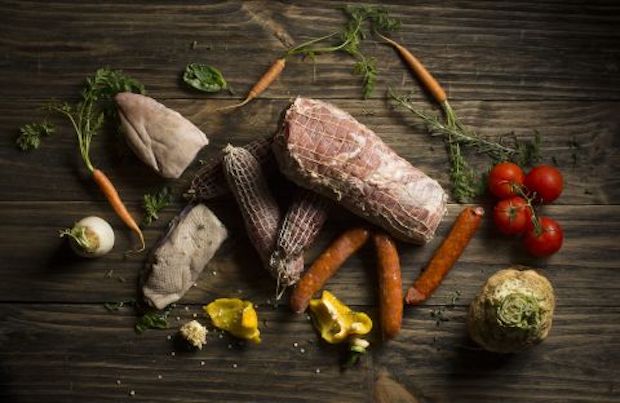


SINGAPORE, May 6 — Say the word “curing” and one thinks of meats hanging in freezing-cold sheds for months, a farmer or homesteader lovingly tending to the product. The end result would be a delicious piece of cured meat that one could slice up and serve on a charcuterie platter.
Now, Drew Nocente, executive chef at Salted & Hung, wants to create a charcuterie revolution by teaching Singaporean foodies the art of curing meat. He wants them to know that they, too, can make cured meat products easily in their kitchens. (No shed required.)
The 36-year-old’s modern Australian eatery took the Best New Restaurant award at the World Gourmet Summit’s awards for excellence ceremony in March. You could call him a “master of meat”, since he has been known for breaking the boundaries of the “meat genre”, including cuts such as offal, tripe and even heart on his menus.
“I think people are scared to cure meats (at home) because they think it’s too technical and dangerous,” said Nocente, who is running a series of charcuterie masterclasses. His first session is today, and is fully booked.
“Curing is (almost) a lost art... I want to educate people on it,” he added.
Curing is simpler than you think — “you just need the know-how”, said Nocente. Growing up, the Italian-Australian helped to cure on his family’s farm, located near Brisbane.
Curing requires cold temperatures of around 5°C. But other than that, “a mix of nitrates and salt are your main ingredients”, he said.
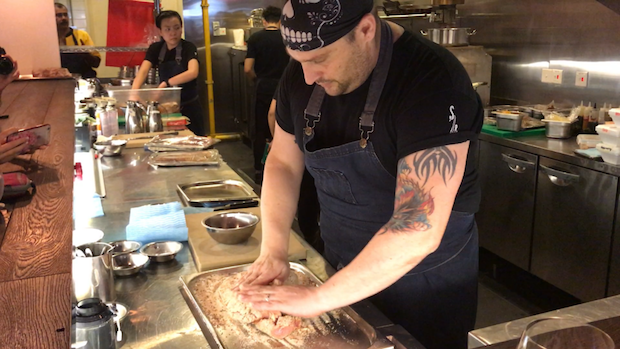
He personally uses Cure #2, which is a pre-packaged mix of both. It helps kill botulism, a harmful bacteria found in food. It can be found online on websites such as Amazon.
And while salt is part of any curing process, it also gives cured meat its texture.
“Without the salt, (the flesh) won’t stay firm... The salt draws out moisture,” Nocente said.
Of course, the other important ingredient is the meat. Nocente recommends heading to a good butcher such as Huber’s Butchery. Make sure your meat is fresh — no moulds on the flesh, please. “Anything green, yellow or black is basically poisonous for you,” Nocente said. When curing, the meat will take on a “powdery white mould”, which one sees on sausages and salami. Do not panic — that is fine.
Your other tool would be a refrigerator.
“Temperature control is the one bit that is the most important after curing,” he said.
Meats like lardo (pork fat) can be kept in a normal fridge but coppa (the muscle of the pug behind the back of the head, at the top of the shoulder) must be kept in a fridge with temperature and humidity control. Ditto for lamb and pork legs, as those require a higher humidity of about 65 to 75 per cent. Normal fridges tend to run drier, and so a wine cooler is often the best choice for home-cures.
Wine fridges are compact, easy to use when it comes to temperature control, and best of all, “yu can pick up wine fridges pretty cheap”, said Nocente. “I used to use wine fridges with my mates back home,” he added.
Beginners should start with lardo, said Nocente, as it is easy to cure.
If you are curing lamb or pork legs, or any cut with bones, “make sure there’s no blood in the joints” as this will cause souring and spoilage. He pushes the blood down the joints, using a “milking” action — “like how you milk a cow”, he said.
“You need to work it out so all the blood runs out the veins,” he said.
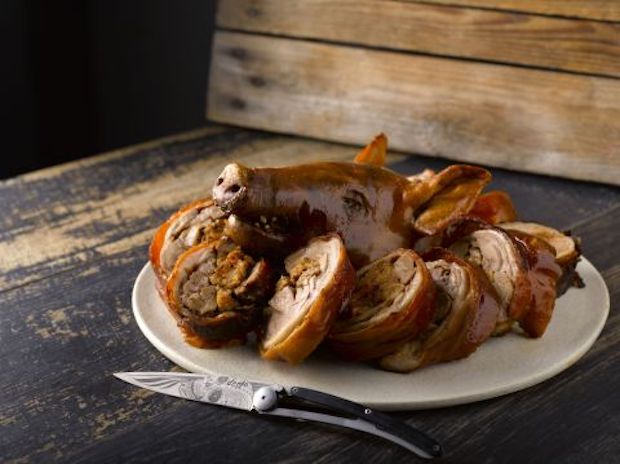
The curing process begins by placing the meat in a metal pan, the covering it with Cure #2. Any herbs or spices — such as pepper, fennel, coriander or mustard seed — can be added to the mix, and will add to the flavour.
Using your hands, thoroughly rub the mix into the meat. Put it into a metal pan, and cover it or wrap the container with foil.
Place it in the refrigerator for two to three weeks.
Once time is up, wash off the cure. Some meats, such as coppa, will next require a soak for 21 hours so that any excess salt is removed.
The meat then needs to be dried — some say to air-dry first, then pat any moisture off with kitchen paper — and then hung in the fridge for two to three months.
Make sure that the meat is not exposed to light or air during this time. Once time is up, the meat can be sliced thinly and served.
If the meat does not taste over-salted, the curing is complete.
To make sure that your meat is cured properly, Nocente says he usually goes by weight. A loss of 35 per cent in weight is a good indicator that the meat is ready after it has been hung. — TODAY


