


KUALA LUMPUR, Oct 5 — There’s a stretch along Jalan Sultan Azlan Shah, just after the Gombak River and before Chow Kit, where about eight Pakistani restaurants line up in a row, their signboards crowding the view and their smoke billowing into the air.
Many stay open for 24 hours, and even those that no longer do still serve diners till the wee hours of the morning.
Among them, House of Pakeeza is one of the best known, a short walk from the Chow Kit monorail station.
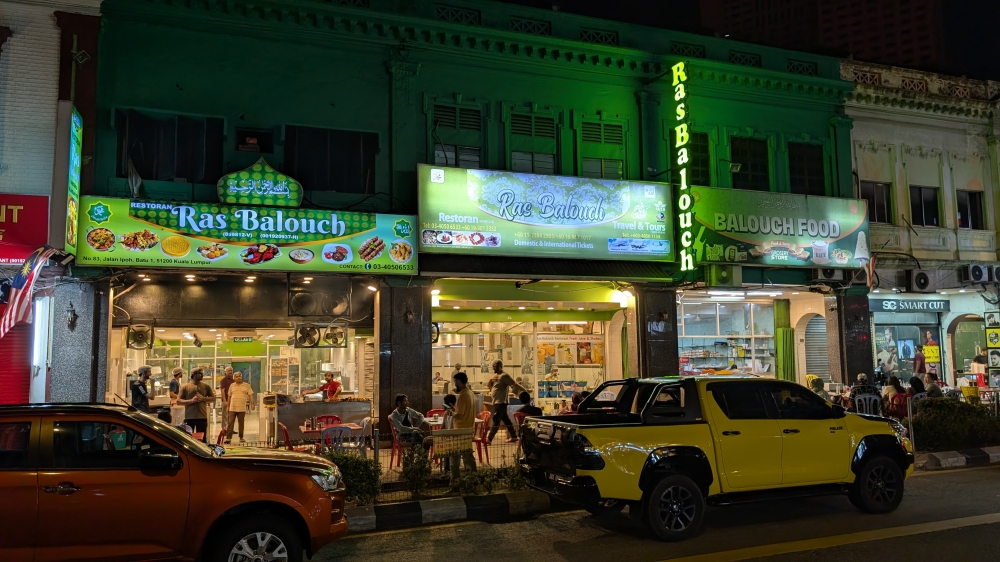
But head further towards the opposite end of the street, and you’ll find one restaurant whose lights shine a little brighter, and whose smoke rises a little thicker than the rest: Ras Balouch Restaurant.
It’s hard to miss Ras Balouch. It’s a verdant splash of green amid a wash of mostly white, sometimes beige-from-age, shops, taking up three shophouses in a row.
The first two house the restaurant, the third is a grocery store, and there’s even a travel agency on the first floor of the second shop, all under the same name.
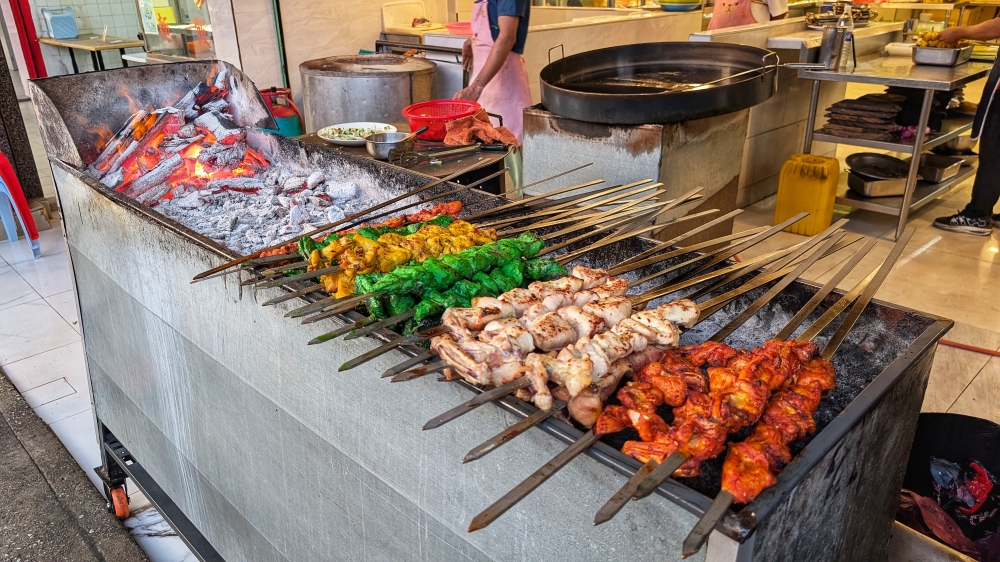
Out front, piles of white-hot charcoal and brightly coloured boti – skewers of marinated, cubed meat waiting to be grilled – are the first to greet you.
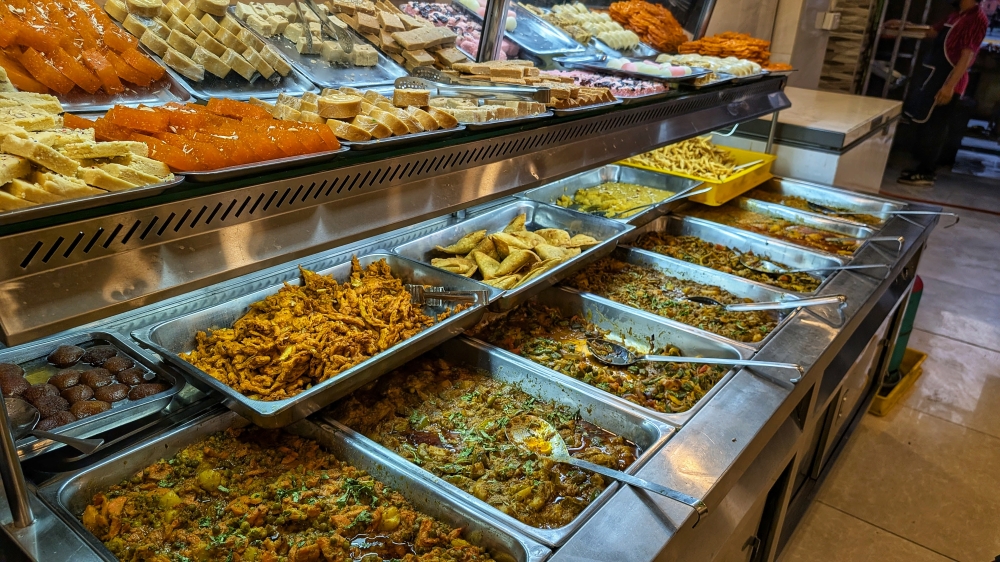
Step into the first shop and you’ll find a veritable emporium of food: on the left, mountains of pulao and biryani line the upper rows above lakes of vegetable curries and dal; on the right, dishes like keema and aloo baingan, potatoes and eggplants cooked in a dry masala, sit below an array of sweet treats such as gulab jamun and suji halwa.
You might sit down and stab a finger at a familiar word or two on the menu, but unless you know a thing or two about Pakistani cuisine, that won’t get you very far.
Or you could do the fun thing, the adventurous thing, and simply peruse the selection, letting your sense of sight and smell guide you.
It’s a bit of a self-service operation, so we ended up with plates of beef keema (RM12), mild, creamy white chicken korma (RM10), palak (RM6), just spinach, no cheese, and aloo methi (RM6), potatoes with fenugreek leaves.
The soft, silky eggplant in the aloo baingan (RM6) proved compelling enough to warrant a second plate, while the daal mash (RM6), a ghee-heavy preparation of the eponymous legume, urad dal or white lentils, proved ideal for freshly made naan (RM2.50).
Of course, the food of a country as geographically, ethnically and culturally diverse as Pakistan can’t be neatly packaged into one or two dishes.
However, the Punjabis and the Pashtun, the two largest ethnic groups, shape much of what the world recognises as Pakistani food.
Karahi, one of the country’s most well-known dishes, traces its roots to Pashtun cuisine.
It’s most commonly made with chicken, but Ras Balouch specialises in a version with mutton, sold by weight at RM70 for a kilo or RM35 for half.
We went with the latter, hoping to still have space for everything else (we did). Karahi is named for the steep, wok-like vessel it is cooked in, and this one arrives in a decorative version, absolutely brimming with chunks of soft, fatty mutton, more meat than bone, in a tomato-based gravy with ginger, green chilli and coriander.
The aromatics work in tandem to temper the gaminess of the meat while giving the thick gravy a sharp edge that’s perfect for mopping up with naan.
It’s rich without being cloying, bright with tomato and ginger, and the green chilli lends just enough warmth.
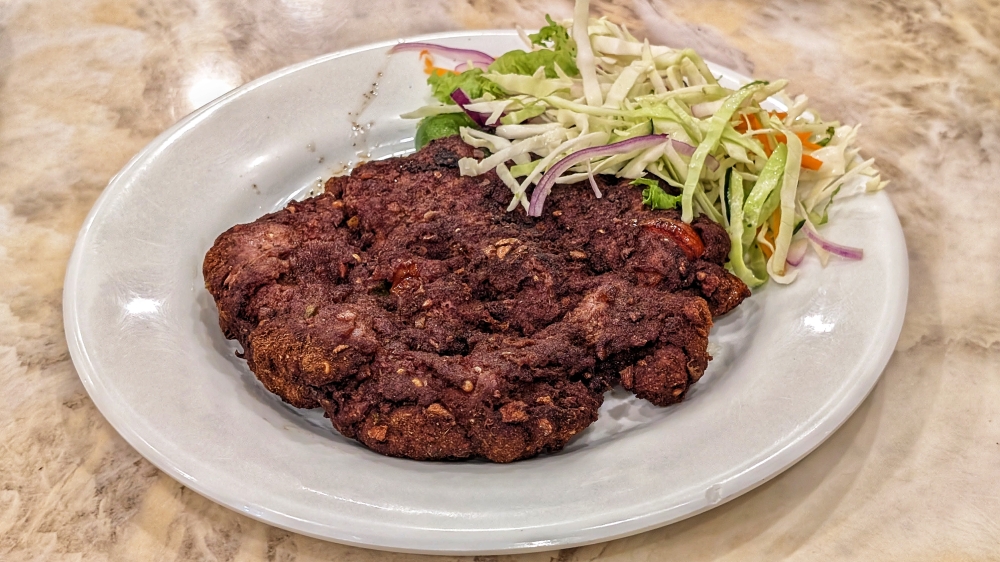
Another popular dish of Pashtun origin is chapli kebab (RM8). Centuries-old Mughlai influence means many kebab dishes, like the boti seen outside, have been absorbed into the local canon, resulting in variations such as this.
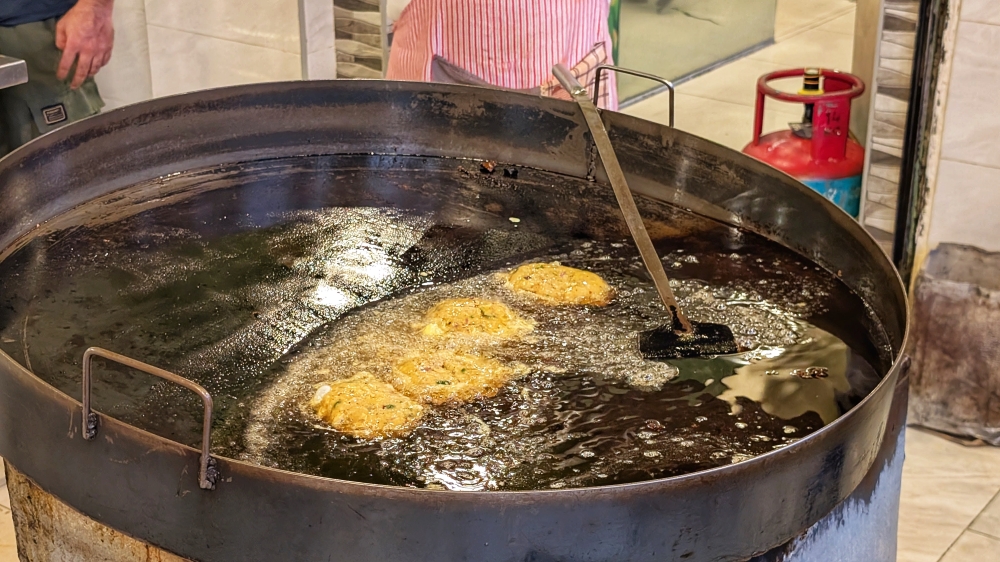
Instead of grilled, skewered meat, it’s a round, flat patty of seasoned mince, usually beef or mutton, that’s shallow-fried in a large, wide pan.
It’s characteristically tangy, with the version here studded with chunks of tomato, onion and coriander, and finished with a healthy squeeze of lime.
The outside has a craggy, crisp crust while the inside stays moist and chunky, and it almost makes you wish it were sandwiched between two buns with a yoghurt spread.
Pakistan, of course, got there first, with chapli kebab burgers a staple of fast food chains there.
Outside, the boti takes on a different character. The cubes of marinated chicken are grilled until deep, blackened char marks form across the surface, while the centre stays juicy.
Among the selection, chicken behari boti (RM10) is a chicken take on bihari kabab, a Pakistani staple usually made with beef marinated in yoghurt, garam masala and a host of other aromatics.
But the real intrigue lay in the oddly named, oddly coloured Turkish boti (RM10). These were cubes of chicken dyed a radioactive shade of green – no, Mountain Dew green – described to us only as “mint”, though I was sceptical since it tasted strongly of coriander.
But it was moist! Cool! And refreshing! A welcome contrast to the heavier, smokier notes in the other boti.
By this point, we were far too full to even entertain the idea of a gulab jamun; the thought of something sweet, sticky and soaked in syrup was too much for our feeble minds, done in by the sheer amount of meat and naan we’d consumed over the evening.
And don’t allow yourself to be tempted by the almond-filled, conical filo pastry with cream (RM3) sitting in the window, as my friend Derek was.
It’s a punt that won’t pay dividends, unlike the snowy white daal mash, the mutton karahi, the chapli kebab, or the Hulk-green boti – all of which, by the way, are excellent value for the price of admission.
Ras Balouch Restaurant
83, Jalan Sultan Azlan Shah,
Titiwangsa Sentral, Kuala Lumpur.
Open daily, 8am-3am.
Tel: 03-4050 6533
TikTok: @ras.balouch
• This is an independent review where the writer paid for the meal.
• Follow us on Instagram @eatdrinkmm for more food gems.
• Follow Ethan Lau on Instagram @eatenlau for more musings on food and self-deprecating attempts at humour.


