


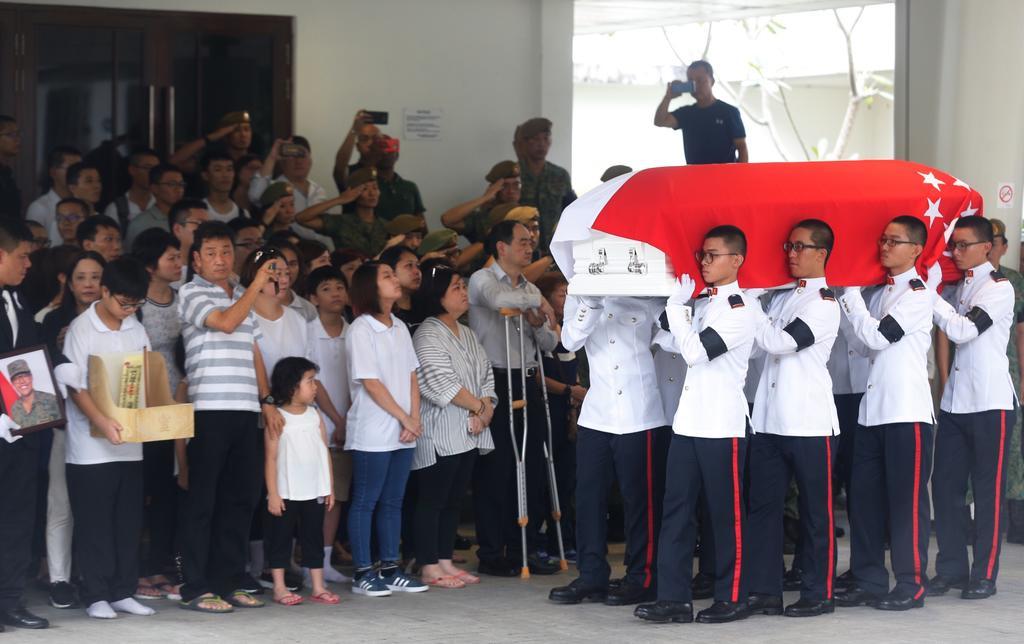


SINGAPORE, Oct 31 — A Singapore Armed Forces officer, Captain Tan Baoshu, 30, will be charged in court today in relation to the death of full-time National Serviceman Corporal First Class Dave Lee Han Xuan.
Lee succumbed to heat injuries on April 30, after spending more than a week in intensive care at the Changi General Hospital.
Tan will be charged with a rash act causing death, the police said in a statement today.
Six other national servicemen who were involved in the incident have also been referred to the Ministry of Defence for investigations, the statement added.
In a separate statement, Mindef said the six national servicemen — two Regulars, four National Servicemen — will be investigated for potential breaches of military law.
The ministry added that internal proceedings will be deferred till after conclusion of criminal proceedings against Tan.
“To prevent any prejudice arising from parallel proceedings, Mindef will defer its internal proceedings until after the conclusion of the criminal proceedings against Tan,” a Mindef spokesperson said.
“If Mindef’s internal investigations find that these six servicemen have committed military offences, they will be liable for punishments under the SAF Act. Punishments could range from a fine to detention and/or reduction in rank as well as administrative penalties,” the spokesperson added.
If convicted of an offence of rash act causing death, he could be jailed for up to five years, fined, or both.
Background to the case
Lee, a Guardsman from the 1st Battalion Singapore Guards, had first shown signs of heat injury after an 8km fast march in Bedok Camp on the morning of April 18.
After an SAF medic tried to bring down his core temperature, he was sent to Bedok Camp’s medical centre where a SAF medical team continued “body cooling measures and treatment”.
He was sent to the Changi General Hospital’s Intensive Care Unit (ICU) at about 9.50am that day.
Lee died on April 30 after more than a week in intensive care at the Changi General Hospital.
Preliminary COI findings
A preliminary assessment from a Committee of Inquiry (COI) convened to look into the training death revealed that significant delay in evacuating Lee, as well as inadequate measures given on-site after his 8km fast march were reasons why he succumbed to his heat injuries.
On April 17, the day before the march, the conduct of an afternoon training session deviated from the lesson plan, resulting in Lee running faster and having less rest than stipulated.
Lee’s platoon was also turned out that night for not observing “lights out”, and were punished with physical exercises, among other things, resulting in the soldiers having six hours and 15 minutes of uninterrupted rest instead of the stipulated seven hours.
The COI found that these lapses leading up to the march could have resulted in accumulated fatigue and insufficient rest, which may have contributed to the heat stroke.
Other possible contributory causes were his less-than-optimal state of health, and potential use of medication for an acute upper respiratory tract infection more than two weeks before the incident.
The COI, however, found no evidence of foul play. There were also no systemic lapses.
Some measures taken by SAF
The bar for medical evacuation has been lowered — any trainee who cannot respond to simple questions on time, place, and identity will be evacuated immediately for heat injury.
Purpose-built cooling pads, which cool up to 15 times faster than ice, have also been introduced. This replaces the use of six ice packs as an immediate on-site cooling measure.
The use of the Arm Immersion Cooling System (AICS) — currently used by the United States’ and Australian militaries — has been made mandatory for fast and route marches spanning 12km and above, as well as endurance runs.
These measures will be rolled out progressively, and made mandatory, across all SAF units and training schools. — TODAY


