


JULY 16 — Over the past few months, I have been making regular trips to Methodist College Kuala Lumpur in Brickfields. Directly opposite the college stands the Malaysian Association for the Blind, a familiar landmark that thousands of motorists pass every day. And yet, it is easy not to notice it.
Cars, buses and motorcycles weave through the streets. Pedestrians move quickly towards offices, shops, restaurants and train stations. The rhythm of the area is constant, purposeful and, at times, hurried. It is only when one pauses, even briefly, that another layer of the scene begins to emerge. Amid this movement, I have started to notice visually impaired men and women making their way through the busy neighbourhood, many walking alone, guided by the steady tapping of a white cane. Their steps are measured and attentive, shaped by a world they experience differently from most of us.
At first, what stood out to me was their determination. But over time, something else began to trouble me. It was not their difficulty, but how easily they could be overlooked.
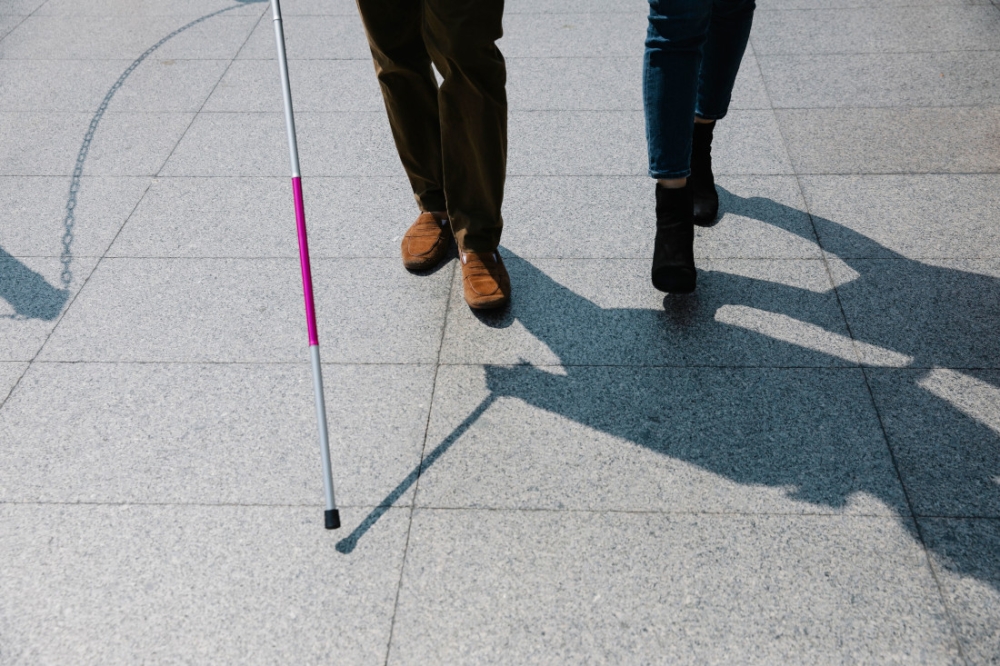
The greatest challenge is often crossing the street. For those of us with sight, this is a routine act. We glance at traffic, judge distances and move almost instinctively, repeating the process so often that we rarely think about it. For a visually impaired person, the same act unfolds very differently. I have watched individuals standing quietly at the roadside, listening carefully to the flow of traffic, waiting for a moment that feels safe. There is no eye contact with drivers, no visual confirmation that they have been seen. What guides them instead is sound, experience and judgement shaped over time.
Around them, traffic continues. Many motorists, myself included at times, move forward without realising what is happening just a few steps away. Not out of indifference, perhaps, but out of habit. We are focused on where we are going, and the few seconds required to slow down or stop can feel longer than they are. And yet, every so often, something changes. A passer-by notices, walks over and gently offers an arm. Together they cross the road, without announcement or expectation, the moment passing almost unnoticed by others.
Once seen, however, it is difficult to forget.
These encounters have led me to reflect on something we rarely question. We often speak of sight as our most important sense, and in many ways it is. It allows us to recognise faces, read words and move through the world with confidence. Yet seeing, I am beginning to realise, is not the same as noticing. We can pass a familiar building countless times without registering its presence, share the same space with others and remain unaware of their experience, or look directly at a situation and still fail to understand what it asks of us.
In this sense, the challenge is not always the absence of sight, but the absence of attention.
The visually impaired individuals I encounter in Brickfields are not defined by what they lack. They commute, attend classes, run errands and organise their lives with a quiet independence. Their white canes are not symbols of helplessness, but tools that enable them to navigate a world that is not always designed with them in mind. What is less visible, however, is how much of their journey depends on the attentiveness of others.
Infrastructure matters, of course. Audible signals, safer crossings and accessible spaces all play an important role. But beyond these, there is something more immediate and more human: a moment of awareness, a willingness to pause, and a decision to respond. A few seconds of patience from a driver may not seem like much, yet for someone standing at the roadside, it can mean the difference between uncertainty and confidence, between hesitation and movement. Such gestures are rarely noticed in a broader sense, but they shape how a space is experienced by those within it.
Helen Keller once wrote, “The only thing worse than being blind is having sight but no vision.” Her words are often quoted, but perhaps not always fully considered. Vision, in this sense, is not about what the eyes can see, but about what we allow ourselves to recognise. It is the capacity to notice what is present, even when it does not demand our attention.
In Brickfields, this lesson appears quietly, without instruction. It is there in the steady tapping of a cane, in the pause before crossing a busy road, and in the brief moment when one person notices another and chooses to act. These are not dramatic events, and they do not call attention to themselves, but they reveal something about the kind of society we are becoming.
Perhaps the measure of a community is not only how efficiently it moves, but how attentively it sees, not only in what is visible, but in what is often overlooked. And perhaps, in learning to notice again, we begin to understand what it truly means to see beyond sight.
* The author is an Emeritus Professor of Biomedical Imaging at the Faculty of Medicine, Universiti Malaya. A 2020 Merdeka Award recipient, he is a medical physicist by training but also enjoys writing, drawing, listening to classical music, and bridging the gap between older and younger generations. He may be reached at [email protected]
** This is the personal opinion of the writer or publication and does not necessarily represent the views of Malay Mail.


