


JANUARY 11 — Iran is once again approaching a decisive political moment — one shaped less by ideology than by exhaustion.
The Islamic Republic has weathered repeated waves of unrest over the past three decades, from student protests in the late 1990s to mass mobilisation after a disputed election in the late 2000s, from economic anger in the late 2010s to the Woman, Life, Freedom movement that shook the foundations of clerical authority in the early 2020s.
Each episode was suppressed. None resolved the underlying crisis of legitimacy.
What makes the present moment different is the convergence of economic collapse, leadership fatigue, and strategic paralysis at the very top of the system.
Prices have surged by nearly fifty per cent since the end of the war against Israel in the summer of 2025, a shock the clerical leadership has been unable to contain or credibly explain.
What was already an inflationary spiral has turned into a full-blown cost-of-living crisis.
Food prices, transport costs, rent, and basic utilities now consume a disproportionate share of household income.
Even the lower middle class — long regarded as a stabilising force for the regime — has been pushed into survival mode.
This post-war economic shock has been especially corrosive because it followed months of official rhetoric demanding national sacrifice, resilience, and unity.
Instead of relief, Iranians received higher prices, shrinking purchasing power, and silence from a leadership unable to translate resistance politics into economic protection. In such conditions, slogans lose their meaning. Sacrifice without security becomes intolerable.
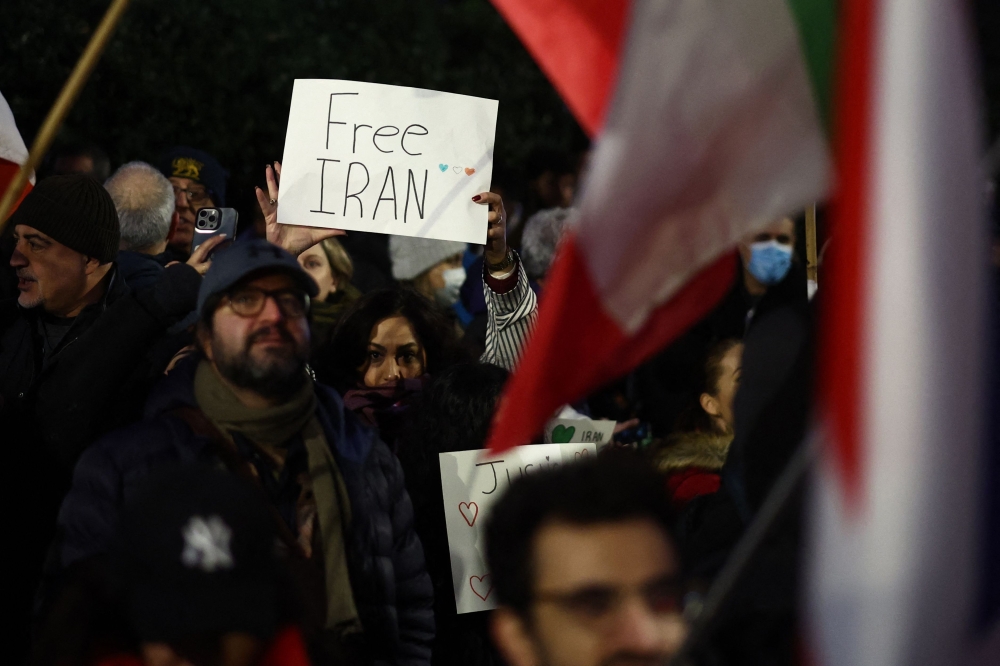
For decades, clerical authority rested on a combination of revolutionary legitimacy, religious symbolism, and the promise of moral governance. That reservoir has been steadily drained.
The aura once associated with the founding generation — figures whose charisma allowed the system to absorb shock after shock — has faded.
Today’s leadership appears older, more bureaucratic, and increasingly disconnected from daily economic realities.
The failure to mount a decisive response during last summer’s confrontation further reinforced perceptions of decline.
In a political culture where deterrence and symbolism matter deeply, restraint was interpreted domestically not as prudence but as weakness.
The regime that once defined itself through defiance now appears strategically cautious yet economically exposed — a dangerous combination in times of hardship.
Traditionally, the state has relied on cutting internet access to fragment protest mobilisation.
But in an environment where inflation approaches forty per cent annually and prices have jumped another fifty per cent in months, anger no longer depends on digital coordination. Economic pain is experienced offline, in markets, homes, and workplaces.
Shutting down communication networks under such conditions does not pacify society — it amplifies resentment and deepens the sense of siege.
Equally destabilising is the lack of coherence at the top.
The clerical establishment and the presidency oscillate between toughness and moderation, sending contradictory signals to a population already primed for distrust. Iranians are politically sophisticated. They recognise disunity when they see it.
Unless the leadership moves in concert — either firmly reformist or uniformly hardline — the public will not be mollified.
History suggests that such moments end not with compromise but with force.
When elite coordination fails and protests escalate, authority ultimately shifts upward.
In Iran’s system, that final decision rests with the Supreme Leader. A crackdown, if it comes, will likely arrive by order from the very top.
Yet every such intervention narrows the regime’s future options. Each suppression restores temporary order while accelerating long-term decay.
Iran’s population is younger, more urban, and far more economically squeezed than in previous decades. Revolutionary narratives no longer compensate for empty refrigerators.
This is why the current unrest matters. It is not merely another protest cycle to be managed.
It is a test of whether the Islamic Republic can still govern through consent rather than coercion, or whether force has become its only remaining language.
The showdown now looming is not driven by ideology alone, but by the collapse of everyday life.
When governance can no longer shield citizens from economic free fall, even the most resilient systems face their reckoning.
The question is no longer whether confrontation will occur — but how it will be resolved, and at what cost to the very republic the clerical leadership seeks to preserve.
* Phar Kim Beng, PhD is the Professor of Asean Studies at International Islamic University of Malaysia and Director of Institute of International and Asean Studies (IINTAS).
** This is the personal opinion of the writer or publication and does not necessarily represent the views of Malay Mail.


