


MARCH 4 — The Korean Peninsula has entered a new and more rigid phase of division. Whatever illusions lingered from the summitry of 2018 have now evaporated.
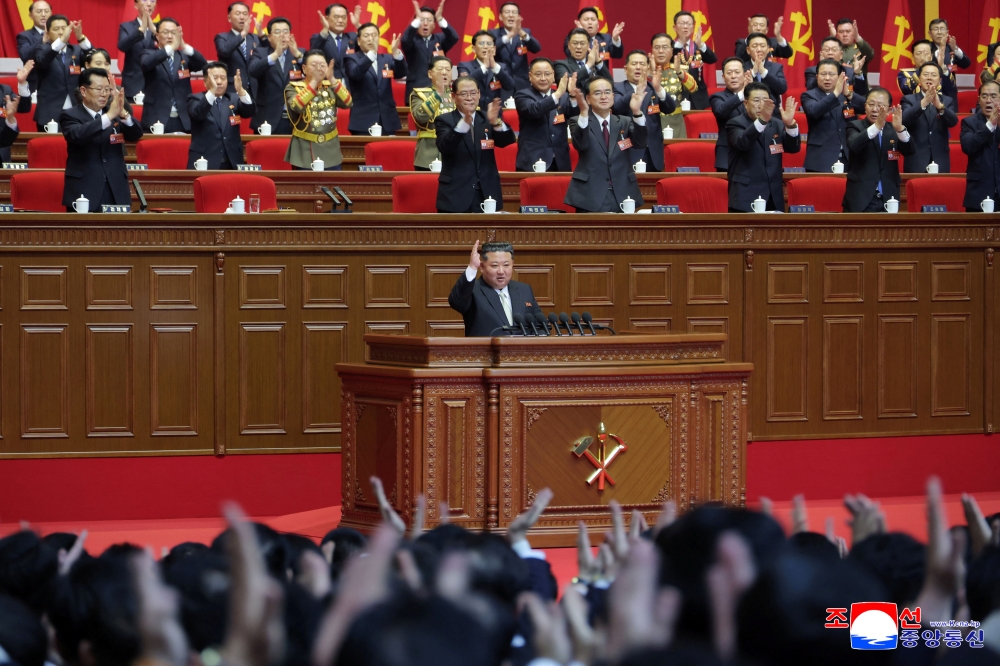
The signals emanating from Pyongyang — especially at the recent Party Congress of the Workers’ Party of Korea — are unmistakable: North and South Korea are set to remain apart, not merely politically but ideologically and strategically.
The separation is no longer a temporary political disagreement awaiting reconciliation. It is a hardened geopolitical reality.
At the heart of this shift lies the calculus of regime survival. For Pyongyang, the world is not divided between friends and enemies.
It is divided between regimes that survive and regimes that are decapitated.
Events in Iran have sharpened this perception dramatically.
Whether one agrees with Tehran or not, the spectacle of targeted leadership pressure, overt military threats, and open discussions of regime removal has not gone unnoticed in North Korea.
If anything, such developments reaffirm what Pyongyang has long believed: nuclear deterrence is not bargaining leverage. It is insurance.
The permanent nuclear state
Under Kim Jong Un, North Korea has moved from ambiguity to absolutism.
The Ninth Party Congress reinforced the notion that its nuclear status is irreversible.
There is no longer even rhetorical space for denuclearization negotiations in exchange for sanctions relief.
The logic is brutally simple.
Ukraine surrendered its nuclear arsenal in the 1990s and was later invaded. Libya dismantled its programme and its leader was overthrown.
Iraq was accused of possessing weapons it did not have and was dismantled regardless.
Iran, despite negotiating in good faith at different junctures, continues to face escalating demands.
To Pyongyang, these are not isolated case studies.
They form a pattern.
North Korea will not repeat what it views as strategic naïveté. Its missiles, warheads, submarines, drones, and cyber capabilities are not symbols of prestige. They are shields against regime decapitation.
South Korea recast as adversary
Equally telling is the shift in rhetoric toward South Korea.
Once described in aspirational tones of eventual reunification, Seoul is now framed as the “principal enemy.” This rhetorical shift is profound.
The North no longer pretends that ethnic kinship overrides alliance politics.
Seoul’s military integration with the United States — joint exercises, missile defence, extended deterrence — cements Pyongyang’s belief that the South is part of a hostile encirclement architecture.
The demilitarised zone remains physically static.
But politically, it has thickened.
Reunification is not on the horizon. It is not even in the rear-view mirror. It has been shelved indefinitely.
The Iran factor: Lessons in deterrence
Recent developments involving Iran underscore the point.
When powerful states openly contemplate targeting leadership, imposing maximalist demands, or expanding military strikes, the message to smaller authoritarian regimes is unmistakable: survival depends on deterrence credibility.
North Korea observes how negotiation frameworks evolve. It sees how demands expand — from nuclear curbs to missile limitations, from sanctions relief to restrictions on alliances and proxy relationships.
The lesson drawn in Pyongyang is that concessions invite more concessions. Strength invites caution.
Hence the hardening line.
The leadership in Pyongyang understands that if it ever appears weak, divided, or open to intrusive inspection regimes, the specter of regime decapitation will grow.
The strategic objective therefore becomes preemptive insulation: deepen nuclear capability, fortify internal security, reduce diplomatic vulnerability.
The United States and strategic signalling
The United States remains central to this equation. The Korean Peninsula is still fundamentally shaped by US forward deployment, alliance commitments, and extended nuclear deterrence guarantees.
But American signalling is often read differently in Pyongyang than in Washington.
When Washington emphasises “all options are on the table,” North Korea hears “leadership vulnerability.”
When Washington demands dismantlement before normalisation, Pyongyang hears “strategic surrender.”
This is not a moral judgment. It is a perception gap.
And in geopolitics, perception shapes policy.
Why the Koreas will stay apart
The structural reasons for continued division are now entrenched:
First, the North’s nuclear posture is permanent.
Second, the South’s alliance with Washington is non-negotiable.
Third, mutual distrust has moved from tactical to existential.
Even if inter-Korean dialogue resumes at some future date, it will be tactical management, not transformative reconciliation.
The peninsula resembles Germany before 1989 only superficially. There is no Soviet collapse looming.
There is no ideological exhaustion visible in Pyongyang’s elite circles. Instead, there is renewed militarisation and ideological consolidation.
North Korea is not liberalising. It is fortifying.
Asean’s quiet stake
From South-east Asia’s vantage point, this hardening is deeply concerning.
Asean has always preferred a denuclearised Korean Peninsula and stable major-power equilibrium.
Instability on the peninsula reverberates across the Indo-Pacific — through trade routes, alliance configurations, and nuclear proliferation norms.
If North Korea continues to expand its arsenal while South Korea deepens missile defence integration with the United States and Japan, the region risks sliding into a layered arms spiral.
That spiral will not explode tomorrow. But it will accumulate quietly.
The iron logic of survival
In the end, the Korean question is no longer about reunification dreams or humanitarian engagement alone. It is about regime psychology.
Pyongyang has concluded that nuclear capability prevents decapitation. Events elsewhere reinforce that conclusion rather than weaken it.
The tragic paradox is this: the more North Korea hardens its deterrent to prevent regime change, the more it entrenches permanent division with the South.
Security for one becomes insecurity for the other.
Thus, the Koreas will remain apart — not because history demands it, nor because culture divides them, but because strategic survival instincts override reconciliation.
Until that survival calculus changes, the demilitarised zone will remain not merely a border of barbed wire, but a line etched by fear, deterrence, and the relentless logic of regime endurance.
And events far beyond the peninsula — from the Middle East to Europe — will continue to shape how Pyongyang reads its fate.
In geopolitics, no regime watches alone.
* Phar Kim Beng is professor of Asean Studies and director of the Institute of International and Asean Studies, International Islamic University of Malaysia.
** This is the personal opinion of the writer or publication and does not necessarily represent the views of Malay Mail.


