


JANUARY 8 — The magnetic pull of BRICS is undeniable. A significant swathe of the Global South is knocking firmly on the grouping’s door. This surge in interest is a symptom of a world straining under the weight of geopolitical fractures, economic uncertainty, and a profound disillusionment with the perceived failures and hypocrisies of the existing, largely Western-led, international order.
As war rages in Europe, tensions simmer in Asia, and global institutions falter, the critical question emerges: Can BRICS truly define the emerging world order? The appeal of BRICS today lies less in a shared vision for humanity. For decades, many nations in the Global South have chafed under a system they see as disproportionately serving Western interests, and wielding unilateral power through mechanisms like the US dollar’s dominance.
BRICS, despite its internal complexities, offers a platform. It embodies the possibility of a multipolar world where non-Western voices carry significant collective weight. Joining, or aspiring to join, is a statement of seeking a seat at a different table.
The push for local currency trade settlements, the New Development Bank (NDB), and discussions around alternative financial messaging systems resonate deeply. Nations seek insulation from dollar volatility and Western financial sanctions. In a world of hardening blocs, BRICS offers a potential hedge, especially for nations wary of being forced into binary choices between the US/EU and China/Russia. It provides diplomatic space and a collective voice, however uneven.
At its core, the BRICS expansion reflects a fundamental demand for recognition, and a greater say in global governance. However, translating this powerful reaction against the old order is a Herculean task. BRICS faces existential challenges. Beijing’s economic dominance within the group is overwhelming. Its strategic ambitions, particularly regarding Taiwan, create deep unease for other members like India. Can a group aiming for multipolarity truly function when one member so clearly seeks primacy?
What exactly is the “BRICS world order”? Is it India’s vision of reformed multilateralism? Or China’s model of state capitalism and alternative governance structures? Or Brazil and South Africa’s focus on development and South-South cooperation? These visions often clash, lacking a unifying ideological core beyond shared grievance. The India-China border dispute is a reminder of deep-seated bilateral tensions. Consensus on complex global issues will be incredibly difficult.
BRICS has no equivalent to the UN Security Council, or the EU’s regulatory framework. Building effective, trusted institutions takes decades. Russia’s invasion of Ukraine and subsequent pariah status in the West complicates BRICS immensely. It makes the grouping appear, to some, as an alliance of the sanctioned and the discontented, rather than a purely positive force. Integrating Russia deeply into a new financial architecture is risky for others.
BRICS will undoubtedly be a significant shaper of the emerging world order, but it is unlikely to be its sole architect in the near term. Its power lies in acceleration and disruption. BRICS is the most potent symbol and vehicle for the ongoing diffusion of global power away from the US-led West. Its expansion makes this process tangible and irreversible.
Even incremental progress on de-dollarisation and alternative payment systems erodes Western financial dominance, forcing adaptation. BRICS provides a crucial megaphone for demands for UNSC reform, fairer trade practices, and climate justice, ensuring these issues can’t be ignored. The very existence and growth of BRICS forces the traditional powers to reassess engagement strategies, offering alternatives that increase bargaining power for smaller states.
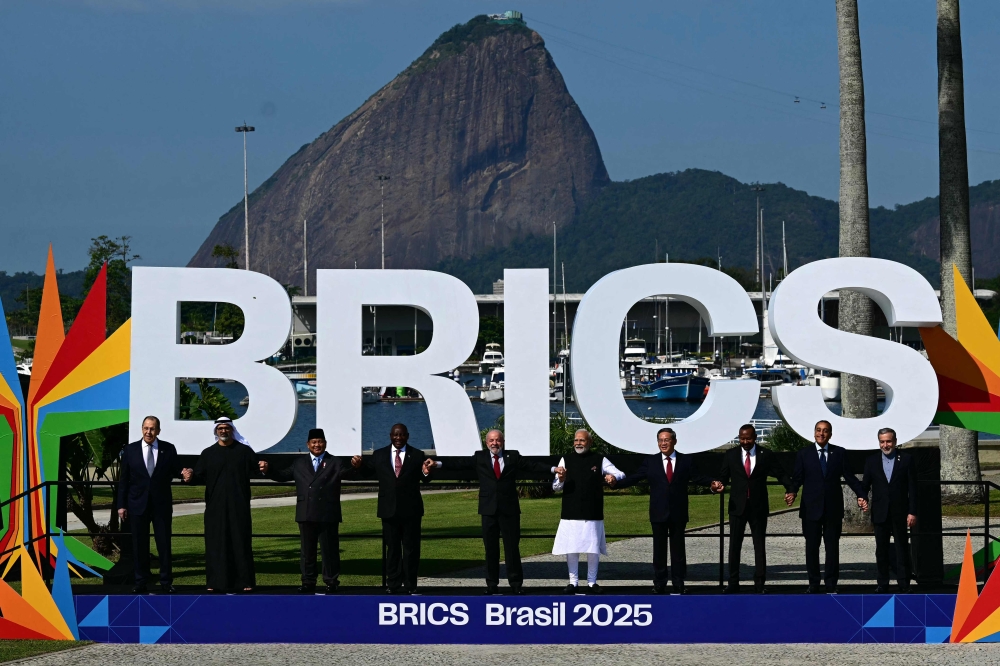
The emerging world order is less likely to be a neat BRICS-led system and more a fragmented, contested, and messy landscape – a “multiplex world”. BRICS will be a major theatre within this multiplex, a powerful bloc representing a significant portion of humanity and economic output. It will challenge Western norms, provide alternatives, and empower the Global South.
However, its internal contradictions – the China-India rivalry, divergent political systems, conflicting strategic interests, and the lack of a unified positive vision – prevent it from presenting a cohesive, universally appealing alternative system to replace the current one wholesale. Its strength is its critique; its weakness is its inability to agree on the cure.
BRICS is not writing the new world order’s rulebook alone. It is, however, tearing out many pages from the old one and demanding a co-authorship role in the next draft. Its success will be measured not in creating a new hegemony, but in ensuring no single power can dominate unchallenged, and that the voices and interests of the Global South are finally heard on equal terms.
The journey towards that more equitable, albeit complex, multipolarity is where BRICS’ true, disruptive significance lies. The world is watching, and the old order is undoubtedly shifting – but the final architecture remains profoundly uncertain.
* The author is affiliated with the Tan Sri Omar Centre for STI Policy Studies at UCSI University and is an adjunct professor at the Ungku Aziz Centre for Development Studies, Universiti Malaya. He can be reached at [email protected].
** This is the personal opinion of the writer or publication and does not necessarily represent the views of Malay Mail.


