


SEPTEMBER 22 — The Attorney General (AG) is vested with prosecutorial power by Article 145(3) of the Federal Constitution, which states that the AG “shall have power, exercisable at his discretion, to institute, conduct or discontinue any proceedings for an offence, other than proceedings before a Syariah court, a native court or a court-martial.”
The designation of the AG as the Public Prosecutor (PP) is found in Section 376(1) of the Criminal Procedure Code (CPC) in the following words:
The Attorney General shall be the Public Prosecutor and shall have the control and direction of all criminal prosecutions and proceedings under this Code.
Both of the above provisions have been interpreted by the courts as giving the AG prosecutorial discretion. The discretion was called “very wide” by Lord President Suffian in the Federal Court case of Long bin Samat & Ors v PP (1974).
Three years later in Johnson Tan Han Seng v PP (1977) Suffian defined “discretion” to mean “liberty of deciding as one thinks fit”. The Lord President explained further the discretion of the AG in the following words:
“[He] has very wide discretion under the Criminal Procedure Code and the Constitution. Before Merdeka Chapter XXXVII of the F.M.S. Criminal Procedure Code and the equivalent provisions of the S.S. Criminal Procedure Code set out his power. Today only the F.M.S. Code remains. Section 376(1) thereof provides generally that the Attorney-General in his capacity as Public Prosecutor shall have the control and direction of all criminal prosecutions and proceedings under the Code.
“[He] may enter a nolle prosequi .... As noted by this court in Long bin Samat v Public Prosecutor [1974] there was ample judicial authority before Merdeka to show that the Attorney General enjoyed wide discretion in regard to criminal prosecutions. As section 3761(1) of the Criminal Procedure Code was already in existence before Merdeka our constitution-makers could have been content with relying on it alone to preserve after Merdeka the Attorney General’s pre-Merdeka power; but our constitution-makers were not content to do so. They deliberately wrote article 145(3) into our Constitution.”
The discretion was subsequently said to be “exclusive” in the case of PP v Zainuddin & Anor (1986) where Lord President Salleh Abas said:
“The law and Constitution in giving the Attorney General an exclusive power respecting direction and control over criminal matters expect him to exercise it honestly and professionally. The law gives him a complete trust that the exercise of this power is his and his alone and that his decision is not open to any judicial review.”
Five years later, the discretion was called “unfetterred” in Karpal Singh v PP (1991) where Lord President Abdul Hamid Omar said:
“The discretion vested in the Attorney General is unfettered and cannot be challenged and substituted by that of the courts.”
The above was referred to in subsequent cases at the High Court, Court of Appeal and Federal Court. The last was in the case of Ahmad Zubair @ Ahmad Zubir bin Hj Murshid v PP (2014).
Then came the case of Sundra Rajoo a/l Nadarajah v Menteri Luar Negeri, Malaysia & Ors (2021) where Chief Justice Tengku Maiimun, delivering the judgment of the Federal Court, said:
“Article 145(3) of the Federal Constitution provides the AG/PP with a wide discretion to institute, conduct or discontinue any proceeding for a criminal offence. This wide discretion means the AG/PP has sole and exclusive discretion in that only he/she can exercise such power. However, the AG/PP does not have absolute or unfettered discretion under art 145(3). [I]t is our judgment that in appropriate, rare and exceptional cases, such discretion is amenable to judicial review.” (Emphasis added)
To the question whether the exercise of the AG’s discretion pursuant to Article 145(3) of the Federal Constitution is amenable to judicial review in appropriate circumstances, the Chief Justice’s answer was: Affirmative, with particular emphasis on the words “appropriate circumstances”.
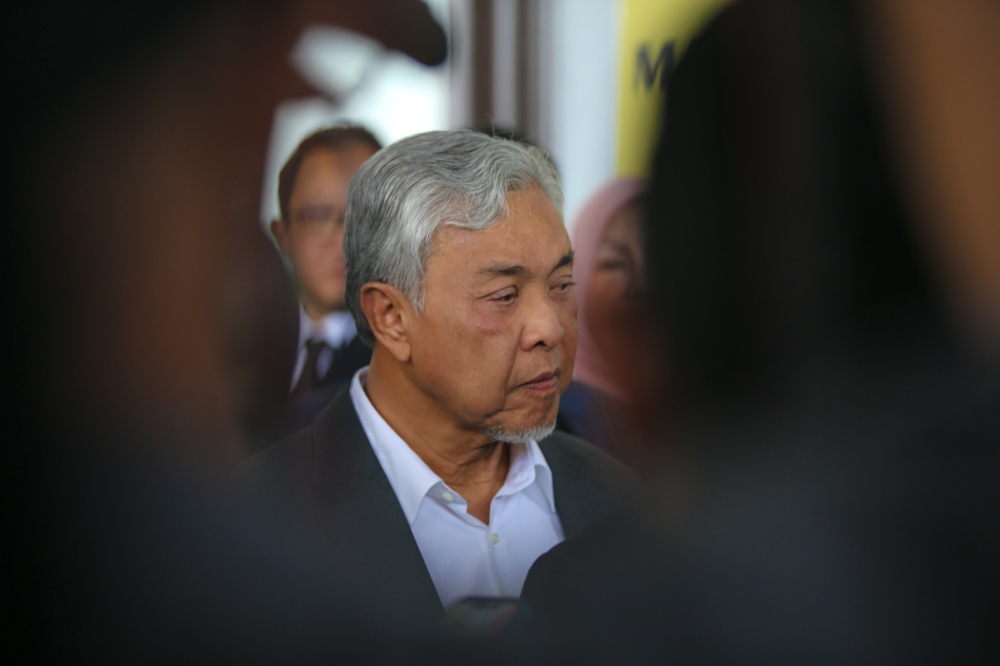
So, take it to the court for a judicial review of the AG’s decision to not prosecute further (nolle prosequi) the criminal case against Zahid. Take inspiration from the Chief Justice of Malaya Raja Azlan Shah (as His Royal Highness then was) who said:
“Unfettered discretion is a contradiction in terms... Every legal power must have legal limits, otherwise there is dictatorship... In other words, every discretion cannot be free from legal restraint; where it is wrongly exercised, it becomes the duty of the court to intervene.
“The courts are the only defence of the liberty of the subject against departmental aggression.” (Pengarah Tanah dan Galian, Wilayah Persekutuan v Sri Lempah Enterprises Sdn Bhd [1979])
Any takers?
* This is the personal opinion of the writer or publication and does not necessarily represent the views of Malay Mail.


