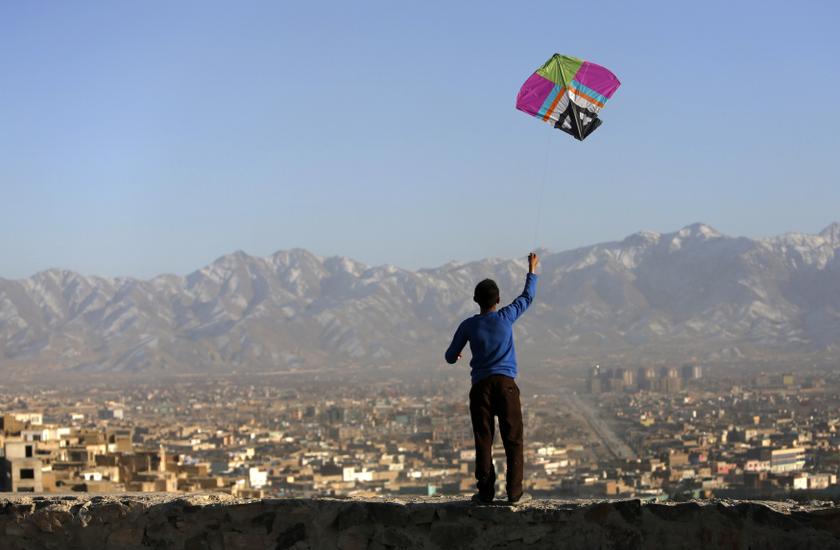
JOHOR BAHARU, March 5 — Flying kites, including flying the ‘wau bulan’ (the Malaysian moon kite) was once a favourite pastime.
The recreational activity is one of the many beautiful cultural heritages of the people in the East Coast of Peninsular.
Sadly, today, one can only find the older generation engaged in this cultural sport. Flying the wau bulan is an art that has little appeal to the younger generation. The traditional Malay pastime stands little chance against today’s maze of digital gadgetry and modern sporting activities.
Although ready-made kites can easily be bought in shops and supermarkets,nits construction is poor compared with the ones made by experienced hands, which are sturdy in build yet intricate in detail.
The technical finesse of constructing a kite or wau is not a skill that can easily be learned. However, it is not impossible to acquire the expertise if one is armed with determination and strong interest.
FOR THE LOVE OF THE TRADE
No one agrees with this more than Yasok Umat, 73, a master in the constructing kites in his hometown of Kota Baharu, Kelantan.
It was a skill that he passed down informally though his students were few in number.
“Their eagerness to learn makes me enjoy teaching them. I want to pass down the skill and knowledge so that it can be passed around to the coming generation,” he told Bernama in an interview recently.
He said it was not easy to find interested apprentices from among the younger generation. However, he believed that a few willing students were better than none.
The father of six has in his collection 30 kites, including the iconic wau, which he made upon the instruction and knowledge passed down by his late father.
COMPETITIONS
Yasok and his friends would often join kite-making competitions or workshops held nationwide.
“We don’t join to merely win. It is because of our love for this cultural heritage that we are willing to travel nationwide. It is something that has been deeply ingrained within us since young,” he said.
Among the wau in his collection are the “wau kucing” (cat kite), “wau jala budi” (leaf kite) and “wau merak” (peacock kite).
His favourite handmade kite is the “misai kucing” (cat’s whiskers), which he often flies for sport in the evenings.
Yasok is among the participants who almost never miss the World Kite Festival in Pasir Gudang since it was first held in 1995.
ATTRACTING THE YOUNG
The kite festival that was held from Feb 19-23 served as the platform to attract the younger generation to learn more about the cultural heritage.
Among the programmes during the festival was the kite-making workshop cum competition, which garnered the interest of 90 local and foreign participants.
The competition, first introduced in 2011, had always been well-received with participants increasing in numbers annually.
For 17-year-old Lee Yue Jie, the competition was a new experience as she had never joined anything like it before in her life.
The student of Sekolah Menengah Seri Kota Puteri 2, Masai, said she found it being the best opportunity to learn the traditional art of making kites.
“My parents are very supportive of me joining this competition. I am not hoping to win though, as that is not my goal,” said Lee, whose family enjoyed kite-flying on a regular basis.
FOREIGN INTEREST
Another first-timer at the competition was Pauline Tayloy from England.
However, the 58-year-old is no stranger to the art of kite making.
“I teach people how to make kites back home, but my students have always been small in number, never more than 20. I have been interested in kite-making since 20 years ago,” she said.
Tayloy has made 50 types of kites in the past 20 years, all kept in excellent condition in her home. Her collection is also used to provide inspiration for her students when seeking ideas for kite-making.
Kite festivals are also common in England and Tayloy rarely missed any of them. However, the one in Pasir Gudang provided a rare opportunity for her to mingle with kite-makers from other countries.
“Kite-making is riddled with challenges. You may have to build and rebuild many times until you find a design that works,” said Tayloy, who took part in the competition with her handmade nylon kite.
AGE IS NOT A FACTOR
The grandmother of seven said her age did not prevent her from actively participating in kite flying. She found a certain tranquillity in the recreational activity and the sight of her handmade kite soaring in the sky never ceased to amaze her.
“It gives me an extraordinary personal satisfaction. That is why I’m going to continue doing this and will be participating in this festival again in the future,” she said.
This year’s competition garnered the participation of 403 people, 234 of which were from overseas.
The festival, with the Pasir Gudang Municipal Council being the main sponsor, featured the theme ‘wind garden’ using kites constructed from recycled materials.
This year’s festival witnessed many kites based on the motifs of traditional musical instruments. There were three categories for the Asean school level - two-dimensional kites, the Rokkaku (six-sided Japanese fighter kites) and train kites. The open category was for three-dimensional kites. — Bernama