


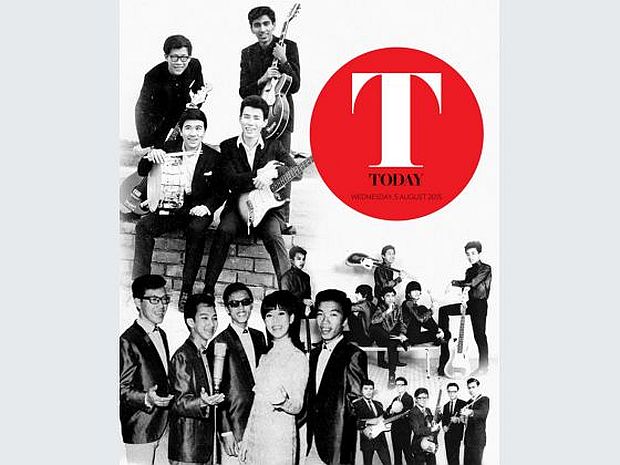


SINGAPORE, Aug 5 — Anyone interested in music made in Singapore ought to be more than satisfied with what is on offer this weekend. For instance, the newly minted UNESCO World Heritage site that is the Botanic Gardens will celebrate SG50 with a three-day line-up of activities (from Aug 7 to 9) that includes a carnival and free concerts by the likes of 53A, Olivia Ong and The Sam Willows.
Over at Bedok Reservoir this weekend is 100+50, a music festival featuring 100 bands and 50 electronic acts and DJs from across Singapore. And, yes, admission is free.
But, while it is easy to get caught up in the musical fervour of the present, perhaps it is appropriate to take a look into the past, where it all began. Many music enthusiasts agree that the genesis for the pop music scene in Singapore began when Cliff Richard And The Shadows performed here in 1961. But it was not until 1965 that it truly erupted with a verve that hasn’t been seen since.
“Sure, The Crescendos had already been established as Singapore’s first successful pop group — and lead singer Susan Lim was the first Singaporean pop idol; and The Quests became the first Singaporean group to get a No 1 hit with Shanty in 1964; however, it was really in 1965 that everything came together,” said singer Vernon Cornelius, who fronted The Quests from 1966 to 1968.
That year saw a proliferation of music acts surfacing all over the island. Record labels such as EMI and Philips saw the potential in signing local bands and singers. Joseph C Pereira, who authored books on the local music scene such as Apache Over Singapore and Legends Of The Golden Venus, said in his notes for the music compilation Singapore 60s: The Definitive Collection that local music “became a flood in 1965 and fans were delirious knowing that each week would bring new releases”.
The sounds of 1965 offered a vibrant and exciting glimpse of what the bands in Singapore were capable of, even as Singa-pop (to borrow Dick Lee’s phrase) would shift and change as the years went by. And perhaps, there is no better time than now — with the current music scene seeming to mirror the vibe of 1965’s — to thank those pioneers for all they have done. Here is a quick taste of the sounds of 1965, the music that defined a generation and secured a place in Singapore’s pop culture history.
HE’S THE BOY (The Crescendos). The Crescendos built their success on their close-harmony vocals and a reputation for turning evergreen standards into rocking covers, such as Lengang Legang Kangkong or In The Good Old Summertime. By 1965, the group had a heavy schedule — the members had day jobs and gigged in their spare time, often taking leave to do shows in Malaysia. But Susan Lim, John Chee, Leslie Chia and Raymond Ho could still rock it out in the studio, judging from the whoops in this version of He’s The Boy.
CHAMPAGNE (The Quests). No list about Singapore music of the 1960s would be complete without at least a track from The Quests. Having already hit the top of the charts in 1964, the band hit their stride the following year, coming up with more hits in the form of instrumental ballads such as Teabreak and Memories. The Quests also released its eponymous instrumental EP, which featured four songs written by guitarist Reggie Verghese. (Up until that point, all the hit instrumentals — Shanty, Memories, Teabreak — were composed by bassist Henry Chua.) The EP also had the band showing off its diverse styles: The acoustic guitar-driven ballad Champagne, the Spanish-flavoured The Man From Madrid, and two out-and-out rockers, I’m Feeling Good and Dum Dum, featuring keyboards. “Everybody forgets that Reggie was a really good songwriter too,” said Cornelius.
THE DEW (The Cyclones). Towards the end of the year, brothers James and Siva Choy, as The Cyclones, became one of the most popular duos of the day, with the release of their EP. Best known for their R&B style, which was dubbed as “wild and tempestuous”, that energy was featured in the two songs written by James (the punchy R&B track The Dew and the strident Oh No, She Didn’t Say), and two others — She’s All Mine and I’ll — written by Laurence Lee, the bassist of The Checkmates, which backed The Cyclones on this recording. The songs all featured a contemporary R&B feel, a genre bands such as Straydogs and Pests Infested would later incorporate to their music.
YOU’RE THE BOY (Shirley Nair & The Silver Strings). By 1965, The Silver Strings — David Chan (lead guitarist), Merlin Lim (rhythm guitarist), Audie Ng (bass guitarist) and Danny Boy (drummer) — had gained a reputation for being one of the more exciting and versatile bands of the time, backing several singers, including Veronica Young, Andy Young and Mike & Herb. Their popularity hit a spike when Shirley Nair joined the band as lead singer. This 1965 debut single by the group showed her songwriting ability and it didn’t take long before this perky track became a hit. The song was revived earlier this year via an SG50 video featuring two of the original band members, as well as young local singer Weish.
WHAT CAN I DO (Mike & Herb and The Silver Strings). Shirley Nair’s prowess as a songwriter once again came to the fore with this song, the B-side — and arguably stronger song — of the debut single by brothers Mike & Herb van Dort, who were quickly dubbed “The Beatles of Malaysia”. With close-harmony singing from the brothers, this track is also backed by the same Silver Strings line-up that featured on You’re The Boy.
I KNOW (Naomi & The Boys). Singer Naomi Suriya was known for her strong, lush vocals and, as the lead singer of The Boys, scored early hits with tear-jerkers such as It’s All Over and Happy Happy Birthday Baby in 1965. This track, one of the many ballads that would be written by The Boys’ Robert Suriya (Naomi’s brother), showed that their original compositions were just as good as any artiste they covered. Robert would go on to be one of the top songwriters of the era.
I’LL NEVER BE MAD AT YOU (Wilson David). This track was written by Alan Poh, a member of The Jets (who provided the musical accompaniment on this recording). By 1965, Wilson David had built such a reputation as a singing sensation that he was often billed as “the undisputed idol” and had screaming fans everywhere he performed. The song may have shades of Elvis Presley, but it showcases Wilson’s ability to tackle rock ‘n’ roll numbers with ease.
LITTLE LADY (Tony Chong & The Thunderbirds). The Thunderbirds also released its debut recording that year: Little Lady/I’m As Sad As I Can Be, a single written by the band’s co-founder Tony Chong (although for some reason the single was attributed to Tony Chong & The Thunderbirds). Little Lady featured a Middle Eastern-lilt — another indication of how adventurous some bands were, considering that British pop a la The Beatles or Cliff Richard was the norm. (Decades later, the song would feature in director Ken Kwek’s movie, Sex.Violence.FamilyValues.)
DON’T PLAY THAT SONG FOR ME (YOU LIED) (Keith Locke and The Quests). The Quests went from strength to strength after they teamed up with Keith Locke. Together they released several hit singles, not least a track that would be a signature tune for years to come: Don’t Play That Song For Me (You Lied). Interestingly, this song was originally relegated to the B-side of the single (the poppy A-side Be My Girl was written by Locke. — TODAY


