













OCTOBER 22 — Reaching middle age means now even the youngest of my friends are in their 30s.
We talk about hospitals and the reality of juggling multiple medical appointments — our own and that of older relatives.
The same line seems to be repeated by many of them: “Once you go into the hospital, you won’t leave alive!”
Auntie ah, if like that I’m either a zombie or miraculously reincarnate as myself at least once or twice a month.
Many older people are scared, seeing their friends go to the hospital ill and then never getting better.
Death comes for us all in time but the creeping fear of death’s eventual ringing of our doorbell has instead manifested as a fear of hospitals.
A friend’s family was especially scathing about how terrible Kajang Hospital was and I dismissed it as “old people fear mongering”.
Then I heard more stories — about how the new children’s hospital had worsened the understaffing at Kajang Hospital and that its facilities were long past due for an upgrade.
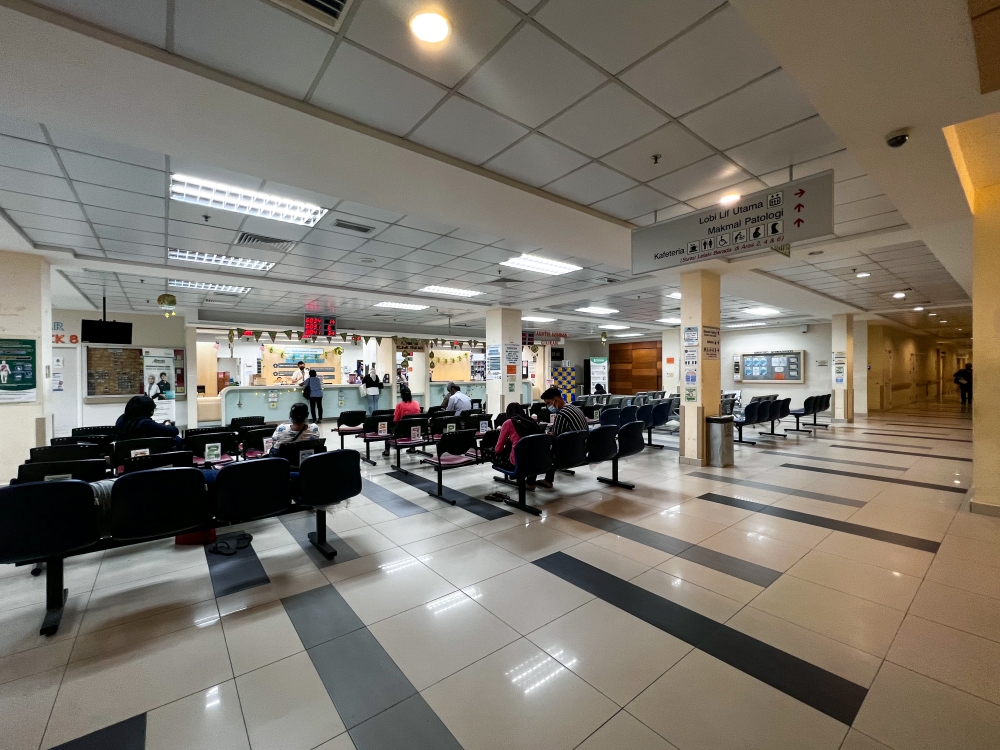
How could you blame people when they see their friends and relatives admitted to the hospital alive but only left dead?
Correlation does not of course equal causation but why build new hospitals in the area without also increasing manpower?
While Serdang Hospital is better equipped, its location does not have access to public transport and the parking there is difficult and expensive — so you would see why residents in the surrounding area would try to go to Kajang Hospital instead.
I also learned that Kajang Hospital does not have an oncology department so cancer patients or those suspecting they have cancer should go to Serdang Hospital instead.
There needs to be more accessible information about which hospitals to go for certain conditions.
It took me being in the system as a chronically ill patient to know which hospitals specialise in which ailment and the whole process is not straightforward.
Breast cancer clinics for instance are only operating on certain days a week, something that many patients don’t know when they first start going to a hospital for treatment.
Circling back to Kajang Hospital. I thought that KL General Hospital could be scary when it’s crowded but apparently Kajang is worse with very few nurses left working in the wards, leaving patients waiting for long periods to get attention.
The population it’s serving is large and growing.
Kajang Municipal Council said that in 2017 the population it served was 1,001,500 people but it’s expected to increase to 1,350,100 people in 2035 covering the districts of Beranang, Cheras, Kajang, Semenyih, Hulu Langat and Hulu Semenyih.
With that many people it is imperative that they have access to affordable and accessible healthcare but with public hospital options being limited, Kajang Hospital being absolutely slammed is not going to change anytime soon.
What can be done in the meantime is to try and encourage the populace to embrace preventative healthcare and go to Klinik Kesihatan first, and early.
It frightens me a little that we are starting to behave like Americans with their ridiculously expensive healthcare system, avoiding going to the doctor unless absolutely necessary and instead self-medicating.
Malaysians pop Panadols a bit too freely I had always thought but it’s easier to take a pill than to go to a doctor, wait for perhaps an hour or so and then brace for fees.
It is actually a lot of work to stay healthy as I’ve had to discover but for too many of us, it requires time that we don’t have.
If you’re already working two or three jobs, when are you going to find time to exercise?
Online I keep hearing health professionals say that older people need to be doing strength or resistance training to prevent sarcopenia.
There’s far too much shaming going on when no one wants to be sick and as a cancer patient I’ve learned that chronic illnesses can come for you no matter how old or how “healthy” you are by most standards.
As I will repeat often, poverty alleviation itself is healthcare too.
Yet I’m learning that poverty is also a policy choice. Who will be desperate enough for work if there aren’t enough poor people?
If everyone has their needs met, why would they need to curry favour with those in power?
I wonder now if Kajang Hospital serves more as a warning than a public service — that in the end, the greater good does not matter as much as the greater expedience.
The staffing situation in public healthcare needs to be addressed quickly before one day, Malaysians start arriving at empty, unstaffed hospitals just like in the US where funding cuts have caused the deaths of small local hospitals and leaving the communities they serve bereft.
Pay for private or die shouldn’t be the future of healthcare in Malaysia but at this rate, it might be.
* This is the personal opinion of the columnist.