


JUNE 4 — After almost a month of fast and furious election/political news from Malaysia, I think it may help to turn our eyes overseas for a bit.
While I believe it’s absolutely urgent to know where on earth Jamal Yunos is, I feel it’s also worthwhile channelling some attention to even more urgent and serious news coming from, of all places, Ireland.
Two Sundays ago, the Republic of Ireland voted in a referendum to overturn its 25-year ban on abortion. Since 1983, the Irish State has acknowledged, “the right to life of the unborn and, with due regard to the equal right to life of the mother, guarantees in its laws to respect, and, as far as practicable, by its laws to defend and vindicate that right.”
Abortion was thus rendered illegal in almost all cases, with the major exception being when a woman’s life was at risk. Irish women could not, by this amendment, terminate their pregnancies in cases of rape, incest or severe foetal abnormality, or at least not in Ireland and certainly not legally.
After this referendum, abortions will likely be allowed for pregnancies up to 12 weeks, as per the draft legislation drawn up by the Irish government’s committee prior to the vote.
Why 12 weeks? What’s so ‘special’ about 12 weeks of pregnancy such that if you terminate the foetus before this timeframe it’s okay but not after?
Those against the repeal of the ban have suggested this timeframe is arbitrary, “plucked out of the air”, so to speak. The committee has justified their choice of 12 weeks by noting that most natural miscarriages occur within this time.
Presumably, therefore, since the natural rejection of foetuses by women’s bodies (should they occur) happen during this time anyway, it’s sensible to “manually” terminate the foetus within just such a timeframe.
Another justification for the 12-week period is that this is the common timeframe during which licensed pills are employed (in countries where abortion is legal). It helps to read the official explanation provided by the (Irish) Institute of Obstetricians and Gynaecologists, which also emphasies the concern for rape victims, the traumatic effects of verification and “rape-testing.”
Basically, to legalise pre-12-week abortion would make it less stigmatising and easier for rape victims to move on after their tragedy.
Left, right and beyond
It is significant that in the deliberations prior to the recommendations, the government committee tasked to review the 8th amendment (known as Oireachtas) disagreed with the Citizens’ Assembly (essentially a committee of Irish political reps and citizens) on one key point: Oireachstas was against allowing terminations “when a non-fatal foetal abnormality is identified, or for socio-economic reasons.”
Hopefully, this table helps clarify:
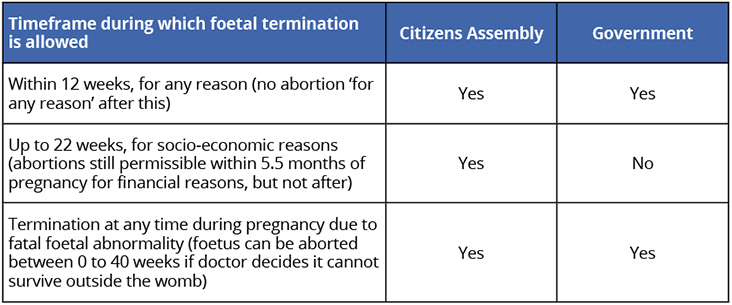 Someone else will need to compare the Irish government’s no-no on 22-week abortions with the law in other countries. But, at least symbolically, it sorta shows the Oireachtas committee remains (partially) committed to the life of the unborn.
For many, especially those with a religious upbringing, this is the crux of the issue. Abortion is killing. Even worse if such killing (or murder) happens as a result of loose moral/sexual standards.
This is why such a referendum can only reflect a waning of the power of the Catholic Church in Ireland and why it’s nearly impossible to find atheists or secularists objecting to abortion.
Furthermore, apart from what religion claims, it is natural to sympathise with the scores of women who, in the past, had to travel to England for abortions or, worse, resorted to illegal (and thus probably unsafe) pregnancy terminations.
In fact, a 1991 landmark case for this referendum, known as “Case X”, whereby a 14-year old rape victim was served an injunction which deemed the life of her unborn as having a greater priority than her suicidal tendencies. The case (when brought to the Supreme Court) eventually went her way, but not before she suffered a miscarriage.
For Irish liberals, the referendum last week can be nothing short of a resounding victory. Only the most “hard-line” of Lefties would be grumbling that the Oireachstas doesn’t fully of approve on “abortion on-demand.”
Right-wingers, especially the religious right, will believe this is a defeat for the unborn. They will (rightly? wrongly?) claim that repealing the 8thwill open the way for more casual and “free-er” sex (although why sex has to be “less free” may be a paradoxical question they won’t want asked). And certainly they’d be sceptical of the 12-week cut-off point above.
Then again, perhaps it’s not fair to tar every religious person with the same brush (of Puritanism?). There should not be any doubt that many Irish people who reject abortion nevertheless care deeply about women and their right to choose.
They’d probably just be concerned about the “for any reason” line in the Citizens’ Assembly recommendations, believing that terminating pregnancies should only be allowed for incidents like rape.
My own perspective is that, without doubt, the health and safety of women must be prioritised. One must not preach about the value or life of the unborn whilst subjecting their mums (or pre-mums, it’s complicated) to danger.
Having said that, I do believe in this old-fashioned thing called the sanctity of marriage and how sex is something that should only happen within its boundaries, and how these same boundaries form the best way to conceive, deliver and raise a child.
My “antiquated” (by liberal standards) view is that a majority of unwanted pregnancies are a result of sexual practices which occur outside of marriage.
Ergo, if we want to reduce the number of abortions (almost by definition the termination of an undesired pregnancy), we must curb pre-marital sex. Of course, one might ask, but why bother to reduce the number of abortions? What’s wrong with terminating a pregnancy in the first place? To which my prehistoric reply would be that life begins at conception. And so abortion at any time after conception equates to terminating a human life.
Gosh, that sounds so archaic, don’t it? (smile)
This doesn’t necessarily mean, if I were Irish, that I would’ve voted No Repeal. As I said, the health of women (whatever their religious views or sexual behaviour) is not something we can ignore. Abortion laws, to put it mildly, are no simple matter.
What about Malaysia?
Anyway, I checked out our Malaysian laws on abortion, well, guess what: We’re not Irish. Not even close. Let’s look at the same table above, and now insert “Malaysian Law” in there based on our Penal Code (articles 312-316):
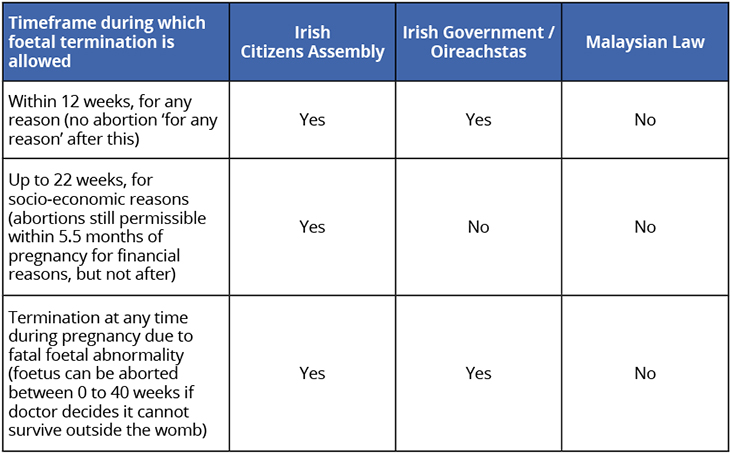 Ironically, our article 312 may have helped the Irish girl in “Case X” as it allows abortions if the pregnancy poses a threat to the mental or physical health of the woman (whereas Irish law at the time didn’t even have an explicit proviso for protecting women’s mental and physical health; this changed in 1992).
To repeat, Malaysian law allows abortion only in circumstances whereby a woman’s life or health (in all aspects) is threatened. Our laws do not allow for abortions in the case of rape, incest or foetal problems which do not immediately threaten the life of the child.
Needless to say, the articles in the code can be highly subjective/debatable and at least one woman, a Nepali, has been convicted under this very article despite her justifying the abortion due to mental reasons (her case was, however, overturned).
Should Malaysia go the Irish way? Should abortion be made legal and, if so, within what timeframe and what reasons? Do Malaysian women face the same problems and issues as the Irish? When do we believe life begins and what is our take on the value of unborn life?
* This is the personal opinion of the columnist.


