


OCTOBER 11 — For many Malaysians, Hizbut Tahrir [Arabic for “Liberation Party”] might not be a household name — compared to the incendiary Ikatan Muslimin Malaysia (Isma) or the more political Angkatan Belia Islam Malaysia (Abim) — but the Malaysian chapter of this global movement has been around since the late 1990s, and counts over 30,000 Muslims nationwide as its members.
Meanwhile, the parent organisation, itself an international political party, was formed in 1953 and has an estimated membership of over one million.
For many Muslims, however, the name Hizbut Tahrir (HT) is synonymous with its weekly newsletters that are distributed at mosques all over the country during Friday prayers.
The content and subject of the newsletters vary, but the group’s message is clear: The only way for Muslims is a return to the caliphate, that is one Islamic state comprising all Muslims with a caliph as its head.
Sounds like a threat detrimental to parliamentary democracy, no?
Although I have covered this group for several years, I thought it would be a hoot to attend HT Malaysia’s inaugural Muktamar Khilafah — a conference of sorts on establishing the caliphate — last weekend, with a view to understanding the group better.
Nouvelle Hotel — formerly Mint Hotel — is located in the Chinese-majority Seri Kembangan in Selangor (Chinese made up 84 per cent of voters in the Sri Kembangan state assembly seat in 2013). Situated between the Kuala Lumpur-Seremban Highway and the Besraya Highway, it is usually a stop for commuters.
I imagine those commuters would have been a little surprised last week to see a number of white and black flags with an Arabic inscription being flown inside the hotel — flags for the Islamic state and war banners respectively.
Both containing the shahadah (the Muslim proclamation of faith), they are styled after the historic banners flown by Prophet Muhammad. But the flags, especially the black banner, have now been co-opted as a symbol of Islamism and jihadism, and for some, terrorism in the name of the religion.
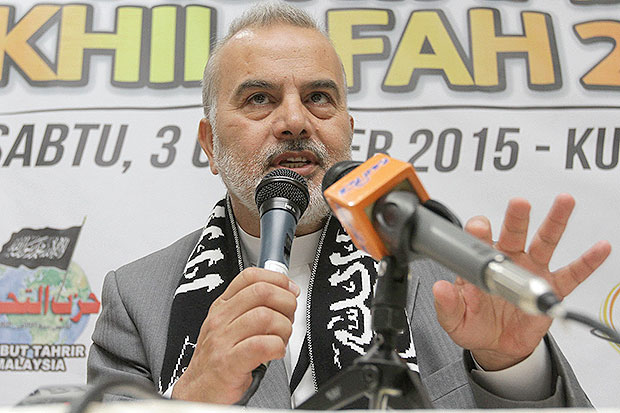
HT is very clear about what it wants. Under its utopic caliphate, a caliph will rule with the advice of a council.
Two bodies under him will oversee governance and administration, with a further eight other agencies beneath them, much like ministries.
The treasury will be a separate agency called a Baitulmal [Arabic for “House of Wealth”] which governs finances and expenditure, including charity and state welfare.
It is easy to see why the hundreds who attended the muktamar would wish to live under a caliphate. For them, the current democratic system has failed them.
They feel that crime and injustice are rampant. Not only are they struggling with the cost of living, they are also appalled by the abuse of power and wastage. They feel that Islam is being trampled, while vice and immorality are creeping into their lives.
“The question is, even if we can topple the current leader, would his replacement be better than who we have now? ... We have stressed many times that a mere change of face in leadership will not change the fate of Muslims,” said HT Malaysia’s spokesman Abdul Hakim Othman in his fiery speech.
Even more worrying is how HT wishes to achieve its goals.
HT Malaysia has always been vague about how they plan to establish an Islamic state in the country. Although HT is a political party globally, it is not registered as one in Malaysia.
Abdul Hakim told me that for now, they are focusing on instigating a paradigm shift among Muslims, so the public will see the need for an Islamic state.
HT’s international spokesman Osman Bakhash was more direct. He said that HT’s current “intellectual struggle” to spread its ideology is just a prelude to pushing for a “revolution” by Muslims worldwide.
But, for the most part, the muktamar was pretty tame.
HT has dissociated itself with the self-proclaimed caliphate announced by terror group Islamic State’s (IS) Abu Bakr al-Baghdadi, saying that HT does not believe in violence, as Muhammad never espoused it.
But with the general sentiment among Islamists towards establishing the caliphate and implementing Islamic laws, one cannot help but wonder if HT is just a gateway organisation for jihadists to join religious crusades elsewhere.
Despite that, I must admit that I find HT Malaysia less intimidating and disturbing than other local hardliners such as Isma.
If anything, HT’s “enemies” are systemic and structural, rather abstract. From what I could gather, they do not appear to have a set timeframe for achieving a caliphate.
While the proposed system is arguably discriminatory towards minorities, HT Malaysia has stayed away from racial superiority and Malay supremacy, believing that a pan-Islamic world has no tribal borders.
Regardless of how they feel, HT Malaysia does not waste its resources on targeted campaigns demonising the usual scapegoats: the LGBT community, ethnic Chinese, DAP, Christians, human rights advocates, liberal Muslims and pluralists.
It is undeniable, on the other hand, that groups such as Isma have a specific timeframe in mind: Right now. And they are openly equating Islamic supremacy with Malay domination.
The group’s candidates stood in the last elections, and there is no doubt they will do so again in the next one.
Do not mistake this for a defence of HT. In the end, while there might be no stopping the Islamists, we can remember that their needs and wants are pretty much the same as any other Malaysian.
At the very least, we have to offer a way forward that is not a caliphate: An inclusive society based on shared values and common goals.
* This is the personal opinion of the columnist.


