


MAY 2 ― “Mr President, welcome to Malaysia. I note you won’t be visiting Negri Sembilan, where we have a village named after Lyndon Johnson who in 1966 witnessed a rural resettlement scheme that the then-government had pioneered in our efforts to become a property-owning democracy. This time your hosts have chosen to showcase other aspects of our democracy, and I hope you get a full picture of its health.
My question is on regional security: For while the communist threat that LBJ spoke of has been defeated, there are strong geopolitical tensions today driven by popular nationalisms. In the context of the Asia pivot, can we in Southeast Asia conclude anything from the US reaction to events in Eastern Europe if hostilities were to break out in the South China Sea?”
That is what I would have asked had President Obama seen my hand at the University of Malaya last Sunday. Given that the town hall was designed for Young Southeast Asian Leaders, I had expected questions on issues concerning the region or its constituent countries. Instead, stardust was in abundance, as we got questions about his life story from kids who apparently hadn’t read Dreams from My Father, and probably not heard about US drone strikes in northern Pakistan either: “Wicked awesome”.
Still there was much to observe. The mere fact the US President picked random people from the audience, rather than replying to pre-selected questions, was widely appreciated. Of course, it shouldn’t be impressive for politicians to reply to frank questions from the public, but it happens so rarely here that it seemed so refreshing, and one hopes that the star-struck young leaders may well demand the same transparency from their own leaders (ideally also having regretted squandering the opportunity to hold the world’s most powerful human being to account).
The geography of the hall too was revealing: Four sides of a square barricaded in on the speaker, unheard for any Malaysian dignitary, though the illusion of vulnerability was dispelled by the presence of secret service agents on every corner, facing outwards and showing no emotion throughout the entire session. This arrangement makes for great photo opportunities: Photographs of blurred smiling faces in the background accentuate an air of approval for the individual in focus.
And the kids were so smiley, and the questions so saccharine, that Obama exploited the opportunity to chew them in trajectories of his own choosing. He referred to the Trans-Pacific Partnership three times, but he was not once challenged on his assumptions. There was, however, a minor kerfuffle when a banner that read “No TPPA” alongside a R4BIA sign sprouted in the hall for about five seconds before being uprooted.
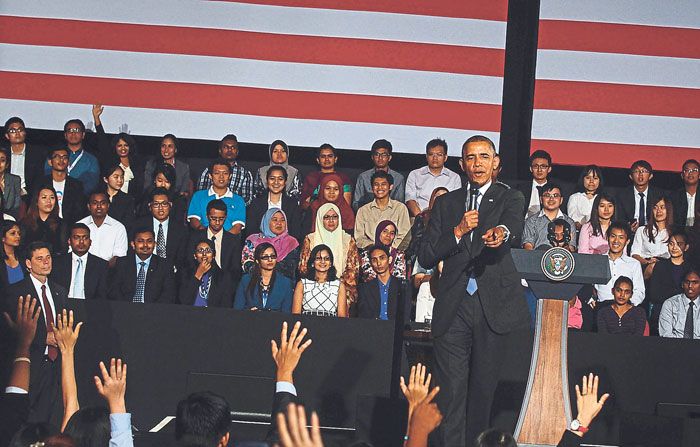
Throughout, the audience buzz was palpable and infectious. Whenever the president made a reference to his family ties with countries in the region, there were whoops and cheers. Curiously, there was silence after Obama said: “We have to create an environment where the rights of every citizen, regardless of race or gender, or religion or sexual orientation are not only protected, but respected.” But when a second later he declared: “We want to work together to ensure we’re drawing on the potential of all our people ― and that means ensuring women have full and equal access to opportunity, just like men” ― he received rapturous applause.
The memorable quote of the session was his marrying of Malaysia and Myanmar to argue against racial and religious discrimination. First, he deployed a personal touch: “In the United States, obviously historically the biggest conflicts arose around race. And we had to fight a civil war and we had to have a civil rights movement over the course of generations until I could stand before you as a President of African descent.”
This sent the audience into a riot of happiness, which set the stage for his pièce de résistance: “Malaysia won’t succeed if non-Muslims don’t have opportunities. Myanmar won’t succeed if the Muslim population is oppressed.” But then, our media chose to focus on, praise or condemn just one side of that statement — it’s always domestic power play that’s on the mind of certain journalists and commentators.
Though I did not get the opportunity to direct words at Obama that afternoon, my question was partly answered when it emerged that the US and the Philippines signed a new defence agreement that would boost the US presence in the region. After the charming, the schmoozing and the selfie, it remains actions that speak louder than words. As his hosts extolled the state of our democracy, I hope it was not just stardust that he left behind.
*This is the personal opinion of the columnist.


