


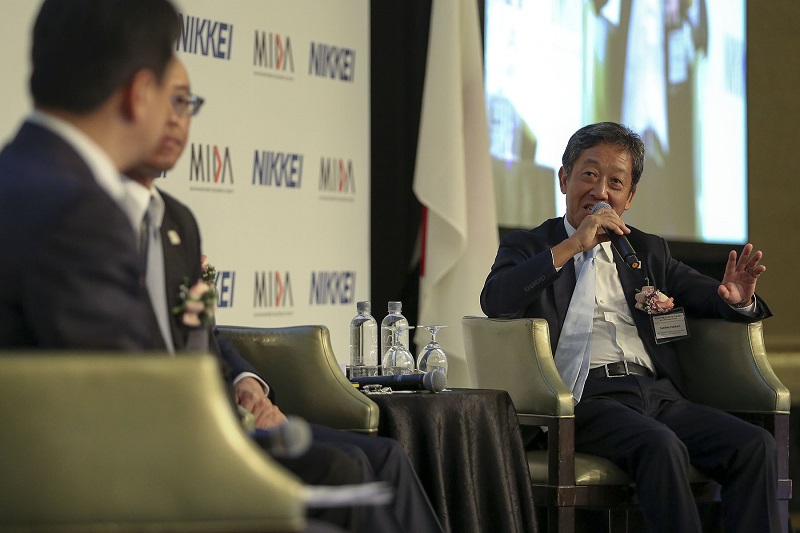
KUALA LUMPUR, Nov 30 ― Japanese multinational corporations (MNCs) told Prime Minister Datuk Seri Najib Razak today to take more active steps in marketing and promoting Malaysia to their country as an investment hub.
During a panel discussion at the Malaysia Nikkei Business Forum 2017, Mitsui & Co (Asia Pacific) Malaysia country chairman Toshihiko Todokoro said the Look East Policy was a success because strong messages came from then prime minister Tun Dr Mahathir Mohamad.
“Well, right now the International Trade and Investment Minister (Datuk Seri) Mustapa (Mohamed) visits Japan at least once a year. But in Mahathir's time, the message came from the head of the nation.
“We want to hear this strong message saying that Malaysia wants Japanese companies to come (and invest). It is very good if the head of nation comes himself,” said the head of the Japanese Chambers of Trade and Industry Malaysia, when asked what his wish list from the Malaysian government was.
Toshihiko was echoing Panasonic Management Malaysia deputy managing director Hiroyuki Imizu's sentiment, who elaborated that Malaysia also needs to send a strong message that it has no plans of abandoning the manufacturing sector in favour of the service sector.
“Some people misunderstand that Malaysia wants to abandon manufacturing, but if the Malaysian government can send out strong messages that they want to grow the manufacturing sector, this commitment would be good news for Japanese companies.
“And I think it's wrong to take the labour intensive industry out of Malaysia (as it has one of the most competitive human resource costs in the region) and put it somewhere else. Instead of doing that, we should make use of what is there and make it stronger,” said Hiroyuki.
With enough official backing, Hiroyuki believes Japanese companies in Malaysia will then have the clout to convince their head offices in Japan to offshore its research and development (R&D) divisions into Malaysia ― a win-win situation for both as Malaysia needs more locally based R&D to achieve developed high-income nation status.
Currently, the policy for most Japanese MNCs is to base its R&D divisions in Japan with improvements and innovations then being rolled out to other regions.
Hiroyuki argued that it would be far more efficient if the manufacturing sector's R&D divisions can be placed locally, where it will have faster direct impact on the market's front lines.
“Let's look at the refrigerator. To design a locally befitting product (for this region), I first need to know what they put in there. We design things on a local perspective before going global.
“In the pursuit of that goal, doing product research in Japan is not speedy enough. We need decentralisation and give more authority to local areas because the locals here would know their own needs and can decide on the designs,” he explained.
He pointed out that Malaysia has a very strong potential as a regional manufacturing and logistics hub due to its central location to Japan's VIP (Vietnam, Indonesia and Philippines) market, consisting of roughly 200 million population per country.
Global logistics company Nikkei Express (Malaysia) managing director Akiya Hayase expanded upon Hiroyuki's argument, adding that Malaysia's strategic location in the centre of billions-strong markets such as India, China and Southeast Asia also plays to its strength as a regional logistics hub.
Furthermore, Akiya said that Malaysia's halal certificate is the most recognised halal certification in the world and that Japanese companies would greatly benefit from it if it wished to penetrate the global Muslim market.
“It is of such high standard that it is acceptable by anyone, anywhere. We have built up our infrastructure appropriate to halal manufacturing and we have halal certifications, but we are Japanese specialists.
“No matter how advanced, we cannot know every aspect of halal production. So this is where we depend on the Malaysian human resources to come to Japan and teach Japanese workers and management on how to produce high quality halal standards.
“This is the direction we have been pursuing and ultimately our goal is to connect all halal requirement countries,” said Akiya.


