


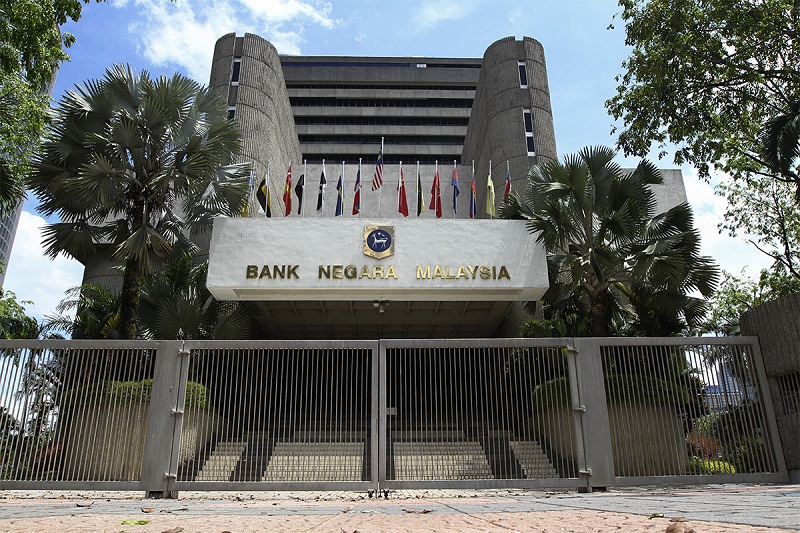
KUALA LUMPUR, May 10 ― Malaysia’s central bank is seen keeping its benchmark rate steady on Friday, taking comfort from a stabilising economy and ringgit currency even as headline inflation hit an eight-year high in March.
Improving demand for crude oil and commodities has sparked much needed momentum in Southeast Asia’s third-largest economy, while measures to clamp down on offshore trade of the ringgit has helped stabilise the currency after a sharp slide against the dollar in early January.
All 10 economists polled by Reuters forecast that Bank Negara Malaysia (BNM) will hold its overnight rate steady at 3.00 per cent on Friday.
Stable core inflation, which came in at 2.5 per cent in March, has helped ease pressure on the central bank to raise rates. Although headline inflation hit 5.1 per cent in the same month, the highest since November 2008, policymakers appear confident that price pressures aren’t spreading across the broad economy.
“We expect the central bank to keep policy rates unchanged for now, unless high headline inflation has a larger pass-through to core prices,” Standard Chartered said in a recent note to clients.
BNM expects headline inflation to average between 3 and 4 per cent this year, compared to 2.1 per cent in 2016.
After its last monetary policy meeting in March, the central bank said that cost-driven inflation is unlikely to have a significant effect on broader price trends, and sees core inflation increasing “modestly”.
That would surely be the hope of Prime Minister Datuk Seri Najib Razak as rising costs threaten his re-election chances as he prepares for early polls.
Less pressure
In July, Bank Negara surprised markets with its first interest rate cut in seven years, but has since kept policy steady in the face of a weakening currency and rising prices. Now, as exports have started to tick up and domestic demand stable, Malaysia is slowly emerging out of a tough two-year period when a downturn in oil and gas prices knocked its economy.
The threat of protectionism in the United States, however, poses risks to the global trade outlook and Malaysia’s economic recovery, analysts say. The Federal Reserve’s gradual tightening of rates, and the potential for more capital outflows hurting a still-vulnerable ringgit, is another headwind to growth.
The central bank expects growth of 4.3-4.8 per cent this year, compared with 4.2 per cent in 2016.
The ringgit was among the region’s worst performing currencies last year, though it has stabilised against the dollar after the central bank stepped in to clamp down on offshore trading of the currency.
Inflation pressures will likely provide the trigger for the central bank to raise rates, AmInvestment Bank said in a note to clients.
“We are of the view that the overnight policy rate which is currently at 3.00 per cent could be raised by 25 basis points in 4Q2017,” the bank said. ― Reuters


