


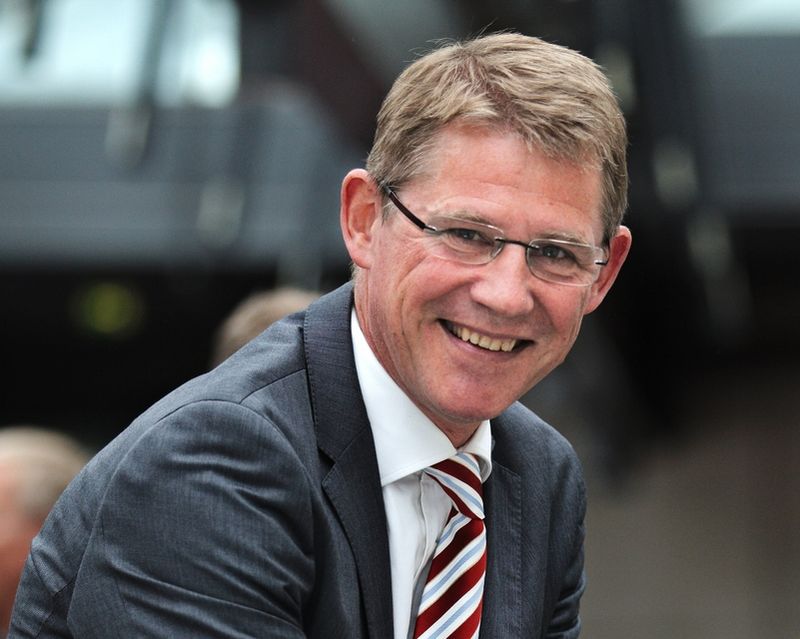
NEW YORK, Nov 3 — The world’s top-performing CEO isn’t a household name. In fact, Lars Rebien Sørensen doesn’t even look like a big-time global executive. We recently travelled to the quiet town of Ridgefield, Connecticut, to meet with the CEO of the Danish pharmaceutical giant Novo Nordisk at his lakefront summer home. He met us in shorts, sandals and a polo shirt, dressed for a bike ride later that day.
How did this mild-mannered, bespectacled executive land in the No 1 spot on our list? It’s partly due to his company’s (darkly) fortuitous decision years ago to focus almost exclusively on diabetes treatment. The runaway global growth of the disease has driven up the company’s sales and stock price.
But his standing also reflects Novo Nordisk’s deep engagement with social and environmental issues, which now factor in to our calculations. “Corporate social responsibility is nothing but maximising the value of your company over a long period,” says Sørensen, who has been with the company for 33 years. “In the long term, social and environmental issues become financial issues.”
Harvard Business Review’s ranking of CEOs is meant to be a measure of enduring success. We track and analyse each CEO’s performance starting from day one of his or her tenure. Our goal is to create a list that gets beyond the most recent quarterly or even annual results and truly evaluates long-term performance.
In the past, our ranking was based exclusively on hard stock market numbers. We looked at total shareholder return, as well as the change in each company’s market capitalisation.
We liked the fact that the ranking was based solidly on data and not on reputation or anecdote. Yet it also felt incomplete, because it failed to account for the many aspects of leadership that go beyond mere market performance.
And so this year we’ve tweaked things. We’ve added to the mix a measurement of each company’s environmental, social and governance (ESG) performance. For this we relied on the calculations of the investment research firm Sustainalytics. We now weight long-term financial results at 80 per cent and ESG performance at 20 per cent.
We’ve also changed our methodology to include CEOs who took the reins before 1995. In the past we had excluded those executives because data for one of our metrics — industry-adjusted returns — wasn’t available that far back. For this year’s list, we’ve analysed the performance of those CEOs as well, using the returns generated from 1995 onward.
As a result of these shifts, the 2015 list is very different from last year’s. On the purely financial metrics, Amazon’s Jeff Bezos leads all other CEOs — just as he did last year. But Amazon’s relatively poor ESG score drags Bezos down to No 87 overall. Sørensen finished sixth in overall financial performance; that, combined with a relatively high ESG rating, earned him this year’s top slot.
Why does Novo Nordisk score so high on ESG? According to Sustainalytics, the company benefits from, among other things, its decision to offer insulin at a steep discount to consumers in developing countries; its transparent and limited political lobbying practices; and its responsible policy on animal testing.
The decision to add CEOs who began prior to 1995 also shook up our ranking. About one-quarter of this year’s top 100 started the job before then, meaning they all are new to the list.
At HBR we continue to experiment with the perfect measure of a CEO’s worth, and we look forward to getting our readers’ input. Are we right to include these critical, but less easily quantifiable, measures? Are there further ways of fully evaluating companies and their CEOs?
Our view is that, in an era of big data and greater transparency, consumers and investors increasingly want to understand a company’s culture and values. They want to analyse its social behavior, not just its share price. These new measurements will only get better over time.
As for Sørensen, he’s happy to be scored in all aspects of the job. In fact, he dismisses the purists who argue that “the business of business is business.” As Sørensen puts it, “I would change that to say the business of business is business — but with a long-term perspective.” And in that calculation, social and environmental issues are critical. — Harvard Business Review/New York Times


