


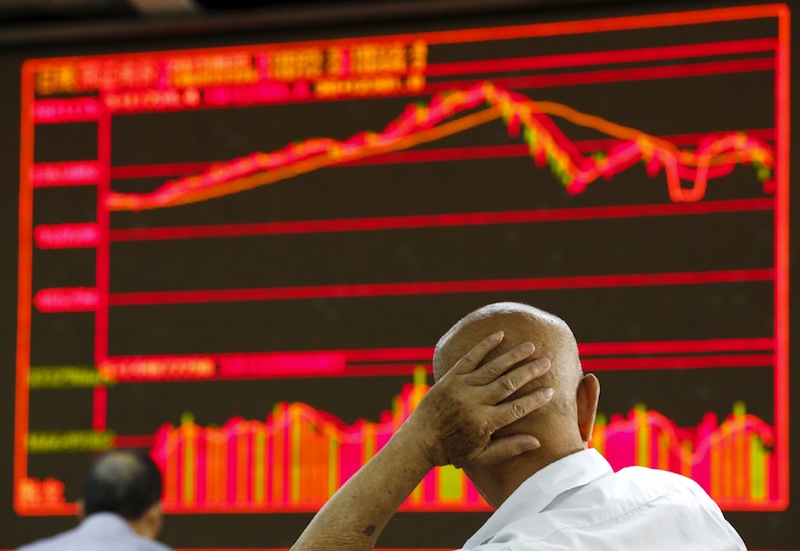
SHANGHAI, Aug 25 — Chinese shares sank, extending the steepest four-day rout since 1996, on concern the government is paring back market support.
The Shanghai Composite Index tumbled 7.6 per cent to 2,966.89 at 2:31pm local time, falling below the 3,000 level for the first time in eight months. The gauge has dropped 22 per cent in just four days since Aug. 19. About 50 stocks fell for each one that rose on Tuesday. The Hang Seng China Enterprises Index lost 2.6 per cent, erasing an earlier gain of 2.7 per cent.
Speculation around the government’s intentions has escalated since Aug. 14, after China’s securities regulator signaled authorities will pare back the campaign to prop up share prices as volatility falls. The China Securities Regulatory Commission made no attempt to reassure investors after Monday’s plunge, unlike a month ago when officials issued two statements shortly after an 8.5 per cent drop.
“It’s panic selling and an issue of confidence,” said Wei Wei, an analyst at Huaxi Securities Co. in Shanghai. “The government won’t step in to rescue the market again as it’s a global sell-off and it’s spreading everywhere now. It’s not going to work this time.”
The CSI 300 Index dropped 7.3 per cent, led by technology, industrial and material companies. The Hang Seng Index retreated 1.1 per cent as a gauge of price momentum dropped to the lowest since the October 1987 stock-market crash. Hong Kong’s benchmark equity gauge is poised for its lowest close since July 2013.
Unprecedented government intervention has failed to stop a more than US$4.5 trillion (RM19.145 trillion) rout since June 12 amid concern the slowdown in the world’s second-largest economy is deepening. Officials have armed a state agency with more than US$400 billion to purchase stocks, banned selling by major shareholders and told state-owned companies to buy equities.
Controllable situation
When the Shanghai Composite tumbled 8.5 per cent on July 27, the regulator issued statements shortly after the market closed saying it would probe the sell-off and underlining the government’s commitment to supporting equities. The CSRC hasn’t made any statements since Monday’s tumble.
“The regulator probably thinks the market slump this time hasn’t impacted the broader financial system, or they think the situation still controllable,” said Xue Hexiang, senior strategist of Huatai Securities Co.
On Aug. 14, the regulator said China Securities Finance Corp., the state agency tasked with supporting share prices, would no longer add to holdings unless there’s unusual volatility and systemic risk, although it would remain in the stock market for years to come.
Officials should wind down the stock market support program even if prices continue to decline, according to a front-page commentary in the state-run Economic Information Daily today.
Stock valuations
About 17 per cent of listed shares traded on mainland bourses were halted from trading today, little changed from ysterday.
The intervention sparked concern among Chinese traders that the government was trying to shore up the market at levels unjustified by weaker economic outlook. Stocks on mainland bourses traded at a median 61 times reported earnings on Friday, according to data compiled by Bloomberg. That’s the most among the 10 largest markets and more than three times the 19 multiple for the Standard & Poor’s 500 Index.
China’s economic growth slowed to 6.6 per cent in July, according to Bloomberg’s monthly GDP tracker. The nation’s first major economic indicator for August signaled a further deterioration as a private manufacturing index fell to the lowest level in six years.
Fund injection
The central bank added the most funds to the financial system in open-market operations since February today as currency-market intervention to prop up the yuan strained the supply of cash.
The People’s Bank of China auctioned 150 billion yuan (RM99.555 billion) of seven-day reverse-repurchase agreements, according to traders at primary dealers required to bid at the auctions.
That compares with 120 billion yuan maturing today, which leaves a net injection of 30 billion yuan. — Reuters


