


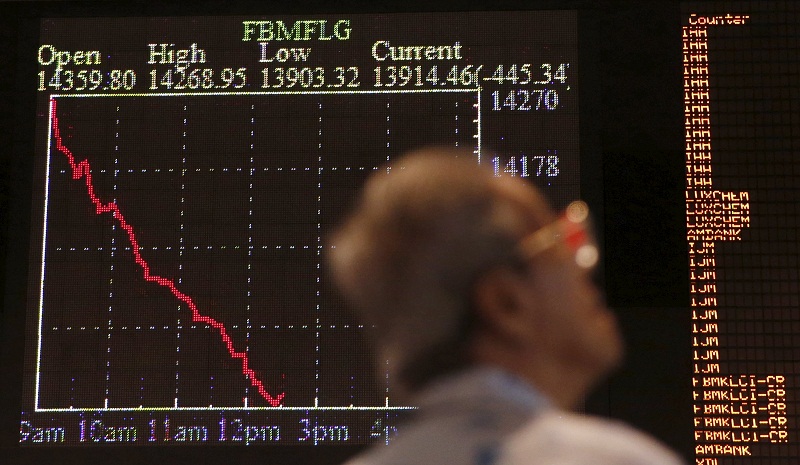
KUALA LUMPUR, Aug 25 — Malaysia’s stocks erased declines that dragged the benchmark gauge down more than 20 per cent from its 2014 high.
The FTSE Bursa Malaysia KLCI Index climbed 0.1 per cent at 10:06 a.m. local time in Kuala Lumpur, after losing as much as 1.9 per cent. The ringgit halted a four-day slide.
Foreign funds have dumped more than US$3 billion (RM12.757) of the nation’s shares this year and the currency is near a 17-year low as political uncertainty clouds the outlook for an economy rocked by plunging oil prices and an emerging-market selloff. Prime Minister Datuk Seri Najib Razak is grappling with allegations of financial irregularities at a state investment company, and facing accusations of impropriety after it was disclosed that political donations ended up in his private accounts in 2013.
Emerging markets are reeling after China’s yuan devaluation Aug. 11 sparked concern the world’s second-largest economy will slow further, undermining demand for oil, copper and other raw materials from countries including Brazil, Russia and South Africa. Malaysia is Asia’s only major net oil exporter.
The rout comes as the Federal Reserve moves closer to raising borrowing costs for the first time in almost a decade, after central banks worldwide boosted stimulus measures to patch up economies following the global financial crisis.
Net foreign sales in Malaysian stocks this year are almost double the 6.9 billion ringgit for the whole of 2014, exchange data show.
Stock Valuations
Malaysia’s government forecasts the economy will expand 4.5 per cent to 5.5 per cent this year, down from its earlier projection of as much as 6 per cent. Earnings at companies on the KLCI are projected to grow 11 per cent in the next 12 months, data compiled by Bloomberg show. That compares with a 30 per cent gain in Thailand and an increase of 78 per cent in Indonesia.
The KLCI index is valued at 13.7 times projected 12-month earnings, down from its April peak of 16.5 times, data compiled by Bloomberg show. The MSCI Emerging Markets Index is valued at a multiple of 10.
The Malaysian Anti-Corruption Commission said this month the RM2.6 billion in those accounts were from donors in the Middle East.
Najib has faced criticism from some members of his party and opposition politicians for the donations. The receipt of political funds was to meet the party and community’s needs and isn’t a new practice, the official Bernama news agency reported Aug. 9, citing Najib.
Malaysia remains committed to market-friendly policies, Najib said at a press conference this month, repeating four times that there would be no restrictions on capital flows or a fixed rate for the ringgit. Central bank Governor Tan Sri Zeti Akhtar Aziz also said there are no plans to move to a less flexible currency regime. — Bloomberg


